Have you ever left a meeting thinking, “They only listened when he repeated my idea”?
Or wondered why an interviewer seemed more interested in how you manage your home life than your professional qualifications?
You’re not imagining things. And you’re definitely not alone.
Despite diversity initiatives and growing awareness, women in tech and other male-dominated industries continue to face subtle forms of bias that can be difficult to pinpoint but impossible to ignore.
The most insidious part?
These external biases often activate and reinforce our own internal limiting beliefs. Beliefs that were likely installed long before we entered the workplace.
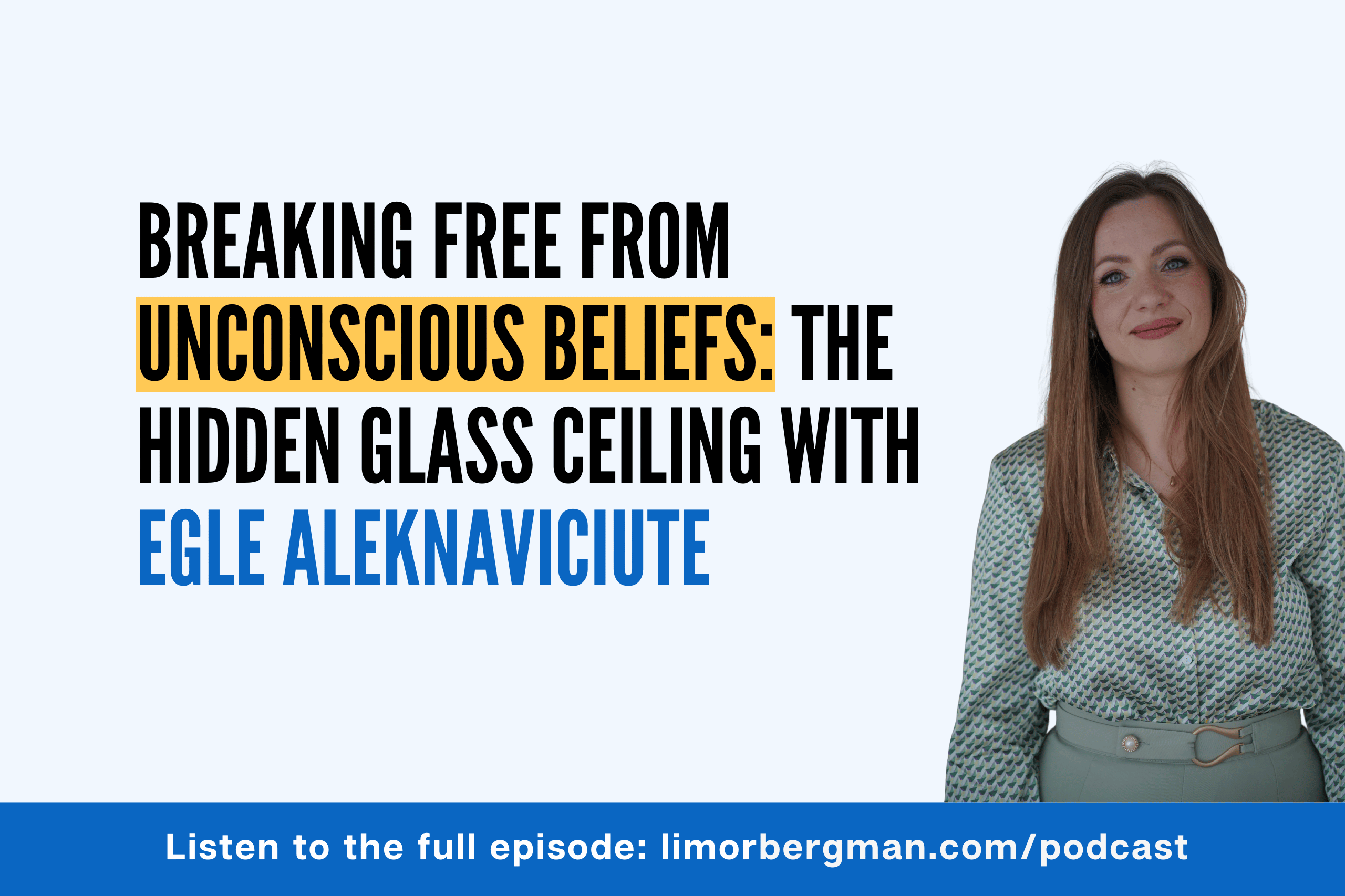
In this episode of From A Woman To A Leader, I spoke with Egle Aleknaviciute, a wealth and purpose strategist who combines subconscious mind work with extensive experience in corporate finance and business transformation.
About Egle Aleknaviciute
With over a decade of experience in corporate finance and having lived across five countries, Egle brings a unique perspective on the subtle ways bias manifests in professional environments.
Her own journey through male-dominated workplaces led her to question why, despite logical understanding and good intentions, gender representation at leadership levels changes so slowly. This curiosity led her to explore the disconnect between our conscious awareness and the unconscious programming that actually drives our behaviors and results.
Today, Egle helps women identify and transform limiting beliefs around success, worthiness, and financial prosperity—empowering them to break through internal glass ceilings that may be holding them back even more than external ones.
Key Takeaways from This Episode
Why do we struggle even when we logically know better?
One of the most profound insights from our conversation is that logical understanding isn’t enough to create change. As Egle explains, “Only 5% to 10% of what we daily think and feel is conscious. The rest is driven by our beliefs that we hold in our body.”
This explains why, despite knowing we deserve that promotion, we should speak up in meetings or ask for appropriate compensation, many women still hold back. Our conscious mind might be saying “go for it,” but our unconscious programming is sending very different messages.
“No matter how ambitious we are or how much we’ve already done in the past, how much evidence we have, we have these beliefs that are formed very early in our lives, and then they create our lives,” Egle notes. “Because logically we might think, but subconsciously we might still hold ourselves back.”
How does unconscious bias show up in everyday work life?
Egle shared several common manifestations of unconscious bias that many women will find painfully familiar:
- The stolen idea phenomenon: Speaking up in meetings only to have your idea dismissed, then celebrated when repeated by a male colleague
- Personal over professional: Job interviews that focus excessively on how you organize your home life before discussing your professional qualifications
- Cultural curiosity as distraction: Conversations that fixate on your cultural background or personal life instead of your work and results
- The age paradox: Being considered either too young or too old, regardless of your actual experience or capabilities
These experiences can be especially frustrating because they’re often subtle enough that calling them out might make you seem “too sensitive” or “making a big deal out of nothing.” As Egle puts it, this social punishment can lead many women to doubt their own perceptions and “pin themselves down.”
How can we identify our own limiting beliefs?
Before we can change unconscious beliefs, we need to become aware of them. Egle offers a practical approach anyone can use:
- Listen to your emotions: Pay attention when you feel angry, frustrated, sad, or disappointed. These emotions signal that something has triggered an underlying belief.
- Question the story: Ask yourself, “Which story in my head is making me feel the way I feel?” Our first reaction is to blame external circumstances, but our emotions are actually triggered by our interpretation of events.
- Challenge the belief: Ask yourself if this belief is truly accurate. Is there another way to look at the situation? What evidence might contradict this belief?
- Journal about it: Writing helps process emotions and gain clarity about underlying beliefs.
For example, if you make a mistake at work and immediately think, “I’m not good enough for this role,” that’s a limiting belief in action. By recognizing and questioning this automatic thought, you can begin to reframe it.
Why is failure so frightening, and how can we reframe it?
Our conversation highlighted how deeply conditioned we are to avoid failure at all costs. From early schooling where failing a test carried significant consequences, we develop a binary view of success versus failure that follows us into adulthood.
This fear of failure can be especially damaging for women in tech, where innovation requires risk-taking and learning from mistakes.
Egle pointed to entrepreneurs as examples of a healthier mindset: “If you look at entrepreneurs and people who lead companies or who build or create companies, they know that failure is something they have to do. They know that the faster they fail, the faster they succeed.”
The key insight here is that failure isn’t inherently good or bad—it’s what we make of it and how we navigate afterward that matters. By reframing failure as information rather than a reflection of our worth, we can develop greater resilience and creativity.
As Egle noted, “Failure is not good or bad by itself, it’s what we make out of it and how we navigate after we failed. And what is failure anyway?”
Practical Tips You Can Apply Today
- Start tracking your emotional reactions: When you feel a strong emotion in a professional context, pause and ask what belief might be triggering it.
- Practice self-validation: Rather than immediately doubting yourself when faced with bias, trust your instincts and validate your own experience.
- Build supportive connections: Find at least one trusted colleague or mentor with whom you can be authentic and vulnerable.
- Practice asking for what you need: Start small if necessary, but begin exercising this critical skill that many women haven’t been taught.
- Reframe rejection: When faced with a “no,” ask what you can learn from it rather than making it mean something about your worth.
- Question your environment: If you’ve tried to influence positive change and still face significant bias, consider whether this environment aligns with your growth.
Memorable Quotes from Egle Aleknaviciute
“By working with our own beliefs, we are more capable to choose which environments are better for us and also influence those environments to support us better in this process.”
“Listening to emotions is the first step, especially the way we are conditioned not to feel emotions or to judge ourselves.”
“Asking for what you need or what you want is an extremely important skill because the way women, especially women on this one, are conditioned is to suppress your needs.”
“There is this growing the trust in yourself that no matter what others say or how they judge you, you will be okay. There is nothing that can change in your worth despite what others think or feel about you.”
Listen to the Full Episode
Available on: Spotify | Apple Podcasts | YouTube
Ready to break through your own internal glass ceiling? This conversation with Egle Aleknaviciute provides powerful insights and practical tools to help you identify and rewrite the unconscious beliefs that might be holding you back.
Remember: you’re not alone in this experience, and the fact that you’re taking steps to understand these dynamics already puts you ahead of the curve. Subscribe to From A Woman To A Leader for more conversations that will help you grow your confidence, influence, and leadership on your own terms.
About Egle:
Egle Aleknaviciute is a wealth and purpose strategist with a background in corporate finance and business transformation. She helps ambitious women break subconscious patterns around self worth, money, and success so they can create both financial and emotional freedom. Egle blends deep subconscious work with practical strategy to support women who feel stuck, overachieving, or afraid to ask for more. You can connect with Egle on LinkedIn and explore her work through her website and Money Freedom Scan below.
🔗 LinkedIn: https://www.linkedin.com/in/ealeknaviciute/
🌐 Website: https://www.egle-aleknaviciute.com/
📊 Money Freedom Scan: https://www.egle-aleknaviciute.com/#moneyfreedom
📷 Instagram: https://www.instagram.com/eglealeknaviciute/
📘 Facebook: https://www.facebook.com/egle.aleknaviciute
Want More Personal Stories & Deeper Insights?
I share my more intimate stories, behind-the-scenes reflections, and personal career lessons on Substack.
It’s the best place to have real conversations with me.
 Join me on Substack:
https://limorbergman.substack.com/
 Stay Connected
 Podcast hub: https://limorbergman.com/podcast
 LinkedIn: https://www.linkedin.com/in/limorbergman
 Instagram: @limorbergman
 YouTube: @LimorBergman