When you picture a tech executive, who comes to mind?
For many people, it is still the classic image: someone who grew up coding, studied computer science, and climbed a very linear ladder into leadership.
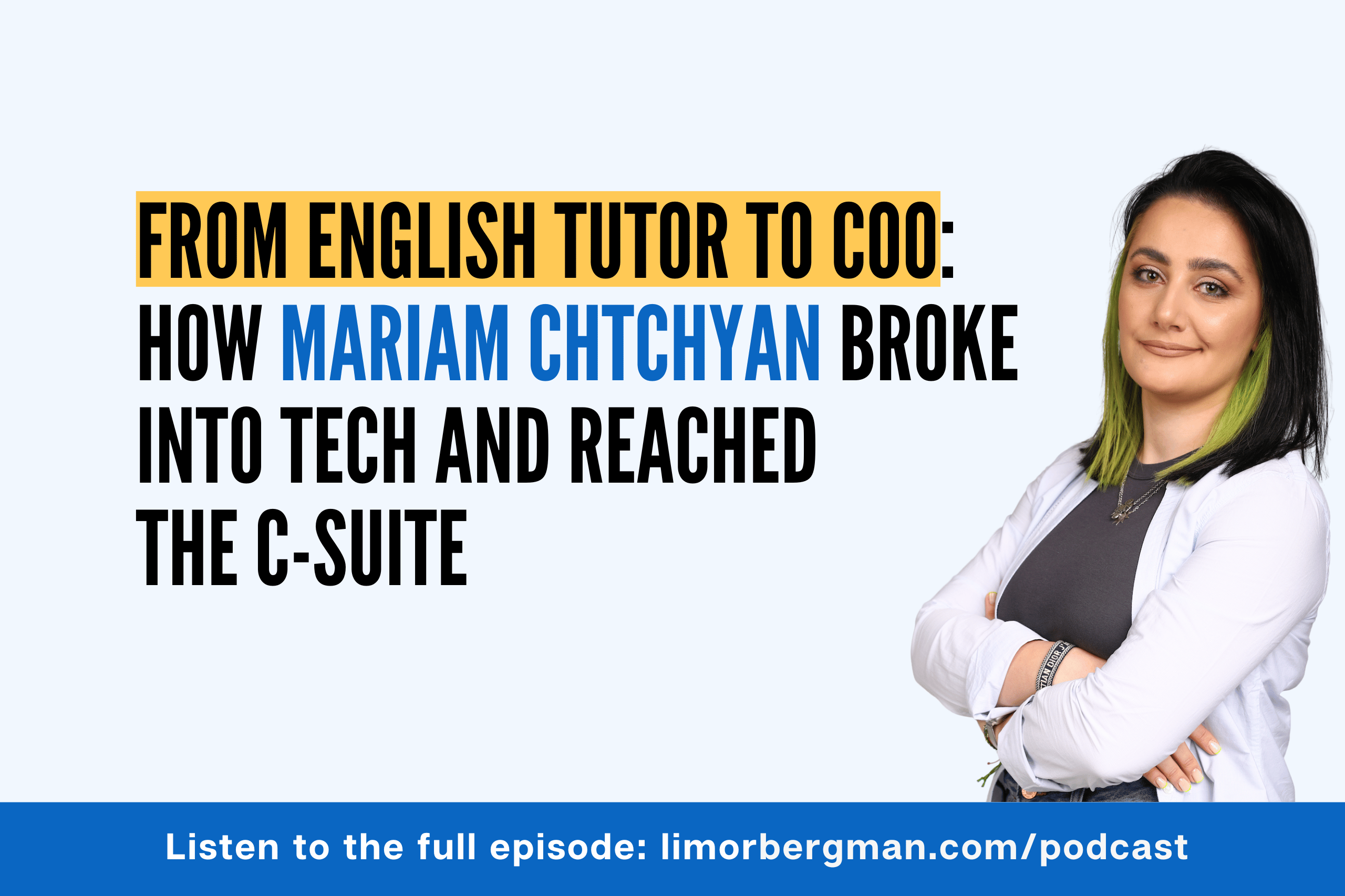
That is not the story of my guest, Mariam Chtchyan.
From English Tutor to Tech Leader: My Unexpected Journey
Welcome to my conversation with Mariam Chtchyan, a remarkable woman who transformed her career from English tutor to tech executive in just seven years. Mariam’s story exemplifies how someone without a technical background can successfully navigate the tech industry through determination, adaptability, and courage.
Mariam’s journey began unexpectedly when she applied for what she thought was an English tutor position at a tech company. She had graduated from a linguistics university and assumed she’d be teaching English to developers. However, during the interview, she discovered it was actually a sales role requiring English proficiency to communicate with international customers.
Despite having zero sales experience or technical knowledge, Mariam accepted the challenge. For about six months, she struggled in this sales position. She found it difficult to promote services she didn’t fully understand, and the metrics showed she wasn’t achieving the expected results.
Pivoting When Something Isn’t Working
One of the most valuable lessons from Mariam’s experience is recognizing when something isn’t the right fit and having the courage to pivot. After realizing sales wasn’t playing to her strengths, Mariam approached her manager about transitioning to project management instead. The company agreed to give her this opportunity, which became a turning point in her career.
This transition wasn’t easy. Without technical knowledge, Mariam faced significant challenges working with developers, QA specialists, and product managers. However, she developed effective strategies to overcome this knowledge gap.
Building Technical Knowledge from Scratch
Mariam’s approach to learning technical skills was both practical and effective. She carried a notebook to every meeting and diligently wrote down every unfamiliar term she heard. After work hours, she researched these terms and concepts to build her knowledge base. Additionally, she spent time with developers daily, observing their work to better understand the technical aspects of projects.
Perhaps most importantly, Mariam wasn’t afraid to ask questions. She embraced a mindset that there are no “stupid questions,” only opportunities to learn. When necessary, she would preface her questions with “I have a basic question that will help me understand better” – creating space for her learning while maintaining professional confidence.
Creating a Culture of Psychological Safety
As Mariam grew into leadership roles, she made it a priority to foster an environment where everyone feels comfortable asking questions. She recognized that psychological safety benefits the entire team – not just newcomers. When people feel secure enough to admit what they don’t know, it leads to better communication, stronger collaboration, and ultimately better outcomes.
This approach highlights an important point: if you’re in a position where people make you feel stupid for asking questions, that reflects more on them than on you. Don’t let such reactions discourage your curiosity and learning journey.
Navigating Traditional Cultural Expectations
Mariam’s story is even more impressive considering the cultural context in which she built her career. In Armenia, where she lives, traditional gender roles remain quite prevalent. She shared a striking anecdote about overhearing two women at an event – one proudly stating that “my husband allowed me to work,” while another discussed how her husband wouldn’t permit her to work outside the home.
Mariam found this notion deeply troubling – the idea that women need permission from their husbands to pursue careers. She believes relationships should be based on mutual agreement and support, not authority and permission. Her article on this topic (which I’ll share later) explores these dynamics in greater depth.
Confronting Gender Stereotypes in Tech
Like many women in technology, Mariam has faced stereotypes about women being “too emotional” for leadership positions. She’s heard comments suggesting women might “cry” when facing difficult situations instead of handling them “like a man would.”
Mariam reframes this perspective brilliantly. What others label as “being emotional,” she sees as being deeply invested in her work. After spending five years on a project, it’s natural to feel strongly about it. This isn’t a weakness – it’s a sign of dedication and commitment.
She also points out how damaging gender stereotypes can be for everyone. In Armenian culture, boys are often told “don’t cry because you’re a boy,” which teaches them to suppress their emotions. Now raising a son herself, Mariam is intentional about encouraging emotional expression, telling him “You need to tell me what you feel. If you’re upset, it’s fine to say so.”
Rapid Career Growth: From Junior to C-Suite
Perhaps most impressive is how quickly Mariam ascended to executive leadership. Within approximately seven years, she progressed from a junior position to Chief Operating Officer (COO). While she acknowledges that working at a smaller company provided more growth opportunities, her rapid advancement wasn’t merely circumstantial.
Mariam attributes her success to several key factors:
- Embracing challenges: She consistently said “yes” to new opportunities, even when they seemed daunting.
- Not letting fear of failure hold her back: Rather than overthinking what might go wrong, she focused on taking action.
- Asking for help when needed: Mariam emphasizes that saying “I need help” isn’t a sign of weakness – it’s a strategic way to ensure success.
- Hard work and determination: Beyond opportunity, Mariam credits her “hardworking nature” as foundational to her achievements.
- Setting clear objectives: Throughout her career, she’s consistently established measurable goals and worked methodically toward them.
Setting Measurable Objectives
Mariam emphasizes the importance of having clear, measurable objectives to gauge your progress. When she was struggling in sales, seeing that she wasn’t meeting her KPIs (Key Performance Indicators) provided objective feedback that the role wasn’t the right fit. This data-driven approach helped her make a rational decision about changing directions rather than persisting in a role that didn’t align with her strengths.
Similarly, as she advanced in her career, setting clear objectives helped her measure her growth and demonstrate her value to the organization. This approach has been instrumental in her rapid career advancement.
Trusting Your Instincts
Throughout our conversation, Mariam returned to the importance of listening to your instincts. Sometimes, despite your best efforts, a role simply doesn’t feel right. This intuitive sense shouldn’t be ignored – it’s often your subconscious processing information that your conscious mind hasn’t fully articulated yet.
When you consistently feel unsuccessful or unhappy in a role, it may not be a reflection of your abilities but rather an indication that you need to find a better fit for your natural strengths and interests. This doesn’t mean giving up at the first sign of difficulty, but rather making thoughtful decisions after giving something a fair chance (in Mariam’s case, six months in sales).
Sharing Knowledge Through Digital Transformation
Now that Mariam has achieved significant success in her career, she’s focused on sharing her knowledge with others. About a year ago, she launched her own podcast focused on digital transformation, where she interviews experts in various fields about their approaches to digital transformation.
While the topic is technical, Mariam ensures the discussions remain accessible enough that people without deep technical backgrounds can benefit from them. This reflects her own journey – making technical concepts approachable for those who may be intimidated by them initially.
Final Words of Encouragement
Mariam’s parting message to women in technology is powerful: “Don’t be afraid of challenges. We are quite strong, and sometimes the only person standing in the way of our success is ourselves. Be confident in yourself, and everything will happen.”
This mindset has clearly served her well, transforming her from an English tutor who accidentally landed in tech to a confident executive leading complex digital projects and sitting in the C-suite – all without a computer science degree and while navigating a traditional culture.
Mariam’s journey offers valuable lessons for anyone looking to pivot into tech, grow beyond their current role, or overcome cultural and gender-based expectations. By embracing challenges, building knowledge systematically, asking questions fearlessly, and trusting your instincts, you too can chart a path to success on your own terms.
Listen And Go Deeper
If this resonates, I highly recommend listening to the full episode with Mariam.
 Listen to the episode: limorbergman.com/podcast
 Watch on YouTube: https://youtu.be/gINh8Wt8qS8
Want More Personal Stories & Deeper Insights?
I share my more intimate stories, behind-the-scenes reflections, and personal career lessons on Substack.
It’s the best place to have real conversations with me.
 Join me on Substack:
https://limorbergman.substack.com/
About Mariam Chtchyan
Mariam Chtchyan is an operations and delivery leader in the tech industry, specializing in digital transformation. She has grown from an English tutor with no technical background into a C-level executive, serving as COO at a tech company and now helping organizations modernize and scale their digital capabilities. Mariam is passionate about challenging traditional gender norms, supporting women in tech, and sharing real stories of corporate evolution through her work and podcast, Digital Shifts – Corporate Evolution Tales.
Connect with Mariam:
Website: https://gohacktech.com/
LinkedIn: https://www.linkedin.com/in/mariam-chtchyan-2b2b3b167/
YouTube channel: (DigitalShift podcast)
https://www.youtube.com/channel/UCu14ZeTD6MmHebxSYirFsPA
Medium article: https://medium.com/@chtchyanmariam/husband-is-not-allowing-me-to-work-bff196e2ac36