You can be the best engineer on your team, the most prepared person in every meeting, the one who delivers quarter after quarter, and still watch someone with less depth get the opportunity you wanted. That is not a performance problem. It is a visibility problem. And it is one of the most common patterns I see in the women I coach.
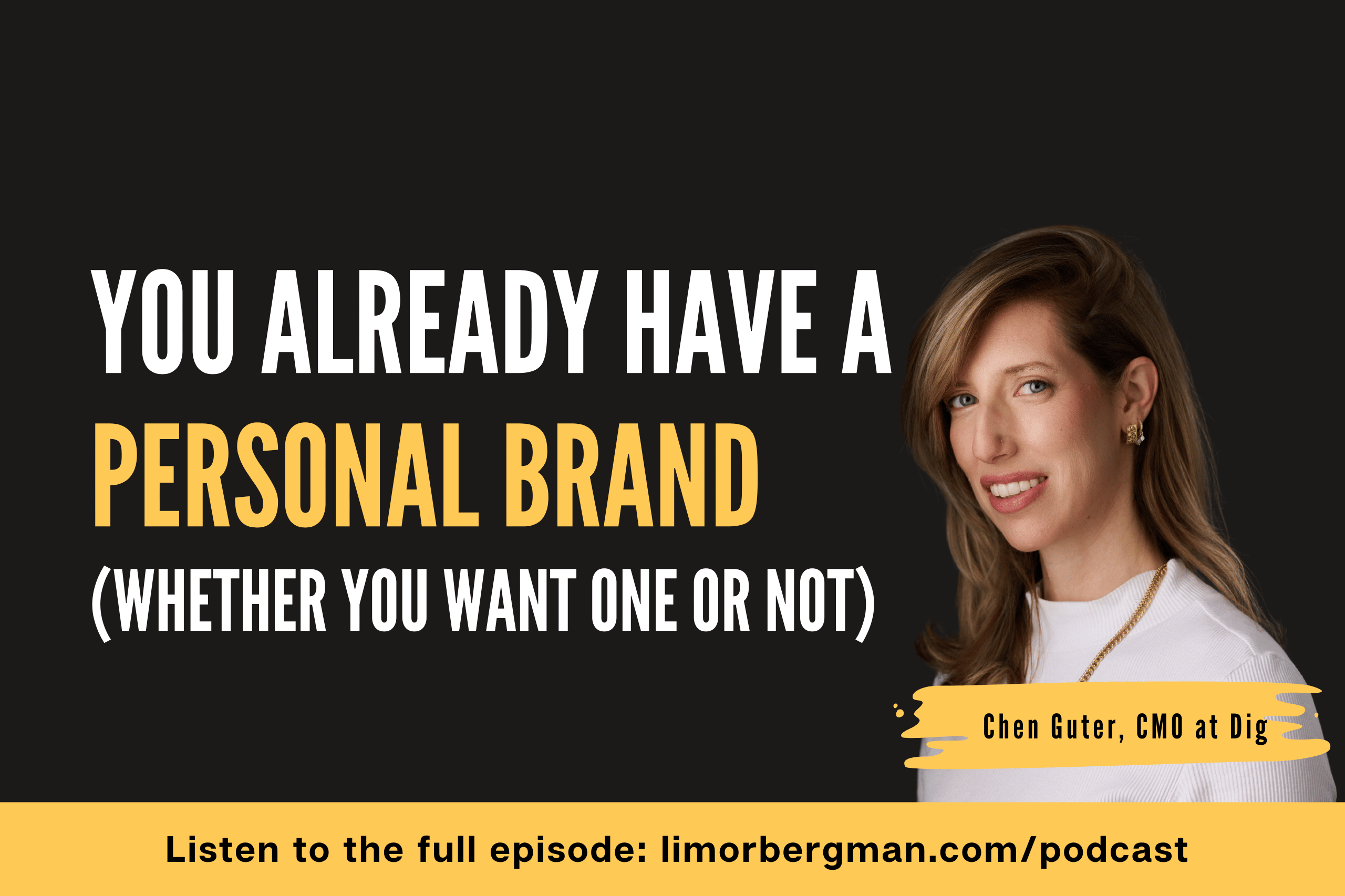
This week on my podcast, From a Woman to a Leader, I sat down with Chen Guter, the CMO at Dig, to talk about personal branding for women who hate self-promotion. Chen spent a decade at Procter and Gamble shaping brands like Pampers, Tide, and Pantene, then moved into high-growth tech leading marketing at Lusha and AppsFlyer. She has thought about this problem more deeply than almost anyone I know, and she has lived it.
What follows is the heart of our conversation, plus what I have learned about the same pattern from twenty years in engineering leadership and from coaching women through it every week.
Why do smart women in tech stay invisible at work?
Smart women in tech stay invisible because they were trained to believe the work speaks for itself. It does not. The belief that good work will naturally get noticed leads high performers to invest everything in skill and delivery and almost nothing in telling their own story.
Chen named this clearly in our conversation:
“We invest so much in building skill, we invest so much in educating ourselves, we invest so much in delivering the best results in our job, and what we neglect many times is being able to tell our story.”
This is the trap. You are doing exactly what you were taught to do, and the thing you were taught to do is incomplete. The work is necessary. It is just not sufficient. Recognition inside your company is not the same as having a reputation outside of it.
How to apply this: For one week, notice how much of your professional energy goes into doing the work versus communicating the work. If the ratio is 95 to 5, you are not unusual. But you are leaving your visibility entirely to chance.
What does “invisible at work” actually mean?
Being invisible at work means your value is known to the people directly around you but not to anyone else, including the people who make decisions about your next opportunity. It is the gap between doing great work and being known for great work.
Chen described the moment she realized this about herself, after a decade at Procter and Gamble:
“Inside the company, everyone knew who Chen Guter is and what my value is. But outside of the company, I didn’t have a name. I was Chen from P&G.”
I had my own version of this. I spent years as a Director of Engineering at companies people knew. My reputation was real, but it lived inside the building. The moment I thought about moving, I discovered that the world did not know me. It knew my title. I wrote about that more personally in the solo episode that accompanies this one and in my Substack essay this week.
How to apply this: Open a private browser window and ask an AI tool like ChatGPT, Claude, or Perplexity to tell you everything it knows about you. Use a browser where you are not logged in, so the answer is not personalized. The result is your brand as the world currently sees it. If it does not represent you, that is the work.
Is your personal brand built by default or by design?
Everyone already has a personal brand. The only real question is whether it was built by default or by design. A brand built by default is whatever impression the world has assembled from the fragments you left lying around. A brand built by design is the one you chose and shaped on purpose.
This was the reframe from our conversation that I have not been able to stop thinking about. Chen put it this way:
“The question is not whether you should build a brand yes or no. The question is do you want your brand to be created by default or by design?”
This matters because most women I coach think personal branding is optional, or worse, that it is self-promotional and a little embarrassing. It is neither. You are not deciding whether to have a brand. You are only deciding whether you are the one writing it.
How to apply this: Look at the answer the AI tool gave you above. Ask yourself one question. Is this the version of me I would have chosen? If the answer is no, you have just found your starting point.
What are the four questions to define your personal brand?
Chen uses four questions in her personal branding workshops to help leaders define their brand from scratch. They move from motivation to strength to story.
1. The first question is about your goal. Why do you even want to shape your narrative? Are you looking for a promotion, more money, a bigger network, a feeling of being recognized? You need to know why, because the why shapes everything else.
2. The second question is about your strength. Chen’s framing here is the sharpest part of the framework:
“Go to the person that knows you the best. You can ask yourself, what’s the one thing they come to me for? This is where your strength is. We need to pinpoint the thing that you’re irreplaceable at.”
3. The third question is about your stories. What are the themes you can talk about, write about, and tell stories about with the least effort? Those themes are how the world learns who you are without needing to interview you.
4. The fourth question, which Chen mentioned later in our conversation, is about your audience and goal alignment over time. Your content strategy should shift as your goals shift.
In my own coaching practice, I use a version of these three questions: who am I here to serve, what specifically am I helping them with, and what do I want to be the first thing someone thinks of when they hear my name. I walk through exactly how I answered each one in the solo episode.
How to apply this: Take ten minutes and answer the first three questions on paper. You do not need to get them perfect. You need to get them started.
What should you put in your LinkedIn headline?
Your LinkedIn headline should say what value you bring and who you help, not just your job title. Your title is already visible in your experience section, and your company logo is already next to your name. The headline is the one piece of space you fully control, and most people waste it.
Chen was direct about this:
“Your title on LinkedIn shouldn’t be a role. The logo of the company you work for is already next to your face. Use this real estate to say what your value is, what you’re strongest at, what you want to do.”
This is the single fastest change you can make this week. It takes ten minutes and it changes the first impression you make on every recruiter, peer, and potential collaborator who lands on your profile.
How to apply this: Rewrite your headline using the three answers from the four-question framework. Lead with who you help and what you help them with. Keep your title in your experience section where it belongs.
Why do even marketers struggle with personal branding?
Marketers struggle with personal branding because they know what good marketing looks like, so they hold their own content to an impossible standard and end up publishing nothing. Chen called marketers “the worst at personal branding” for exactly this reason. They over-edit themselves into silence.
Engineers, and I say this as an engineer at heart, have a different version of the same problem. We were not trained that personal branding is hard. We were trained that it is unnecessary. The code speaks for itself. The results speak for themselves. So we never build the muscle at all.
Different starting point, same destination: silence.
How to apply this: Notice which version is yours. If you are an over-editor, your work is to lower the bar and publish the imperfect thing. If you are someone who thinks branding is unnecessary, your work is to accept that the belief itself is the obstacle.
How long should you wait before publishing your first video on LinkedIn?
You should not wait at all, and the cost of waiting is almost always invisible to you while you are paying it. Chen, a CMO with eighteen years of marketing experience, admitted she waited four years to publish her first video on LinkedIn.
“I wanted to do video on LinkedIn for four years before I actually published my first video. Four years.”
I had my own four-year wait. For me it was this podcast. I knew I wanted to start one for at least a year before I did, and what finally broke the stall was a friend who said, “Why don’t you just start it? I’ll be your first guest.” I tell that whole story in the solo episode.
How to apply this: Identify the thing you have been quietly avoiding. Then find your version of “I’ll be your first guest.” Sometimes that is a friend, sometimes a coach, sometimes it is just you deciding that this is the week.
The bottom line
Personal branding is not self-promotion, and it is not optional. You already have a brand. The work is not to decide whether to have one. The work is to decide whether you are going to be the one who designs it, or whether you are going to leave it to chance and to other people’s incomplete impressions.
The women who get the opportunities they actually want are not always the ones doing the best work. They are the ones whose value is legible to the people making decisions. That legibility is something you can build, on purpose, starting with ten minutes and a LinkedIn headline.
Frequently asked questions
What does it mean to have a personal brand if you’re in engineering leadership? Having a personal brand in engineering leadership means the value you bring is known and legible beyond your current team and company. It is the difference between being respected inside the building and being known in your field. For engineers, this is often underdeveloped because the culture teaches that the work should speak for itself.
How do I build a personal brand on LinkedIn if I hate self-promotion? Start by reframing what personal branding is. It is not promoting yourself, it is making your real value visible and accurate. Begin with your LinkedIn headline, then share content about what you have learned and the problems you solve, not content that praises you. Authentic storytelling does not feel like self-promotion because it is not.
What should I put in my LinkedIn headline? Put what value you bring and who you help, not just your job title. Your title is already in your experience section and your company logo is next to your name. The headline is the most valuable space on your profile, so use it to communicate your strength and your direction.
How long does it take to build a personal brand? You can start in ten minutes by rewriting your LinkedIn headline, but building a brand that opens doors is an ongoing practice measured in months, not days. The point is not speed. The point is intentionality and consistency over time.
Why do marketers struggle with personal branding? Marketers struggle because they know what good marketing looks like, so they hold their own content to a standard that paralyzes them. They over-edit themselves into silence. The fix is to lower the bar for publishing and accept that an imperfect post that exists beats a perfect one that does not.
What is the difference between a brand built by default and a brand built by design? A brand built by default is the impression the world has assembled from whatever fragments you left behind. A brand built by design is the one you chose and shaped intentionally. Everyone has a brand. The only question is which kind.
How do I get over the fear of posting on LinkedIn? Recognize that the fear is normal and that even a CMO with eighteen years of experience waited four years to post a video. The fear does not go away on its own. It is broken by action, and action is often easier when one person, a friend or a coach, gives you the push to just start.
What are the four questions Chen Guter uses to define a personal brand? The four questions are: what is your goal and why do you want to shape your narrative, what is your strength or the one thing people come to you for, what are the themes and stories you can tell most easily, and how should your content strategy shift as your goals change over time.
Listen, watch, and go deeper
This post is based on my conversation with Chen Guter, CMO at Dig, on the From a Woman to a Leader podcast.
Listen to the full episode with Chen: podcast hub or watch on YouTube
Listen to my solo episode, where I share my personal take on what it cost me to let my title be my entire brand: watch on YouTube
Read the deeper, more personal version of this story on my Substack: The Dinner Party I Can’t Stop Thinking About
Connect with Chen Guter on LinkedIn.
If you are reading this and thinking you know you need to do this work but you do not know where to start, you do not have to figure it out alone. I work with women in engineering leadership every week on exactly this. Book a promotion strategy call and let’s figure out your next move together.