
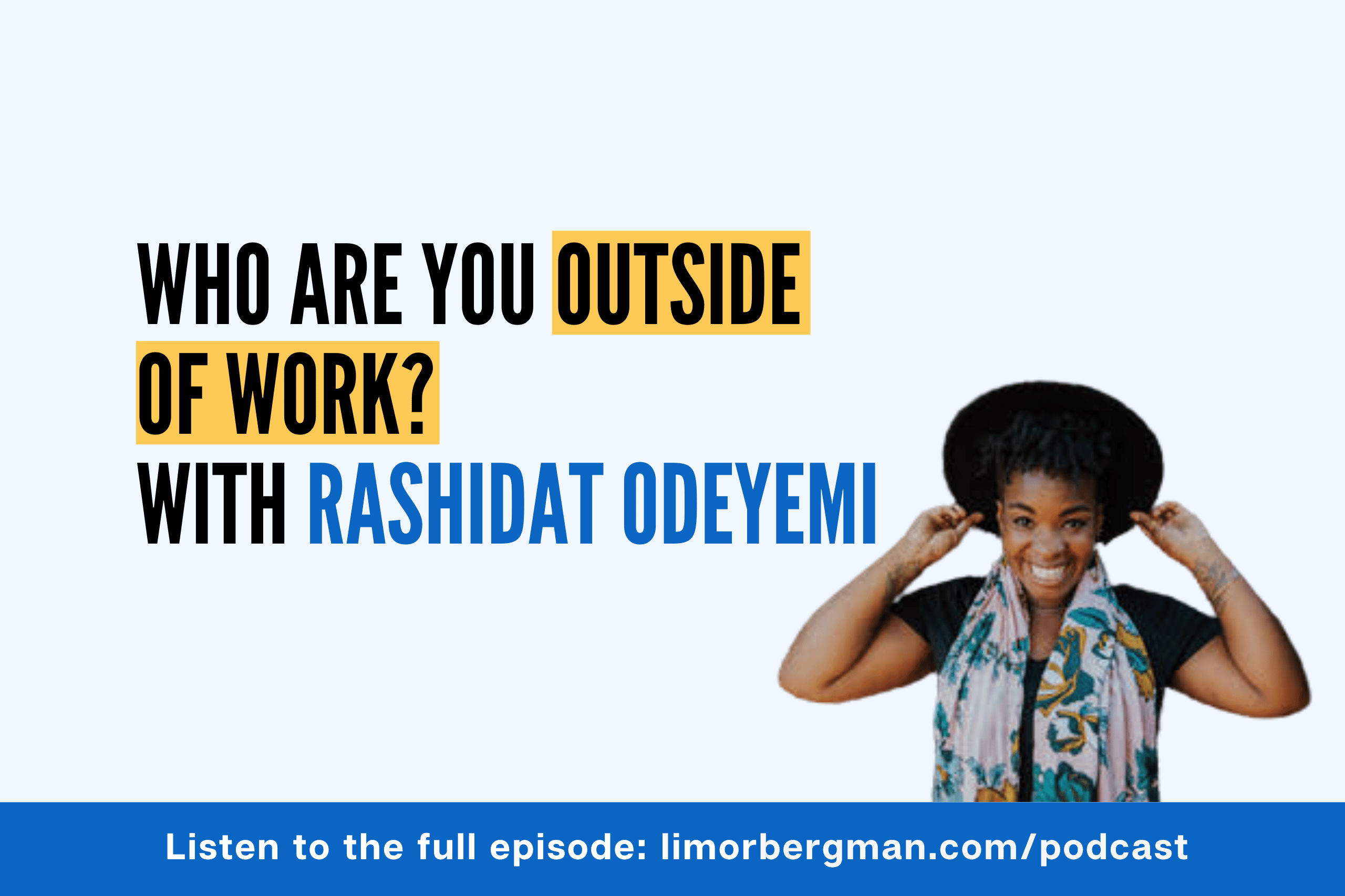
You’ve spent so many years answering “what’s next” that you can’t actually answer “what do I want?”
You’ve been promoted, you’ve been recognized, you’ve been told you’re impressive — and somewhere along the way, you stopped knowing how to talk about yourself in any way other than your job title.
So what happens the day someone asks you who you are outside of work?
That was the question that opened my conversation with Rashidat Odeyemi on this week’s episode of From a Woman to a Leader. Rashidat is the CEO of Rashidat O Limited Co., a Lifestyle Coach, and Rest Mindset Mentor. She left a corporate fashion career, paid off her last student loan, and spent a year traveling to fifteen countries trying to answer one question that had stopped her cold. Today she helps other women answer it without falling apart in the process.
Here are the five things from that conversation that I think every woman in tech leadership needs to hear.
1. Why does the question “who am I outside of work?” scare so many high-achieving women?
Because they’ve spent so long answering “what’s next?” that they’ve stopped knowing how to ask anything else.
Rashidat told me what happened the first time she asked herself the question.
“If you didn’t have to worry about money, if your kids were taken care of, you got your house for free, whatever kind of car you wanted, what is it that you would do? When I first asked myself that question, it was like a deer in headlights. It scared the living bejesus out of me, because I couldn’t figure out what the answer was.” — Rashidat Odeyemi
[EMBED CLIP: Rashidat’s “deer in headlights” moment]
Here’s what I see again and again in my coaching work. High-achieving women in tech build entire careers answering the next-promotion question. The job becomes the identity. The role becomes the dream. And the day someone asks them who they are outside of all that, they go blank.
That blank space is not a sign that something is wrong with you. It’s a sign you’ve been outsourcing the question for a long time.
How to apply this: Sit with the question for ten minutes. Write down whatever comes up — even if what comes up is “I don’t know.” That’s information. The work is in the asking, not in the immediate having of the answer.
2. What’s the difference between a task and a trait — and why does it matter?
Because the task is what your job is. The trait is who you are. Most women have lost the language for the second one.
Rashidat made a distinction in this conversation that I want every senior woman in tech to keep nearby.
“At work I was a technical designer. But those were tasks that I did. Outside of that, I’m a problem solver. I’m super creative. I’m process-oriented. I get excited about exploring things. Those are the things of who you actually are. The tasks that you do at work are just tasks.” — Rashidat Odeyemi
The pattern I see in the women I coach is that they’ve fused the two. They are the role. They are the title. And when the role ends — through layoff, restructure, pivot, or their own choice — they don’t know who they are anymore.
How to apply this: The next time you describe what you do, separate the task from the trait. “I run program management” is the task. “I’m the person who can see the whole system and translate it for everyone in the room” is the trait. The trait travels with you. The task doesn’t.
3. How do you find what you’re actually good at when you can’t see it yourself?
You ask the people around you. The things you do most naturally are the things you don’t notice you’re doing.
Rashidat said something on this episode that hit me harder than anything else in the conversation.
“There’s so many beautiful things about us that we do naturally, that if we knew what those were, those were the things we would actually make a business out of. But we don’t see them. You need a mirror to reflect back something — some of the things that are beautiful about you that you do naturally.” — Rashidat Odeyemi
[EMBED CLIP: Rashidat on the “good blind spot” and needing a mirror]
This is why pure self-reflection often goes nowhere. The things you do most naturally are exactly the things you don’t notice. Someone has to tell you. A coach. A mentor. A peer. A friend who’ll be honest with you.
How to apply this: Pick three people who have known you for at least a few years. Ask each of them this exact question — “what’s a thing I do that makes you say ‘of course she’d do that, that’s so her’?” Listen to the words they use. Write the words down. The pattern across the three answers is your mirror.
4. How do you stop trying to do everything at once?
You pick one cup. You pour the whole pitcher into it. The other nine ideas don’t die. They wait.
When Rashidat described the trap most ambitious women fall into when they try to start something new, she gave a metaphor I’ve been repeating to clients all week.
“If you have ten glasses, ten different ideas, and you’re trying to fill each of them with one pitcher, you’re only getting drops in each. None of them are getting enough water to wet the bottom of the cup. You’ve got to pick one. I’d say start with three. But if you really want to do this well, focus on one.” — Rashidat Odeyemi
This is the pattern in every multi-passionate woman I work with. The ten ideas aren’t the problem. The strategy of pouring drops into all of them at once is the problem.
How to apply this: Write down the ideas you’ve been trying to make progress on simultaneously. Pick the one that, if you focused on it for the next 90 days, you’d be most disappointed to look back on and see no progress. Pour the pitcher into that one. The other nine are not gone. They’re waiting their turn.
5. Why is putting a deadline on your dream the surest way to kill it?
Because the dream has its own timeline, and bullying it with yours just exhausts you both.
The single most quotable moment of this episode was Rashidat’s reframe of how women in tech kill their own dreams.
“Don’t get bogged down by your goals. Get bogged down by the timeline, by the deadline that you put on your goals. The plant is like, I don’t blossom based on your time, on what you decided boo. That’s not how it works.” — Rashidat Odeyemi
[EMBED CLIP: Rashidat on “the plant doesn’t blossom on your timeline”]
I see this in the women I coach all the time. They’re chasing a promotion deadline they invented. A business launch deadline they made up. A “by 40 I should have” timeline that no one else agreed to.
The pace isn’t the problem. The deadline you put on the pace is.
How to apply this: Look at your current goals. For each one, ask — did the work require this deadline, or did I require it? If you set the deadline, you can move it. The work doesn’t lose anything when you remove the false urgency. You gain back the ability to actually do it.
The Bottom Line
Rashidat’s path doesn’t look like a straight line. It looks like a series of honest moves — quitting the job that wasn’t her, traveling to figure out the question, focusing on the one thing she could give away easily, and removing the deadline so the dream could actually grow.
If you’re carrying the belief that you should already know what you want, that you have to do everything at once or nothing is happening, or that you’re behind because you haven’t hit the timeline you invented for yourself — I want you to hear what Rashidat said out loud on the episode.
You’re not lost. You forgot how to dream. Ask the question. Find your mirror. Pick the one cup. Drop the deadline.
Listen to the full episode
🎧 Listen on Spotify, Apple, or anywhere you get your podcasts: https://limorbergman.com/podcast/
📺 Or watch on YouTube: https://youtu.be/owfsPhTyTfU
About Rashidat Odeyemi
Rashidat Odeyemi is the CEO of Rashidat O Limited Co., a Lifestyle Coach, and Rest Mindset Mentor. She helps women turn their hustle into the fulfilling life they’ve been working so hard for — without pretending they’re fine, waiting until retirement, or burning out. After leaving a corporate fashion design career and spending a year traveling to fifteen countries across Southeast Asia, Africa, and Europe, she started her coaching practice in 2018.
Resources mentioned
- The Gap and the Gain by Dan Sullivan and Dr. Benjamin Hardy
- Rashidat’s YouTube video on turning your passions into a business: https://youtu.be/ceNqJZRchR4
https://youtu.be/ceNqJZRchR4
Connect with Rashidat
- Rashidat’s website: https://rashidato.com
- Rashidat on LinkedIn: https://www.linkedin.com/in/iamrashidato/
- Rashidat on Instagram: https://www.instagram.com/iamrashidato/
- Rashidat on TikTok: https://www.tiktok.com/@iamrashidato
- Rashidat on YouTube: https://www.youtube.com/@iamrashidato
FAQ
Why do high-achieving women feel like they’ve lost their identity outside of work?
Many high-achieving women in tech have spent decades answering the “what’s next?” question — the next promotion, the next role, the next milestone — without ever pausing to ask “what do I actually want?” In this episode, Lifestyle Coach Rashidat Odeyemi explains that this isn’t a personal failing. It’s a pattern. The job becomes the identity over time, and the version of you that exists outside of work goes quiet from disuse. Reactivating it starts with asking what you’d do if money, status, and other people’s expectations weren’t part of the equation.
What’s the difference between a task and a trait at work?
A task is what your job description says you do. A trait is who you are while you’re doing it. Rashidat Odeyemi gives the example: “technical designer” was her task, but “problem solver, creative, process-oriented” were her traits. The task ends when the role ends. The trait travels with you across roles, careers, and life stages. Most women have spent so long describing themselves with the task that the language for the trait has gone rusty.
How do you find out what you’re naturally good at if you can’t see it yourself?
Ask other people. The things you do most naturally are the things you do without noticing — which means you can’t see them in yourself. In the episode, Rashidat Odeyemi calls this “a good blind spot” and recommends getting a mirror. Specifically, ask three people who have known you for years what you do that makes them say “of course she’d do that — that’s so her.” The pattern in their answers is your mirror.
How do you focus on one idea when you have ten you want to pursue?
Pick the one that, if you looked back in 90 days and saw no progress on it, you’d be most disappointed about. That’s the cup that gets the pitcher. Rashidat Odeyemi’s metaphor — “if you pour one pitcher into ten cups, none of them get enough to wet the bottom” — captures the math of trying to do everything at once. The other nine ideas don’t die. They wait.
Why is setting a deadline on your goals counterproductive?
Because most personal goals — career growth, business building, healing, identity work — have their own timeline that doesn’t move just because you wrote a date next to them. Rashidat Odeyemi puts it plainly: “the plant doesn’t blossom based on your time.” When you set arbitrary deadlines and don’t hit them, you call yourself behind on a race no one else agreed to. The pace isn’t the problem. The false urgency is.
Can you be ambitious and slow down at the same time?
Yes. Ambition and pace are two different things. You can want a big career, a big business, or a big life, and still recognize that bullying the work with deadlines you made up doesn’t get you there faster — it just exhausts you. The question is whether you’re addicted to the deadline or actually committed to the goal.
How do you start “dreaming again” if you’ve been in corporate for years?
Start with roles, not jobs. Write down all the roles you play in your life — mom, sister, problem solver, organizer, the creative one, the friend who hosts — and ask which of them you’re not letting yourself use enough. That list is the door back into the parts of you that work has been quietly crowding out.
What does “three hills you’d die on” mean for finding your message or business?
Rashidat Odeyemi’s framework for finding what you’re meant to talk about — and eventually build a business around — is to identify three topics you’re so passionate about that someone could put you on a podcast tomorrow with no script and you’d know exactly what to say. Most people start with ten. You narrow them down by saying them out loud, watching what your audience reacts to, and committing to the three that consistently come back.
Connect with Limor
- Website: https://limorbergman.com
- Podcast hub: https://limorbergman.com/podcast/
- LinkedIn: https://www.linkedin.com/in/limorbergman/
- Substack: https://limorbergman.substack.com
- Book a promotion strategy call