
Curiosity Is a Leadership Skill (Not a Personality Trait)
Ever feel like asking a question might make you look less competent? Or worry that admitting you don’t know something will undermine your authority?
Trust me, I’ve been there. I used to think leadership was about having all the answers, but I’ve learned something crucial:
Curiosity is actually one of our greatest leadership strengths.
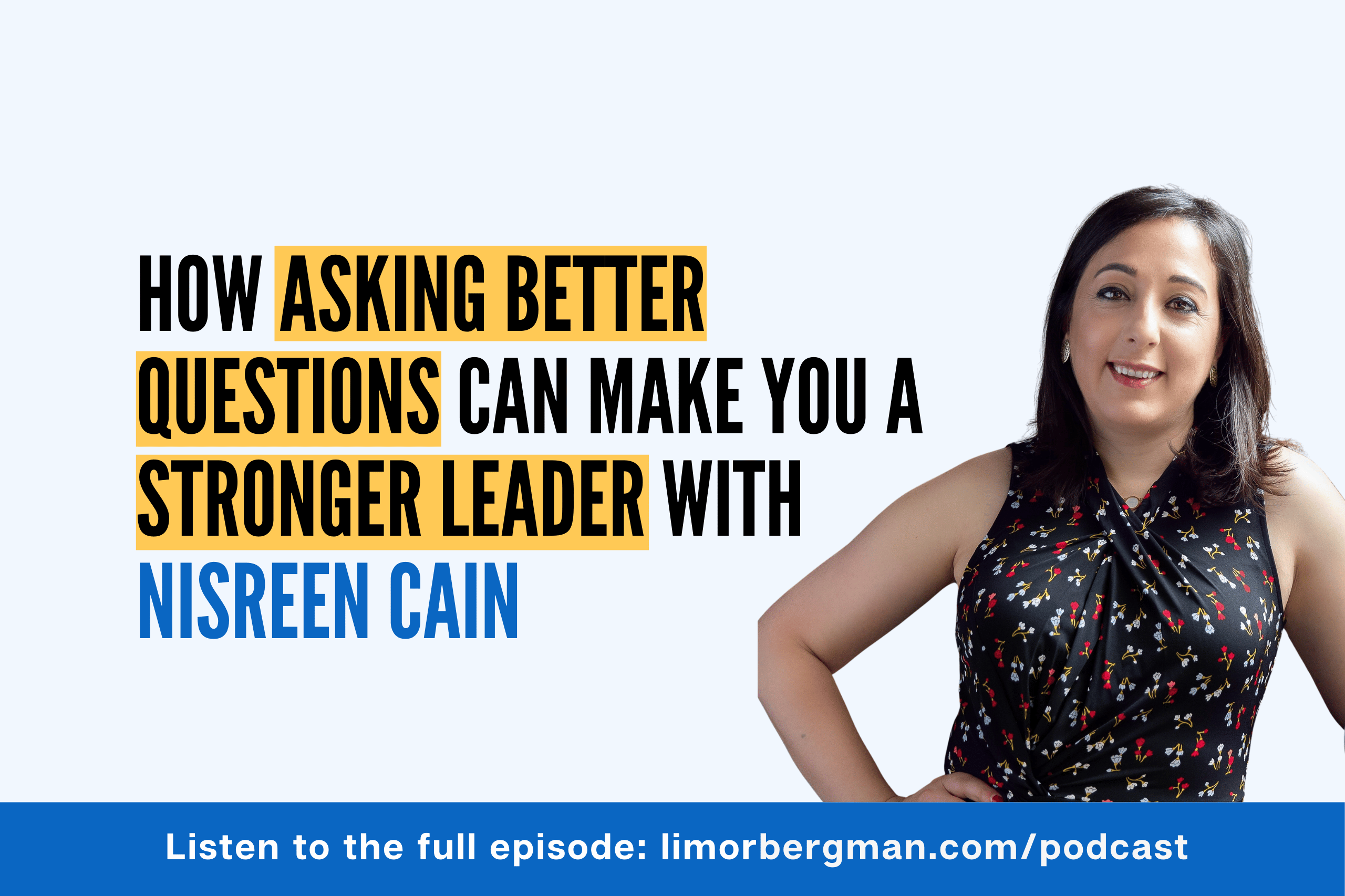
Recently, I sat down with Nisreen Cane, a former Google leader, startup executive, and now a computer science professor, helping professionals navigate the AI era.
Nisreen shared her journey of embracing curiosity, especially as a woman in tech, and how it’s transformed her approach to leadership and teamwork.
In this post, I want to highlight her main ideas and how they can help you ask better questions, build stronger teams, and lead with confidence.
Ready to become more curious and powerful? Let’s dive in.
Why Curiosity Matters Right Now?
Curiosity sounds simple.
But in leadership, curiosity is often the difference between:
-
a manager who controls
and
-
a leader who develops people
Between:
-
teams that execute
and
-
teams that think
And between:
-
feeling like you must “prove you belong”
and
-
leading from clarity and confidence
Nisreen and I explore how curiosity becomes harder as you rise. Because the more senior you become, the more people expect certainty, answers, and direction.
But the truth is, great leadership isn’t built on having all the answers.
It’s built on asking better questions.
Main Takeaways from Our Conversation
1. Curiosity Is a Leadership Strength, Not a Weakness.
Nisreen emphasized that curiosity challenges the ego and helps build trust.
Women, in particular, often hesitate to ask for help or question ideas to preserve credibility.
But she points out that asking thoughtful questions enhances your authority and signals confidence, not doubt.
When you ask questions rooted in genuine curiosity, you invite collaboration and innovation—not weakness.
My insight: I’ve seen firsthand how questions open doors to deeper understanding and trust. The more I ask, the more my team respects that I value their input.
Remember, being curious demonstrates courage and confidence.
2. Asking Questions Builds Psychological Safety.
Many women hold back because they fear being judged or seeming unprepared.
Nisreen explained that creating an environment where questions are welcomed builds psychological safety, where everyone feels comfortable sharing their doubts and ideas without fear of judgment.
Tip: Normalize questions in your team by encouraging open dialogue. When you, as a leader, regularly ask for input, you set the tone that curiosity is appreciated and safe.
3. How to Ask Questions Without Losing Authority.
Here’s a big one. Nisreen shared that framing questions correctly is essential. Instead of asking “Can you do this?” in a way that might seem like doubting someone’s capability, frame it as “What’s your approach here?” or “How do you see this fitting into the bigger picture?”
This shifts questions into collaborative, strategic conversations.
4. Leadership Through Curiosity, Not Control.
Leaders often feel they need to control every detail. Nisreen advocates asking questions that guide thinking rather than dictating actions: “What are the best options here?” rather than “Do it my way.”
This approach empowers teams and sparks creativity.
Pro tip: Develop questions like “What are the main risks?” or “How does this align with our vision?” to lead with curiosity and trust.
The Hidden Reason Many Women Stop Asking Questions
One of my favorite parts of this conversation is when Nisreen shares a story from grad school.
She spent days researching and translating technical papers. She did all the work. Built the full presentation.
And then someone asked her a simple question:
Why didn’t you just ask the postdoc sitting next to you?
That moment stuck with her. Not because she did “bad work.” But because she saw something deeper:
She defaulted to doing everything alone.
Many of us do.
Especially women.
Because we’ve internalized a belief that asking for help makes us look less capable. Or worse, that it proves we’re not qualified.
And if you’re also introverted, it can feel even harder.
I shared that too.
Even now, I still catch myself thinking:
Can I do this myself? Should I?
What will they think if I ask?
Curiosity vs Competence: The Double Bind for Women Leaders
This might be the most important insight of the episode.
Nisreen describes what happens when she asks questions in male dominated engineering leadership rooms:
“When I ask questions, the assumption becomes I don’t know.
It doesn’t become I’m challenging your thinking.”
That’s the double bind.
A man asks questions and looks strategic.
A woman asks questions and risks being perceived as unsure.
So Nisreen evolved her approach. And this part is gold:
She started framing her questions.
Instead of asking directly, she’d say:
“I’m going to put my coaching hat on for a second.”
That one sentence changes the entire interpretation.
It signals authority and intention. It tells the team:
This isn’t uncertainty. This is leadership.
The Leadership Questions That Build Better Teams
If you want practical takeaways, this episode delivers.
Nisreen shares the kinds of questions she asks that create clarity and momentum:
-
How did you arrive at this solution?
-
What decision points did you make along the way?
-
How does this move us closer to the vision?
-
What happens if we don’t do X?
-
What evidence would change our minds?
These are not “I’m lost” questions.
These are “I’m leading” questions.
They build psychological safety because they invite thinking, not defensiveness. They build ownership because they don’t dictate. And they build trust because people feel seen when you engage thoughtfully with their work.
Curiosity and Decision Making: When There’s No Perfect Answer
We also talk about something every engineering leader faces:
There are usually multiple valid solutions.
Which can feel empowering. And sometimes paralyzing.
Nisreen shared how she helps teams make decisions without getting stuck in perfection or ego:
-
What’s the cost of going in this direction?
-
Can we reverse the decision later?
-
Which option is more adaptable over time?
-
What is the smallest decision we can make now?
That’s leadership.
Not “pick the perfect answer.”
Pick the next best decision that keeps learning possible.
The Core Takeaway: Be Curious About Yourself First
Before we wrapped, I asked Nisreen what she wanted listeners to take home.
Her answer was simple and profound:
Be curious about yourself first.
Your values. Your shadow values. The stories running in your head when you hesitate.
Because curiosity isn’t just a tool for managing others. It’s a way of leading yourself.
And when you understand what’s driving you, you lead with more confidence, less perfection, and a lot more authenticity.
How to Start Cultivating Curiosity Today
- Ask open-ended questions: “What do you think about this approach?” or “How did you arrive at that conclusion?”
- Frame questions to build trust: “Can you tell me more about your process?”
- Embrace beginner’s mind: Go into conversations without assumptions; be genuinely interested.
- Encourage your team to ask: Model questions yourself and reward curiosity.
- Reflect on your values: Curiosity stems from self-awareness and confidence.
Listen and Watch
If this resonates, you’ll want the full conversation.
🎧 Listen to the episode: limorbergman.com/podcast
📺 Watch on YouTube: https://youtu.be/ge0ENTr0hSA
And if you want deeper reflections, behind-the-scenes lessons, and more personal leadership writing from me:
💌 Join me on Substack: https://limorbergman.substack.com/
About the Guest: Nisreen Cain
Nisreen Cain is a Computer Science professor bridging industry and academia to help professionals navigate the AI era. After 25 years in technology leadership spanning corporate giants like Google to startups like Propel and Babel Street, she now brings real-world experience into the classroom, and academic curiosity into industry practice.
She’s passionate about empowering women in tech to question assumptions, communicate their value clearly, and lead with authenticity instead of perfection.
Connect with Nisreen:
-
LinkedIn: https://www.linkedin.com/in/nisreencain/
-
Instagram: @nisreencain
-
Newsletter: https://beyondthebinary.substack.com
FAQ: Questions Answered in This Episode
What does curiosity look like in leadership?
Curiosity in leadership looks like asking thoughtful, strategic questions that help your team think, reflect, and align to the bigger vision, rather than controlling or dictating execution.
Why do women in tech hesitate to ask questions?
Because many women have been conditioned to believe that asking questions signals incompetence. In male-dominated environments, questions can be misinterpreted as uncertainty instead of strategic thinking.
How can a woman leader ask questions without losing authority?
Frame your questions with intention. Nisreen uses language like “I’m putting my coaching hat on,” so the team understands the purpose is development and clarity, not lack of knowledge.
How do you balance being independent with asking for help?
Do basic research first, then bring your “wall questions” to others. This shows respect, builds connection, and leads to more productive conversations.
How does curiosity help decision-making in engineering?
Curiosity helps teams explore options without ego, avoid perfection paralysis, and make reversible, adaptable decisions based on evidence and evolving context.
What are examples of strong leadership questions?
Examples include:
-
How did you arrive at this solution?
-
What decision points did you make?
-
How does this support our vision?
-
What evidence would change our minds?
Why is curiosity tied to psychological safety?
Because curiosity invites dialogue. It signals that it’s safe to explore, challenge, and learn. When leaders model curiosity, teams feel less judged and more empowered to think openly.