You’re in a meeting. You have a solid idea. You start to share it, and within seconds you can feel the energy shift. The other person gets defensive. Their tone changes. What should have been a productive conversation is suddenly an argument about who’s right.
If that sounds familiar, you’re not alone. This is one of the most common patterns I see in my coaching, especially with women working in male-dominated fields like tech and engineering. You know your ideas have merit. But somewhere between knowing it and saying it, things go sideways.
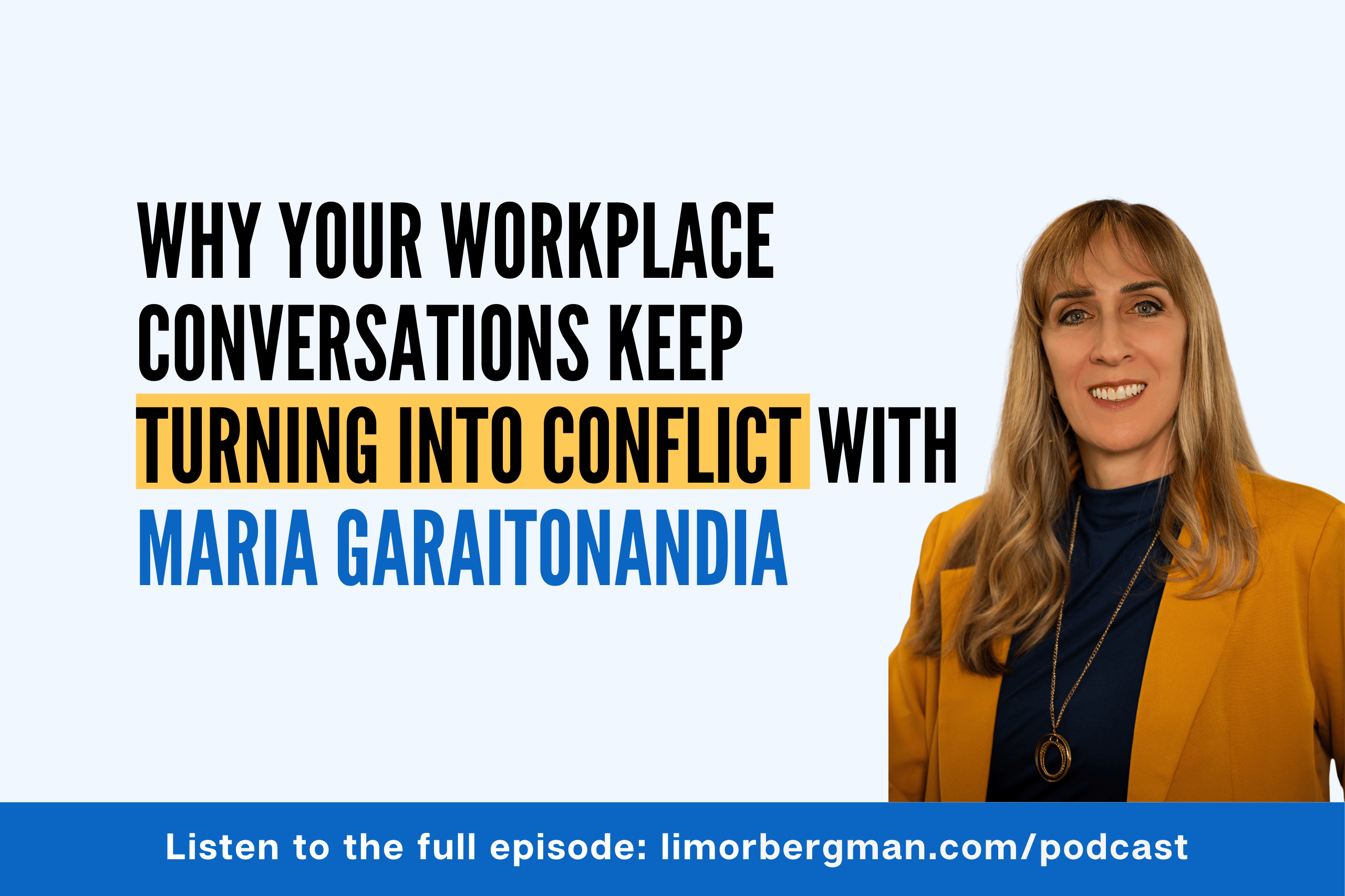
I sat down with Maria Garaitonandia, an intercultural coach and communication strategist with over 25 years of experience, to uncover why this keeps happening and what to do about it. Maria is the author of Untangling Communication for Empowered Leadership and Team Success and has spent two decades bridging cultural and communication divides across global teams. What she shared in our conversation applies to anyone who has ever struggled to get their point across without triggering defensiveness.
🎧 Listen to the full episode: Why Your Workplace Conversations Keep Turning Into Conflict
1. You Don’t Know What You Don’t Know (And Neither Does the Other Person)
Maria brought up the Johari Window, a model that shows us we all have blind spots about how we come across. She illustrated this with a story I loved: an American colleague was frustrated because his Mexican coworkers would message him with “Hi, how are you?” and then stop. He thought they were wasting his time.
Maria’s response to him was direct: “They have been taught that you need to always greet a person first and recognize their humanity before assuming that you’re there just to solve their problems. It’s rude to jump right into business without properly greeting someone first.”
This is not just a cross-cultural issue. It happens between any two people who assume the other person thinks and works the way they do. And it’s happening in your office right now.
How to apply this: Before your next difficult conversation, pause and ask yourself: “Am I assuming this person sees the situation the same way I do?” If you haven’t explicitly asked them for their perspective, the answer is probably yes. And that assumption might be the root of the conflict.
2. Most Workplace Conflict Isn’t Actually About the Work
Maria broke this down in a way that I think will change how you look at your next disagreement. Yes, there are structural conflicts about resources, decisions, and performance. But underneath those, most conflict is driven by personality, communication style, and background.
As Maria put it: “We might be on the same page as far as what we want to achieve, but how we go about it is a different matter.”
Think about the last time you clashed with a colleague. Were you really disagreeing about the goal, or about the approach? And did either of you stop to understand where the other person was coming from before pushing your own view?
How to apply this: Next time a conversation gets tense, try separating the “what” from the “how”.
Say something like: “I think we’re actually aligned on what we want to achieve. Can we talk about how we each see the best path to get there?”
That reframe alone can de-escalate most arguments.
3. The Paradigm Shift: Every Head Is a Whole World
Maria referenced the famous subway scene from Stephen Covey’s The 7 Habits of Highly Effective People. A man is annoyed by a father whose kids are misbehaving. He confronts the dad, who responds: “I’m so sorry. I just left the hospital. My wife has just passed away.”
In one sentence, everything shifts. Annoyance becomes compassion.
Maria connected this to a Spanish saying that stayed with me: “Cada cabeza es un mundo.” Every head is a whole world. You never know what the other person is going through, what they’re thinking, or what they’re feeling. They may have the best intentions, but you’re not privy to what’s happening in their mind.
She tied this to emotional intelligence, specifically the third element that Daniel Goleman describes: looking at the other person and asking yourself, “What could be the rational reason this person is saying or behaving the way they are?”
How to apply this: Before reacting to someone’s behavior, ask yourself Maria’s question: “What could be the story here that I’m not seeing?”
That one question can prevent a conflict before it starts.
4. Why You Should Start with WHY, Not WHAT
This is the core insight from the episode, and the foundation of Maria’s CLEAR framework. Most of us start conversations with what we want or how we think something should be done. And the other person’s immediate reaction is resistance: “Who is she to tell me what to do?”
Maria’s approach flips this: “If you start off a conversation with a tiny bit of context, and by this I mean starting out with a little bit of background or the why, it shows courtesy to the other person because you are sharing your reasoning with them.”
She gave a practical example that made this click for me. Instead of walking into a meeting and saying “We need to change this process,” try: “I’ve been looking at our current process and I noticed we have a 15% error rate that’s causing a lot of rework. I’ve been thinking about a different approach that might help us improve our output. What do you think?”
The difference is night and day. In the first version, you get defensiveness. In the second, you get brainstorming. As Maria described: “She’s coming in with a good intention. I see that she’s already given this some thought. I’m going to listen and see what it’s all about instead of, here she comes bossing me around again.”
How to apply this: Before your next request, proposal, or piece of feedback, write down your “why” in two or three sentences. Share that context first, before you say what you want.
Watch how the conversation changes.
5. The CLEAR Framework: A Dance, Not a Checklist
Maria’s full framework is an acronym: Context, Listen & Empathize, Adjust, Reframe. But what makes it powerful is that it’s not a rigid step-by-step process. It’s a continuous dance.
Here’s how it works in practice:
Context (C): Start by sharing the why behind what you’re about to say. Two or three sentences is enough. You’re showing courtesy by sharing your reasoning.
Listen & Empathize (L + E): If there’s any objection or pushback, ask open-ended questions. Paraphrase what you’re hearing. Show genuine interest in the other person’s perspective. This is where the real information lives.
Adjust (A): With the richness of what you’ve gathered from listening, you now understand the other person’s perspective better. You’re adjusting your understanding in real time.
Reframe (R): Now you can make a proposal or suggestion in a way that addresses their concerns. You’re reframing your original idea so it’s more palatable because you actually understand what they need to hear.
And then you do it again. You give context, listen, adjust, reframe, give more context. Maria described it perfectly: “You’re working it, you’re working it, you’re working it all the time.”
The language she suggested is something I want every reader to try: “I can see how this makes a lot of sense. I’d like to invite you to consider…” or “Have we thought about the impact of X, Y, and Z?” You’re being diplomatic without being silent.
How to apply this: Pick one conversation this week where you know there might be tension. Before you go in, plan your opening context (the why). During the conversation, focus on asking one more open-ended question than you normally would before making your point. That’s the CLEAR dance in action.
6. How to Be Assertive Without Being Labeled Aggressive
This is the question I asked Maria because it’s something I personally struggle with and hear from almost every woman I coach. How do you find that sweet spot?
Maria named it directly: “How do you hit that sweet spot between being considered the pushover or the mat, and being the bitch?”
She shared a coaching example of a quality control director at a pharmaceutical company whose manager said she was “too maternal” and “coddling her team.” On the other end, women who push back get labeled as “too tough.” It’s a real double bind, especially in male-dominated fields.
Maria’s answer ties back to the CLEAR framework: give validity to the other person’s position first, then invite them to consider yours. “I can see why you would think that it’s this way because… I’d like to invite you though to consider…”
As I shared in the episode, I’ve found that asking powerful questions rather than making statements is often the most effective route with ego-driven colleagues. Instead of “you’re wrong,” try “have you thought about what would happen if…?” It’s the longer route, but it leads to much better results.
How to apply this: Next time you disagree with someone, try this two-step approach: first, acknowledge what’s valid in their perspective (and mean it). Then use Maria’s language: “I’d like to invite you to consider…”
You’ll be surprised how differently the conversation goes.
7. Stop Sweeping It Under the Rug
Maria used a metaphor I haven’t been able to shake: “It’s almost like you’re sweeping all of the dirt under the rug and eventually the rug has this huge lump under it and you keep tripping over that same lump.”
Most of us avoid hard conversations because they feel scary. But if you still have to work with that person, and every time you think about them you tense up or try to avoid them, that avoidance is costing you. It’s costing your energy, your focus, and as Maria said bluntly: “It’s impacting the bottom line.”
Her suggestion is vulnerable and brave: “I’d really like for us to have a smoother relationship and maybe we haven’t gotten off on the right foot. What do we need to do in order to feel like we can trust each other?”
That takes courage. But as Maria reminded us: practice makes progress.
How to apply this: Think of one professional relationship that feels heavy or strained right now. What would it look like to have a five-minute conversation that starts with: “I’d like for us to work together more smoothly. What do you think we need?”
You don’t have to solve everything. You just have to start.
The Bottom Line
Most workplace conflict isn’t about who’s right. It’s about how we communicate what we think. Maria’s CLEAR framework gives you a way to navigate those conversations without losing yourself in the process. Start with why. Listen before you push. Adjust as you go. You can be diplomatic without being silent.
🎧 Listen to the full episode: Why Your Workplace Conversations Keep Turning Into Conflict
📺 Watch on YouTube: How to Navigate Conflict at Work Without Being Called Aggressive
📝 Read the deeper, personal version on Substack: I am a recovering avoider
About Maria Garaitonandia
Maria is an intercultural coach and communication strategist with over 25 years of experience helping leaders and teams communicate effectively across cultures and generations. She lived in Mexico for 20 years bridging differences between American and Latin American teams, and works with organizations in telecommunications, pharmaceuticals, and beyond. She is the author of Untangling Communication for Empowered Leadership and Team Success.
Connect with Maria:
- Website: mariagaraitonandia.com | globalbridgestraining.com
- LinkedIn: Maria Garaitonandia
- Instagram: @mariagaraitonandia
- Book: Untangling Communication on Amazon
More Resources on Career Growth for Women
Read my personal story: I Wasted Years Waiting for Permission to Lead, a deeper dive into my own journey and what finally changed
Need support with your career or business transition? I coach women in tech to grow into leadership roles without losing themselves. Learn more about coaching
About the Author: Limor Bergman Gross coaches women in tech to grow into leadership roles. She hosts a weekly podcast featuring conversations with women leaders and shares personal insights on career growth and leadership development.
Books & Resources Mentioned
- Untangling Communication for Empowered Leadership and Team Success by Maria Garaitonandia
- The 7 Habits of Highly Effective People by Stephen Covey
- How to Win Friends and Influence People by Dale Carnegie
- Daniel Goleman’s Emotional Intelligence framework
- The Johari Window model
FAQ: Workplace Conflict and Effective Communication
How do I handle conflict at work without making it worse? Start by sharing context before making your point. Instead of leading with what you want, explain why it matters first. This shifts the other person from defensive mode to collaborative mode. Maria Garaitonandia’s CLEAR framework (Context, Listen & Empathize, Adjust, Reframe) provides a repeatable approach for any difficult conversation.
Why do my workplace conversations keep turning into arguments? Most people start conversations with what they want or how they think things should be done, which triggers defensiveness. When you start with the why instead, you show courtesy by sharing your reasoning, and the other person is more likely to brainstorm with you rather than push back.
How can women be assertive at work without being labeled aggressive? Give validity to the other person’s position first, then invite them to consider yours. Use language like “I can see how this makes a lot of sense. I’d like to invite you to consider…” This approach lets you be diplomatic without being silent, and assertive without triggering the aggressive label.
What is the CLEAR communication framework? CLEAR stands for Context, Listen & Empathize, Adjust, and Reframe. It’s a dynamic communication model created by Maria Garaitonandia that works across cultures and generations. You share context first, listen and empathize with the other person’s perspective, adjust your understanding, and reframe your proposal based on what you’ve learned. It’s a continuous dance, not a rigid checklist.
How do I give feedback without demoralizing my team? Lead with context so the person understands your reasoning before hearing the feedback. Ask open-ended questions to understand their perspective. Then reframe your feedback in a way that addresses their concerns. The key is making it a two-way conversation rather than a one-way directive.
How do you resolve conflict when the other person is ego-driven? Instead of telling them they’re wrong, ask powerful questions: “Have you thought about what would happen if…?” or “Have we considered the impact of…?” This approach challenges their thinking without making them lose face, which is especially important with colleagues who are driven by being right.
What role does emotional intelligence play in workplace conflict? Emotional intelligence is the cornerstone of conflict resolution. It involves recognizing what’s really upsetting you, exercising self-control before reacting, and asking yourself what rational reason the other person might have for their behavior. As Maria says, “Cada cabeza es un mundo” (every head is a whole world). You never know what someone else is going through.
How do I start a difficult conversation with a colleague I’ve been avoiding? Be open and vulnerable. Try: “I’d really like for us to have a smoother relationship. What do we need to do in order to feel like we can trust each other?” It takes courage, but avoiding the conversation is costing you more than having it would.