
You made a call once that turned out badly. Maybe you hired the wrong person, or backed a project that quietly died, or stayed somewhere a year longer than you should have. And in the months after, without ever quite saying it out loud, you filed that away as evidence.
Evidence that your read on things is not reliable. That other people see more clearly than you do. That trusting yourself as a leader is something you have not earned yet, and maybe will not earn until you string together a longer run of being right.
So now you check with three people before you decide. You wait for someone more senior to say it first. You call it being collaborative, and sometimes it is. But underneath there is a quieter belief running the whole thing: if I could just stop being wrong, then I could finally trust myself.
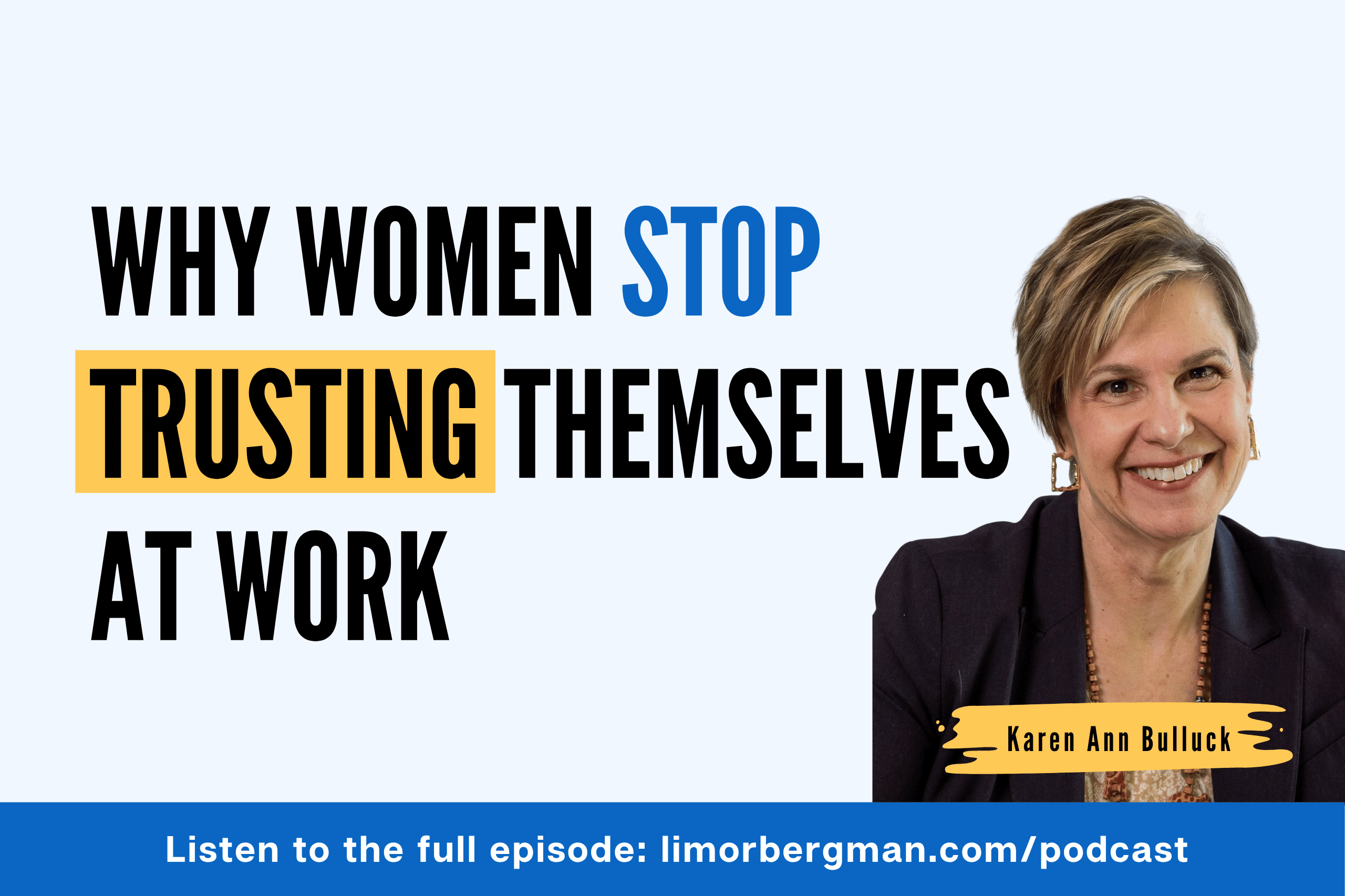
This week on the From a Woman to a Leader podcast, I sat down with Karen Ann Bulluck, the first woman promoted to executive vice president at AM Best Company, who sat on the board and then walked away from all of it to write novels. Her Ascending Ladders series follows women leaders through the ethical dilemmas that never make it into a leadership book.
But that’s not what we talked about. We talked about the thing underneath all of it, which is what happens to you, over years, when the person you are at work is not quite the person you are.
Below are the insights from our conversation, with my own experience and concrete steps you can take this week.
1. Trusting Yourself as a Leader Was Never a Promise That You’d Never Be Wrong
This is the reframe I most want you to take from this episode. When I asked Karen how a woman starts building trust with herself, she went straight to the belief that blocks it, which is the idea that a mistake is proof of unreliability.
“that’s another thing that I think is a big problem with people not trusting themselves is they think if they make a mistake or they make the wrong decision that therefore they are not trustworthy”
And then she gave the line I have not stopped thinking about since we recorded.
“trusting ourselves ultimately is not about trusting that we’re never going to make a mistake. It’s trusting that we’re resilient enough to be able to fix it or to be able to resolve it or to be able to move on after we have made a mistake.”
Karen on why trusting yourself is about resilience, not perfection
Here’s what I see again and again in my coaching. A woman brings me one decision from three years ago that went badly, and she has built an entire theory of herself on top of it. She is not asking whether the decision was reasonable given what she knew at the time. She is treating the outcome as a verdict on her judgment.
But being right and being resilient are two completely different capacities. One of them depends on information you do not have yet. The other is available to you today, mistakes and all.
How to apply this: Take the one decision you still hold against yourself and write down what you actually did after it went wrong. Who you told, what you changed, how long recovery took. You are looking for evidence of resilience, which is the thing you can actually trust. It is almost always there, and you have almost certainly never counted it.
2. The Gap Between Who You Are and Who You Perform As Is Costing You More Than You Think
Karen calls this the overarching theme of her whole series, and she does not soften it.
“that disconnect between who you are inside, what your real values are, what your real personality is, what your emotions are, and who you are being or being forced to be on the outside, and that disconnect creates that internal conflict that really just kills us all.”
Karen on the disconnect between who you are inside and who you perform as at work
I had a client last week who is stepping into her first leadership role and had decided she needed to become someone else to do it. Stricter. More serious. Less herself. I told her absolutely not, and here is why that matters beyond how exhausting it is.
Karen made the connection I had not put into words before. The performance does not only cost you. It costs your credibility.
“when you’re so disconnected with yourself, you don’t trust yourself and other people aren’t going to trust you because it becomes apparent in different ways that you’re playing a role.”
People can feel it. Not consciously, and they usually cannot name it, but they register that something is not lining up. And they hold back accordingly.
To be clear, this is not an argument against boundaries. Karen was careful about that, and so am I. You will adjust your behavior in different rooms and different roles, and that is just competence.
“that’s completely different than tying yourself up in knots by being somebody different.”
How to apply this: Name the specific behavior you perform at work that costs you the most energy. Not a vague feeling, one behavior. The flat voice in meetings, the laugh you do not mean, the enthusiasm you fake. Then drop it in one low-stakes meeting this week and watch what actually happens. Almost nothing, usually. That’s the point.
3. When Everyone in the Room Says Fire Him, You’re Still Allowed to Wait
This is the story that opens the episode, and it is the best illustration of trusting yourself I have heard in a while.
Karen had an employee transferred into her department. His previous boss, who Karen was not getting along with, had filled his head with stories about her. He walked into Karen’s office, said he could not do this, walked out of the building, and did not come back for three days.
“And so I was getting a lot of pressure from HR, from my boss to say, look, you gotta fire the guy. can’t, you can’t just have people walking out in the building like this and not coming back for days. Like you’ve got to just fire him. You have every right to. And I’m like, yes, I have every right to, but let’s just give this a little bit time.”
HR said fire him. Karen waited three days.
He came back. They had a real conversation. He stayed, made a serious contribution for years, and eventually came to her retirement party.
“if I had listened to conventional wisdom there, we would have fired him and we would have lost somebody who really made a good contribution”
Notice what she did not do. She did not win the argument with HR, and she did not prove she was right in advance. She bought time, in a way that cost the organization almost nothing, and let the situation reveal itself. That is what trusting your own read looks like in practice. It is rarely dramatic.
Sound familiar? Most of the women I work with can point to a moment where they had a strong instinct, everyone senior disagreed, and they folded. Not because they were persuaded, but because holding a minority position felt too exposed.
How to apply this: The next time your read differs from the room, do not argue for your conclusion. Ask for time instead. “Can we give this a week and see?” is a much easier thing to win than “I think you’re all wrong,” and it gets you the same outcome.
4. You Can Experiment Without Blowing Up Your Career
When a woman is torn between staying somewhere difficult and leaving, the advice she gets is almost always framed as one enormous binary. Karen’s answer was more useful than that.
“I think there are things, smaller steps you can take along the way to test the waters and see how do I do things differently. And experiment in the environment.”
She was honest that some environments genuinely have to be left. But she thinks that is a much smaller category than we treat it as.
This is where women get stuck. The decision gets framed as stay and stay silent, or leave. And because leaving is enormous, and silence is corrosive, they sit in the space between for years.
There is a third option, and it is smaller than either. Run an experiment. Do one thing differently in a way that is reversible and see what the organization does with it. You are not testing whether you are right. You are gathering information about how much room you actually have, which is usually more than you assumed and occasionally much less. Either answer is useful.
How to apply this: Pick one thing you have been assuming you cannot do here. Say the unpopular thing in a small meeting, push back on one deadline, run a project the way you actually think it should be run. Do it once. Then judge the environment on what happened, not on what you feared would happen.
5. Naming What You Can’t Share Beats Pretending There’s Nothing There
Something I struggled with as I moved up was that I am a naturally open and transparent person, and leadership kept handing me things I was not allowed to say. It felt awful, and I could tell people sensed the gap.
So I started saying it out loud. Not the thing itself, just the fact of it. There is something going on, and I’m sorry, I can’t share it with you right now. At least then there was no elephant in the room.
Karen did exactly the same thing.
“I think to your point naming it and saying, look, yeah, there’s something going on here, but I really can’t talk about it.”
Here is why this works. People are extremely good at detecting that information is being withheld and extremely bad at guessing what it is. When you do not name the gap, they fill it, and what they invent is almost always worse and more personal than the truth.
Naming it costs you nothing confidential and buys back all the trust the silence was draining.
How to apply this: The next time you are sitting on something you cannot share, say the sentence out loud. “There’s something I can’t talk about yet, and I will tell you when I can.” Then actually come back to it when you can, because that second half is what makes the first half mean anything.
6. Remote Work Killed the Drive-By, So the Human Part Has to Be on Purpose
Karen spent most of her career able to walk into someone’s office and ask what was going on. That casual, unscheduled contact was doing enormous invisible work, and most of us lost it without ever replacing it.
“with the remote work, you’ve got to be intentional about doing that. You’ve got to be intentional about setting either setting up time or just, you know, pinging someone and say, hey, do you have 10 minutes? And just do a check-in. It doesn’t have to be formal. And I think it’s better if it’s not formal. And I think that’s part of the problem with remote work. Almost everything ends up being formal.”
I had an engineer on my team who did not want one on ones. A lot of engineers do not, and he was at the far end of it. So I told him he had to show up for five minutes a week, just so I could check that everything was fine. That was the whole meeting.
He thought it was ridiculous. It also worked.
And this connects back to trust, because Karen was clear that sharing something real about yourself is not a distraction from the work. It is the mechanism.
“But sometimes you need to say, hey, I have something going on in my personal life. You share as much as is appropriate. And that makes you real.”
I know this puts me at odds with some coaching orthodoxy about how much a coach should disclose, and I said so on the episode in slightly stronger language. I stand by it. I tell my clients I am married, I have four children, I live here, my son is in the military. Not because it is about me, but because nobody opens up to a blank wall.
How to apply this: Block two fifteen minute unstructured check-ins this week with people you only ever meet about deliverables. No agenda. Open by sharing one real thing about your own week first, because they will not go first and it is unfair to expect them to.
About Karen Ann Bulluck
Karen Ann Bulluck spent her corporate career at AM Best Company, where she became the first woman promoted to executive vice president and served on the board. Her path there was unusually cross-disciplinary, which is part of why she writes so well about the ethical grey zones most leadership advice skips over.
She left to write fiction about women’s leadership, which she started only after trying to write a conventional leadership book and finding it unbearable. In her words, “I started writing that and it was awful. I mean, I was bored with it. And I was like, okay, if I’m bored with this, everybody else is going to be bored with this.” The idea for the first novel arrived on a walk, as a scene of a woman at her first board meeting deciding whether to say what she actually thought.
She is now the founder of DARING TO TRANSCEND and the author of the Ascending Ladders series: Discovering Power, Pursuing Truth, and Embracing Trust. She is also a contributing author to three international bestselling anthologies.
Since recording this episode: Embracing Trust, the third book, is out in ebook, paperback, and hardcover. The audiobook for the first two is available, with the third following shortly.
Connect with Karen:
- LinkedIn: linkedin.com/in/karenannbulluck
- Website: daringtotranscend.com
- Free resources and her bi-weekly blog: daringtotranscend.com/resources
- Books: available on Amazon, Barnes & Noble, and most other booksellers
What I Took From This Conversation
The thing I keep coming back to is how much of what we call self-doubt is actually a category error.
We treat trusting ourselves as a scoreboard. Enough right calls and we earn it. But a scoreboard means every wrong call takes it away again, which is why so many capable women never feel like they get there no matter how much they achieve. There is always another decision that could go badly.
Karen moved it somewhere much steadier. Trust yourself to handle it, not to predict it. That version does not evaporate the next time something goes wrong, because being wrong was always part of the deal.
And it connects to the other half of the conversation in a way I did not expect going in. You cannot trust a version of yourself you are performing. The disconnect Karen describes is not just exhausting, it actively blocks the thing underneath it. Which means the work is not becoming more certain. It is becoming more yourself, and then finding out you can live with the results.
You Don’t Have to Figure This Out Alone
If you are reading this and recognizing yourself, the constant second-guessing, the version of you that shows up to work and does not quite feel like you, the one decision from years ago that you are still using as evidence, I want you to know that is one of the most common things I see and one of the most fixable.
It is also very hard to see from the inside. That is not a personal failing. You cannot read the label from inside the jar, which is most of what a coach is actually for.
Book a promotion strategy call, and we’ll figure out your next move together.
Where to Start This Week
Find your evidence of resilience. Take the decision you still hold against yourself and write down what you did after it went wrong. That record is the thing you can actually trust, and you have never counted it.
Drop one performance. Identify the single behavior you fake at work that costs you the most energy, and skip it in one low-stakes meeting. Watch how little happens.
Ask for time instead of agreement. The next time your instinct differs from the room, do not argue your conclusion. Ask for a week. It is a far easier thing to win, and it gets you the same result.
Frequently Asked Questions
What does it mean to trust yourself as a leader?
Trusting yourself as a leader means trusting that you can handle the consequences of a decision, not that you will always make the right one. As Karen Ann Bulluck puts it, it is trusting that you are resilient enough to fix it, resolve it, or move on after a mistake. This is a meaningful distinction because being right depends on information you do not have yet, while resilience is something you can build and evidence today.
Why do so many women in leadership doubt their own judgment?
Many women doubt their judgment because they treat a single bad outcome as proof that their whole decision-making process is unreliable. The belief underneath is that a trustworthy person does not make mistakes, so any mistake disqualifies them. Because this standard is impossible, no amount of achievement resolves the doubt, which is why highly accomplished women often still feel like they have not earned self-trust.
Is it unprofessional to show emotion at work?
No, and suppressing emotion at work causes more damage than expressing it. Karen Ann Bulluck describes how the corporate world trains people to stuff emotions down and be tough, and how those emotions then fester rather than disappear. The practical middle ground is not performing emotions or hiding them, but acknowledging that something is going on, including your own state, so people are not left guessing.
How do you set boundaries as a manager without becoming a different person?
You adjust your behavior for different roles and relationships, but you do not construct a different personality. Karen Ann Bulluck draws the line clearly: tweaking how you show up in different positions is normal and necessary, while tying yourself in knots to be somebody different is what causes real damage. A useful test is whether the adjustment costs you energy to maintain, because sustained performance is the version that erodes both your wellbeing and other people’s trust in you.
Should I leave my job or stay and try to change things?
Before choosing between those two options, run a small reversible experiment to find out how much room you actually have. Karen Ann Bulluck argues that some environments genuinely must be left, but that far more of them allow experimentation than people assume. Doing one thing differently in a low-stakes way gives you real information about the organization, which is more useful than deciding based on what you fear would happen.
How do you build trust with a remote team?
You build trust on a remote team by making informal contact deliberate, because the casual drive-by conversation that used to do that work no longer happens on its own. Karen Ann Bulluck recommends short unstructured check-ins, like pinging someone to ask if they have ten minutes, rather than adding more formal meetings. The problem with remote work is that almost everything becomes formal, and formality is exactly what prevents the kind of conversation that builds trust.
How much should a leader share about their personal life?
Share as much as is appropriate to the context, because sharing something real is what makes you legible as a person rather than a role. Karen Ann Bulluck notes that when something significant is happening in your life you will not be quite the same at work, and naming that helps people understand rather than speculate. The goal is not disclosure for its own sake but giving people enough of you that they can trust and connect with you.
Who is Karen Ann Bulluck?
Karen Ann Bulluck is an author, speaker, and the founder of DARING TO TRANSCEND. She was the first woman promoted to executive vice president at AM Best Company, where she also served on the board, before leaving corporate life to write fiction about women’s leadership. She is the author of the Ascending Ladders series, which includes Discovering Power, Pursuing Truth, and Embracing Trust, and a contributing author to three international bestselling anthologies.
Listen to the full episode with Karen
🎧 Listen to my conversation with Karen: Trusting Yourself as a Leader Doesn’t Mean Never Making a Mistake
📺 Watch on YouTube: https://youtu.be/Z70U0O3jqGI
📝 Read the deeper, more personal version on Substack
Full Transcript
Full transcript of my conversation with Karen Ann Bulluck on the From a Woman to a Leader podcast. Lightly edited for readability — filler words and false starts removed, wording otherwise unchanged.
Why I wrote a leadership book as fiction
Limor Bergman Gross (01:48): For those who don’t know, Karen wrote three books, which I actually find very interesting — the idea of writing business books, but they’re fiction. So tell us a little bit about that.
Karen Ann Bulluck (02:05): Well, it’s really interesting how that came about, because I was in business. I was in corporate for many years. When I left corporate, I was an executive vice president and on the board and all of that. And I left because I really wanted to help women in the workplace, particularly women leaders. I became a coach, and I was doing some coaching, and I wanted to write a book about women’s leadership — maybe how to do it a little bit differently, other than just copying the guys.
And so I started writing that and it was awful. I mean, I was bored with it. And I was like, okay, if I’m bored with this, everybody else is going to be bored with this. So I just kind of put it on the back burner and said, all right, I have to think about this more, because I don’t know how I want to write this.
And then one day I was out for a walk and I sort of envisioned, or heard, or saw this scene in my head of this woman at her first board meeting, not agreeing with the direction that everybody on the board was going, but not sure — okay, do I disrupt this? Do I say what I think? Do I just go along? This is my first board meeting, what do I do? And that was really interesting to me.
I went home, I wrote it down, and that eventually became the prologue of the first book in the series, Discovering Power. And I thought, in fiction I can really talk about the emotions behind what people are thinking and feeling, give different perspectives, which I really love, because we’re not one-dimensional people. We have different ideas and there’s no one right way to do things. The other thing is, I thought I could explore some creative solutions that would inspire people to think about things differently, rather than just say, this is how you do it.
Finding your voice in a room that doesn’t expect it
Limor Bergman Gross (04:30): There is no one way to do things. And the first book is about finding your voice and drawing boundaries. I think this is especially difficult for women, especially in boardrooms or in very male-dominant rooms — how to find your voice, how to be different, how to be you. So share a little bit from your book and your character.
Karen Ann Bulluck (05:01): Cheryl is the main character, and I think she has a lot of the concerns about it that women do. Am I going to be seen as weak? Am I going to be seen as overly emotional? And honestly, in the first book, her husband labels her as over-emotional and tells her she needs to knock this stuff off.
I think that’s a fear that a lot of women have. I’m going to be seen as weak and emotional, and be labeled and be dismissed, because I’m not focused only on the bottom line, or I’m not going along with how everybody else thinks things should be done. Cheryl in the first book really struggles with that. She has to question herself, and she doesn’t always get support from her husband or from other people in her life, because she wants to say something different.
And then she asks herself: should I leave? Is this not for me? I have found in my career as a coach, a lot of women have chosen to leave corporate versus trying to stand up for things, which is hard. So I’m not blaming them for that, but I think it’s a big loss to corporate.
Should you stay or leave? Run a small experiment first
Limor Bergman Gross (06:26): What’s your take on that, if a woman struggles with those thoughts? Should I leave? Should I stay? Should I stand up for myself? Should I fight this battle or not?
Karen Ann Bulluck (06:39): Those are all individual choices, but for me personally, I always feel like if I don’t at least try to do something — what do you have to lose? If you’re thinking about leaving anyway and you’re trying something, okay, you could get fired and that would create problems. I guess that’s always a possibility of an outcome. But it’s a pretty extreme one.
I think there are smaller steps you can take along the way to test the waters and see how do I do things differently, and experiment in the environment. Not all environments — there are some environments you have to leave, I’m not disagreeing with that. But I think there are a lot more environments where you can experiment and explore and make small changes. You don’t have to do everything at once.
The employee who walked out for three days
Limor Bergman Gross (07:33): Any examples of what an experiment can look like?
Karen Ann Bulluck (07:38): There’s one that was really interesting, because it was based on an experience that I had in corporate. I had an employee who was moved from one department into my department, and he was going to report to me. His boss and I honestly were not getting along at the time, for a lot of different reasons. And she basically told him all these crazy stories about me.
So when he found out that he was going to be working for me, he completely flipped out. Like, my God, I can’t do this. And he came into my office and he says, I can’t do this, I can’t do this, I’m leaving. And he got up and he left. He literally walked out of the building and he did not come back for three days.
And so I was getting a lot of pressure from HR, from my boss, to say: look, you’ve got to fire the guy. You can’t just have people walking out of the building like this and not coming back for days. You’ve got to just fire him. You have every right to. And I’m like, yes, I have every right to, but let’s just give this a little bit of time. We’ll just mark him out on vacation and let’s see what comes out.
So after three days, he came back. We had a really good conversation. He decided to stay. Honestly, we became very good friends. Not only did we have a good working relationship — he actually even came to my retirement party, which was pretty exciting. It ended up being a good situation, and everybody afterwards said, okay, well, you were right.
But if I had listened to conventional wisdom there, we would have fired him and we would have lost somebody who really made a good contribution for the next five, seven years. I mean, he stayed for a while after that.
Cheryl faces a similar situation in the book. I changed the situation, obviously. And people have said to me flat out, well, that would never work in an organization. I’m like, well, it did work in an organization.
If an organization doesn’t allow you the leeway as a manager or as a leader to do some of those things, then maybe you do ask the question — it’s time to leave and find someplace else. But for me, that was like a little stake in the ground for Cheryl. It’s also a little stake in the ground to say, let’s try to change things so that we’re taking people’s emotions a little bit more into consideration here. This person was really upset, and the person that Cheryl’s dealing with is really upset, for good reasons. So let’s see if we can work with them.
Why stuffing emotions down doesn’t make them go away
Limor Bergman Gross (10:46): I think there is a hesitation — people are afraid to face emotions in general.
Karen Ann Bulluck (10:57): Yeah, including our own.
Limor Bergman Gross (11:04): And we have to address them. If someone is upset, or even if they don’t say anything but we just see it on their face — something is going on, and if we don’t address it, it’s just going to get worse.
Karen Ann Bulluck (11:19): It does. It festers. Even with our own emotions, when we just stuff them down and ignore them — which is basically what we’re taught to do in the corporate world, just be tough and move on — you stuff them down and it does get worse.
It creates a disconnect. And that’s actually one of the bigger themes of the whole series. That disconnect between who you are inside, what your real values are, what your real personality is, what your emotions are, and who you are being, or being forced to be, on the outside. That disconnect creates that internal conflict that really just kills us all.
You can’t lead as a character you’re playing
Limor Bergman Gross (12:12): You raised something I want to touch on, Karen. I just had a client last week, and we had a discussion about exactly this. She’s stepping into leadership and she has this perception that she needs to be someone else when she’s a leader. I told her, absolutely not.
I really believe that we need to bring ourselves to anything that we do. If there’s a disconnect, like you mentioned — if we are playing a role, trying to play a character — as a manager I need to be strict, I need to be serious, I need to set boundaries, and we don’t let ourselves be us. First of all, it’s really difficult and frustrating and tolling on us. And then it’s going to blow up in our face. It’s not going to work.
Karen Ann Bulluck (13:17): You’re so right. I was talking about this with someone else the other day, in the context of the third book of the series, which talks about trust. That’s again part of the overarching theme: when you’re so disconnected with yourself, you don’t trust yourself, and other people aren’t going to trust you, because it becomes apparent in different ways that you’re playing a role.
Now, are there certain boundaries around how we play roles, and when we’re in different positions do we need to tweak our behavior a little bit and maybe have different sets of boundaries? Yes, there’s no doubt about that. But that’s completely different than tying yourself up in knots by being somebody different.
Naming what you can’t share
Limor Bergman Gross (14:10): Definitely. It’s a balancing game you need to play, between being yourself and still sometimes setting boundaries. As a leader — because I’m a very open and transparent person — it was very difficult for me as I grew as a leader that sometimes I had to mask things. I couldn’t share things with people. It was very difficult.
And you know what I did? I used to tell people: there are things I just cannot share. I’d just say it out loud, so at least there wasn’t an elephant in the room.
Karen Ann Bulluck (14:49): Yeah, and I used to do the same thing, because it is hard when there are things that you just can’t share. And there are things you really just can’t share. So to your point — naming it and saying, look, yeah, there’s something going on here, but I really can’t talk about it.
Boundaries without becoming a different person
Limor Bergman Gross (15:11): How do you set the fine line, the boundaries, when you’re in leadership? Okay, I’m not your friend, I cannot be lovey-dovey and the coolest person with everyone. But still, I want to be me. I want to have fun, I want to have friendships. I don’t want everything to be transactional and so serious. How did you balance that?
Karen Ann Bulluck (15:37): I had a very hard time balancing that. That was something I struggled with, because I kind of went down the road of, I have to be serious. What I found, though, is that different people respond to that differently. And I think ultimately that’s what I ended up learning over time. There were some people that I could be more friendly with and more open with and have more of a friendship with. And then there were other people that I needed to keep things more formal with.
It depended a lot on the individual and what they needed. I also learned there were some people I had to protect myself with, because they were people that were going to take advantage of things. So it was a combination of trying to meet people where they were and meet what they needed from a leader and from a boss. But it was also: here’s somebody where, if we cross boundaries, they’re not going to be able to honor the boundaries and they’re going to take advantage of things. It’s a balancing act, and to me it really comes down to working one-on-one with the people you’re working with.
Limor Bergman Gross (17:06): And getting to know them.
Karen Ann Bulluck (17:08): Yeah. And what they need.
Remote work killed the drive-by conversation
Limor Bergman Gross (17:09): I think this is one of the challenging things, especially when we get into remote and hybrid — we don’t know the people well enough. It used to be so simple. You go to the office, you hang out with people. I’m thinking even about my parents’ generation. They worked with the same people their entire career, so they knew those people. Nowadays people switch jobs. You have to make an effort to get to know people.
Karen Ann Bulluck (17:43): I agree with you. It’s a lot more difficult today, with the remote work, with the pressures of getting things done, with people changing jobs. I was fortunate. I worked with the same people for a lot of my career and I knew them well. But I also had the opportunity for most of my career to go in and sit down in their office and say, hey, what’s going on? Just that drive-by visit.
And with the remote work, you’ve got to be intentional about doing that. You’ve got to be intentional about either setting up time, or just pinging someone and saying, hey, do you have 10 minutes? And just do a check-in. It doesn’t have to be formal, and I think it’s better if it’s not formal. That’s part of the problem with remote work. Almost everything ends up being formal.
Limor Bergman Gross (18:40): Yeah, because it’s a meeting on your calendar. It’s not that you walk in the corridor, you meet someone in the coffee break and you just chat. You have to schedule something.
I had a fight with one of the engineers who worked with me. He didn’t want to do one-on-ones. A lot of times engineers don’t like meetings and formalities, and he was the extreme. He just didn’t want to meet with me. And I told him, you know what, you have to show up for at least five minutes. I’m just going to check what’s going on and that everything is cool. That’s it. I was forcing him to check in with me for five minutes every week. It was hilarious.
Karen Ann Bulluck (19:31): There are people that don’t like that, and then there are people that crave that. There are people that want that half hour on your calendar every week.
Limor Bergman Gross (19:44): There are people that want more than half an hour, and you have to protect your time.
Karen Ann Bulluck (19:50): That’s true. It was always interesting to me who wanted meetings, who didn’t want meetings, whether they were one-on-one or group meetings. Those dynamics were always really interesting to me.
Limor Bergman Gross (20:09): I would echo what you said — you have to be intentional when you work with people remotely. Spend the time with them, try to know them, understand their motivations, understand what they’re passionate about, what they like, what they don’t like, what their aspirations are, a little bit about their life, as much as they’re willing to share. Just to get to know them.
Karen Ann Bulluck (20:35): And I think that’s the hardest thing about remote — really steering the conversation to what their life is like. In the office it’s pretty easy to say, hey, what are you doing this weekend? But when you’re talking to somebody remotely, there’s a formality around it that doesn’t often lend itself to that kind of conversation.
Why sharing something real is the mechanism, not a distraction
Limor Bergman Gross (21:01): My strategy is that I start sharing. Even — and I would say something that maybe some coaches will disagree with me on — I am a coach, and according to the ICF, or at least the coaches I’ve talked to, you have to be asking questions and not sharing too much about yourself. And I think, excuse my language, this is BS.
Karen Ann Bulluck (21:25): I agree 100 percent, which is why I never got my ICF certification.
Limor Bergman Gross (21:36): So you know what I do? I share. I live here, I’m married, I have four children. We talk a little bit about family. Today I had a coaching call with a client and we talked about the war, and how he lives with his in-laws, and how he’s handling the situation. And I share about my son in the military. You have to have those kinds of interactions, because that’s how you build trust.
Karen Ann Bulluck (22:08): It is. And you do have to share. I think there are two big reasons. One is that we share stories, and that’s how we connect with one another — which is another reason I wrote my books in the form of stories.
The other thing is that we need to know what’s going on in other people’s lives. People need to know what’s going on in your life as a leader, because there are people who are very good at keeping things compartmentalized, but for most of us, one spills over into the other. When there’s something big going on in our personal lives, we may not exactly be the same in the office. And that’s okay.
But sometimes you need to say, hey, I have something going on in my personal life. You share as much as is appropriate. And that makes you real. It makes people understand — Karen might be a little cranky this week because of this thing going on. It creates that connection, and it creates an openness to be able to navigate those emotions we were talking about earlier.
Trusting yourself was never a promise you’d never be wrong
Limor Bergman Gross (23:22): I want to touch on trusting yourself, because this is one of the things I see again and again with my clients, with my female clients. They don’t trust themselves. They don’t trust their instincts. They question themselves. That’s where I usually come in and help them. Share a little bit, maybe from your book or from your experience — how can a woman start building trust with herself?
Karen Ann Bulluck (24:02): It is a hard question, because I saw it over and over in my coaching clients as well, and I know I went through this myself.
Part of it goes back to what we were talking about earlier about emotions, where we’re taught not to trust our emotions — that we’re rational human beings, and if it’s not rational, it’s not valid. Well, in today’s world we’re learning that we are way more than rational people, and that our emotions play a big part in who we are as human beings, in our creativity, in our problem-solving abilities, in all of those things. I mean, if we just want to be rational, then we’re all going to be replaced by AI, because AI supposedly is purely rational.
In the story of Embracing Trust, which is the third book in the series and the most recent one, there are three women who are all faced with situations where they have to decide: do I trust myself to make these decisions? In one case, one of the women makes a decision to change jobs. So she trusts herself to say, okay, I’m going to make this decision. And then she finds out — now who do I trust in this environment? And can I trust this new environment? And now, have I made a bad decision? All of a sudden she’s saying, did I make the wrong decision in changing jobs?
And that’s another thing that I think is a big problem with people not trusting themselves: they think that if they make a mistake, or they make the wrong decision, that therefore they are not trustworthy. We all make mistakes. One of the biggest steps, and one of the things that two of the women in Embracing Trust have to deal with, is: I’ve made a mistake, what do I do about it?
Trusting ourselves ultimately is not about trusting that we’re never going to make a mistake. It’s trusting that we’re resilient enough to be able to fix it, or to be able to resolve it, or to be able to move on after we have made a mistake. I think one of the things that people, and women in particular, think is: if I trust myself, then that means I can never make a mistake.
Limor Bergman Gross (26:53): There’s no such thing as never making a mistake.
Karen Ann Bulluck (26:56): Of course there’s not.
Limor Bergman Gross (27:02): I think it’s a practice. I always tell the women I coach, you have to practice it. Practice just going with your instincts, trusting — as you said, the emotions, what you feel should be done. A lot of times we feel it in our gut. This is what I should be doing. So trust yourself to know what’s best for you.
Where to find Karen
Limor Bergman Gross (27:32): Fantastic. So tell us about the books — where can our listeners find them, and how can they connect with you?
Karen Ann Bulluck (27:41): The easiest way to connect with me is on LinkedIn, or you can connect with me through my website, which is daringtotranscend.com. That’s sort of my brand, Daring to Transcend. The books are available on Amazon, and I believe they’re available in most other places where you can buy books as well — Barnes & Noble and other places.
Limor Bergman Gross (28:03): Wonderful. Well, thank you so much, Karen. It’s been a pleasure having you here today.
Karen Ann Bulluck (28:08): It’s been a delightful conversation, as always. Thank you so much for having me. I’ve really enjoyed it.
Displaying Transcript-Karen-Ann-Bulluck-COPYPASTE.txt.