
You read the job description. Ten requirements. You can do eight of them well, and you can probably learn the other two inside a month.
And then you closed the tab.
You have done this before. You told yourself you would put your name forward once you had a bit more experience. You told yourself you would post the thing once you had edited it one more time. You signed up for another course instead of launching the offer. And the quiet story underneath all of it is the same one: I am not qualified enough yet, and everyone will be able to tell. That is imposter syndrome at work, and it does not feel like fear. It feels like being responsible.
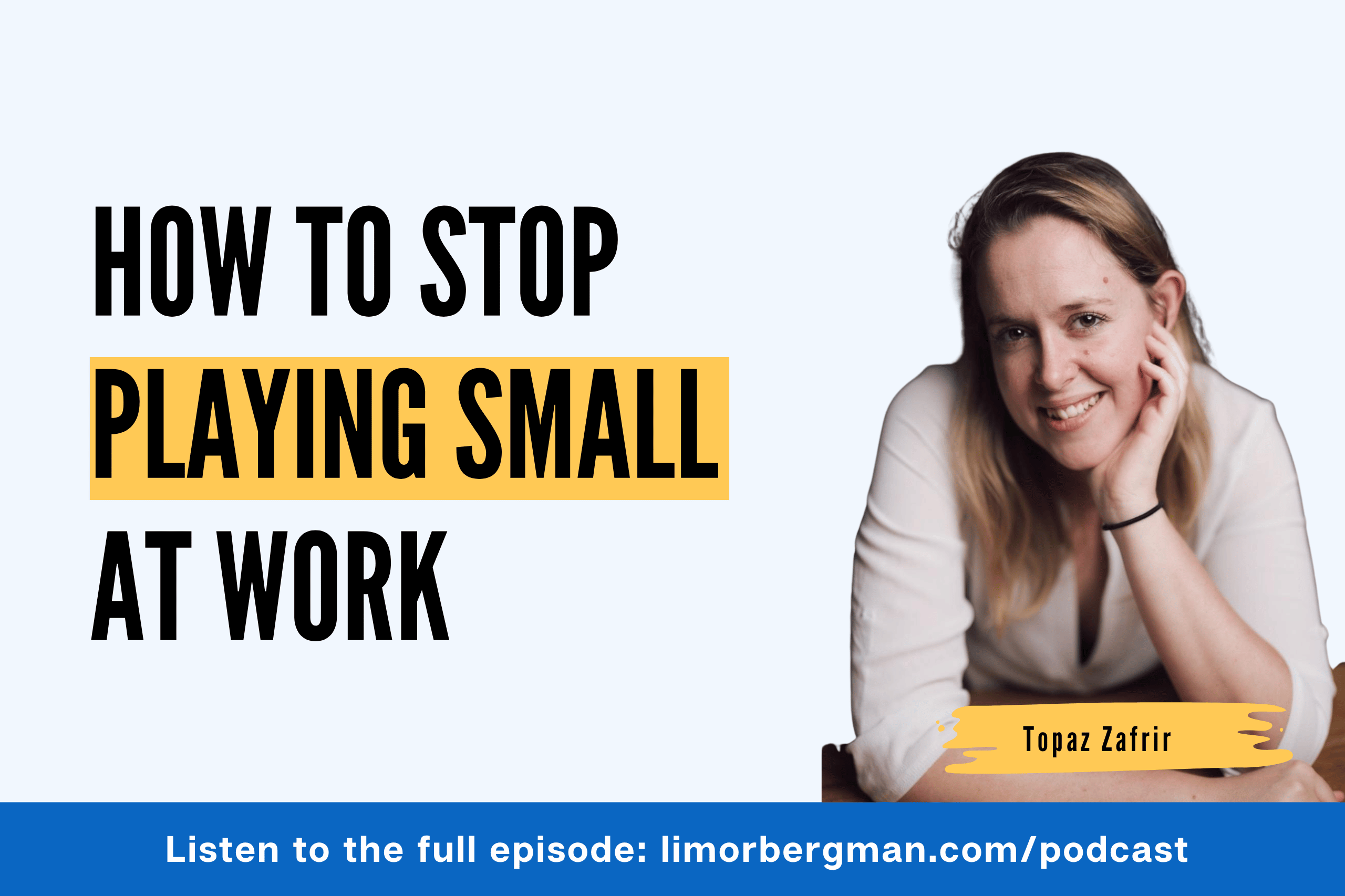
This week on the From a Woman to a Leader podcast, I sat down with Topaz Zafrir, a life and business coach in British Columbia with a master’s in organizational consulting and more than 14 years of experience facilitating groups. She works with self-employed women on one very specific problem: the gap between knowing what to do and actually doing it.
But that is not really what we talked about. We talked about the thing most advice on confidence skips, which is that the women stuck in this pattern are not underqualified and they are not lacking information. They are measuring themselves against a standard nobody else in the room agreed to.
Below are the insights from our conversation, with my own experience and concrete steps you can take this week.
1. You Are Being Measured Against a Bar Nobody Else in the Room Is Using
Early in our conversation Topaz shared a number that reframes this whole problem. It is not about ability. It is about the threshold each of us sets before we will claim what we know.
“There was a research that showed that men needs to know only 30% to talk about something as experts while women need to know 70% before they would consider themselves as expert in a field.”
The 30% / 70% research
She followed it with what that gap actually produces:
“And that shows you already that there’s a huge gap between how comfortable I am to talk and to sound professional in something that I do.”
Here is what I see again and again in my coaching. The woman who counts the two requirements she cannot meet and closes the tab is not being realistic. She is applying a private rule that the person who got the job never applied to himself. And because the rule feels like integrity, like not overselling, like being honest about her limits, it is almost impossible to argue her out of it. Sound familiar?
How to apply this: The next time you disqualify yourself from something, write down the actual percentage of it you can already do. Then ask yourself one question: would I tell a friend with these exact numbers not to try? If the answer is no, you have your evidence.
2. Playing Small Does Not Look Like Failing. It Looks Like Preparing.
This is the part of the conversation I think will land hardest, because playing small is almost invisible from the outside. Topaz has been watching it for years in her practice, and she was very direct about what she kept finding.
“I got so many brilliant, talented, smart women that are just hiding. In many various ways, they’re hiding.”
When I asked her what that actually looks like on a normal working day, she got specific, and this is the version most women will recognize:
“If it’s a lecture, if it’s a post, if it’s, I don’t know, in a meeting, I’m going over my notes again and again and again and refining and refining and refining and nothing is good enough. Like it’s a pursuit that never ends.”
She also named the version that costs money outright:
“Playing small could be even like leaving money on the table of not calling back people that were interested in working with you because you are afraid that you would bug them.”
This is where women get stuck, and it is worth sitting with why. Nobody is going to interrupt you and say “stop preparing.” Refining looks like diligence. Studying looks like ambition. Not following up looks like being considerate. Every one of these behaviors is rewarded socially right up until the moment you notice that someone less prepared has the role, the client, or the platform you wanted.
How to apply this: Name your own strategy this week. Are you a refiner, a credential collector, or someone who does not follow up? Pick the one that is most true, then do the opposite once. Send the draft unedited. Skip the course. Call the person back.
3. Imposter Syndrome at Work Is Not Fixed by One More Certification
If the problem were knowledge, more knowledge would solve it. Topaz made the case that it never does, because the bar moves with you.
“There’s always more preparation to do, more research, more schooling, more whatever. This is endless. You would always be better in a few years than you are right now. This is a fact. But when are you stop hiding?”
And then the question that I have not been able to stop thinking about since we recorded:
“When do you stop doing another diploma, starting another training, going back to the sketching table?”
I have watched women in tech leadership spend two years and real money on certifications for a promotion that was never going to be decided on credentials. The committee was never counting her courses. It was asking whether anyone had seen her lead. More preparation is the most respectable way to avoid being visible, which is exactly why it is so hard to give up.
How to apply this: Look at the next piece of learning you have planned and ask honestly what it is for. If you cannot name a specific thing you will do with it within 60 days, it is probably protection rather than preparation. Put the money toward being seen instead.
4. Stop Trying to Step Out of Your Comfort Zone. Expand It Instead.
This was the reframe that made me stop and write it down, because it quietly corrects advice almost all of us have been given.
“I’m usually actually not saying step out of your comfort zone, but expand your comfort zone. Because if you step out, this is too scary.”
Expand your comfort zone, do not step out of it
She explained why the distinction matters so much in practice:
“Because you don’t want to step away from where you are completely. Then you feel like helpless. You just want to do something small steps. Small steps are our best friends.”
Think about how much of the standard advice assumes a leap. Quit the job. Do the scary thing. Feel the fear and do it anyway. For a lot of capable, over-responsible women, that framing does not produce courage, it produces paralysis, because the leap is genuinely too big and some part of her knows it. Expanding is different. Expanding means the ground under you stays where it is and the edge simply moves out a little further each time.
How to apply this: Take the thing you have been avoiding and find the version of it that is one step past comfortable rather than ten. If a keynote is terrifying, ask a question in the next all-hands. If a launch feels impossible, tell five people what you are building.
5. Answer the Inner Critic With Evidence, Not With Argument
Most of us try to talk ourselves out of self-doubt, which mostly means arguing with a voice that has a limitless supply of counterpoints. Topaz suggests something different, and it starts with understanding what the critic is actually for.
“Our inner critic is there to protect us.”
Because its job is protection, it produces a very detailed list of everything that could go wrong. Her move is to deliberately build the other list:
“Actually sit and write a list for all the reason that you actually can and will succeed.”
And her reason for it:
“What we feed, it what grows.”
Here is what I would add from the coaching seat. Do this in writing, not in your head. In your head, the positive list evaporates the moment the critic speaks again, because you have no record of it. On paper it becomes evidence you can return to on the day you need it, and you will need it on a day when you feel least able to generate it from scratch.
How to apply this: Open a note on your phone titled “why I can.” Every time you get proof you are capable, a piece of feedback, a problem you solved, a thing you shipped, add one line. Read it before the meeting or the pitch, not after.
6. The Reason You Are the Right Person Is Rarely the Obvious One
I shared something on the episode that I had not really examined until Topaz named what I was doing. I was approached to run AI training. I have never positioned myself as an AI expert and I do not publish as one, and I said yes anyway.
What I noticed afterwards was that I did not talk myself into it by pretending to be something I am not. I found the real reason. I may not be the best expert in the world in AI, and I am probably not. But I know how to teach people at different levels, at the pace that is right for them, without making them feel like they are behind. I bring the coaching mindset to it. That is what made me the right person.
Topaz reflected it straight back at me:
“So you know what you did? You did exactly what I advised. You search actively for the positive lens of why am I the right person to be doing that? And you find your reason. You found your reasons because you do have capabilities and you do have experience that is relevant even if it’s not 100%.”
This is the piece most women skip. When you are offered something slightly beyond your obvious expertise, the instinct is to check whether you match the job as written. The better question is what you bring that the person who matches it perfectly does not. Often that is the actual reason you were asked.
How to apply this: The next time you are asked to do something you feel underqualified for, do not audit yourself against the requirements. Write one sentence starting “I am the right person for this because” and finish it with something that is true about how you work, not what you have studied.
7. The Polished Version of You Is the One Nobody Connects With
Topaz told a story from two weeks before we recorded. She had agreed to say a few words about imposter syndrome at a networking event, expecting to speak briefly from her seat. Then they called her name.
“And apparently we were 50, 60 women in the convention. And she called me up to the podium with a microphone, with the presentation, with my face and saying about me, showing me as an expert. And I was not ready for this at all.”
The podium moment Topaz was not ready for
She went up. She stumbled. And then:
“I was not perfect, but I did it. And I got so many positive feedback because I was standing there and I was showing myself and I came vulnerable.”
Her argument is that this was not despite the imperfection:
“When you’re human, you are relatable. I could work with you. I want to work with you. And if you’re perfect, then it’s untouchable.”
And the line that turns the whole episode over:
“The hiding is actually making you unapproachable in so many ways.”
We tend to think of hiding as a safe, neutral position. It is not neutral. The refined, careful, edited version of you is the version people cannot find a handhold on. I bring vulnerability into my conference talks for exactly this reason, and it is the part people write to me about afterwards, never the polished part. This matters more now than it used to, because in a world where anyone can generate something flawless, the flaws are the proof that a person is actually there.
How to apply this: In your next post, talk, or update, include one thing that did not work. Not a humblebrag failure, an actual one. Watch which part people respond to.
About Topaz Zafrir
Topaz Zafrir is a life and business coach with a master’s in organizational consulting and over 14 years of experience facilitating groups. She started her career in consulting before moving from Israel to a small town in British Columbia, and went back to school for coaching when she realized the small business owners she was advising did not need more advice, they needed accountability and someone to believe in them out loud. In her practicum she kept meeting the same person over and over: a brilliant, capable woman who was hiding. That became her work. She now helps self-employed women move past self-doubt and the fear of visibility, combining deep inner work with practical tools.
In her own words: “I help self-employed women press ‘send,’ show up, and talk about their business without freezing, overthinking, or hiding.”
- Website: topazcoachingandconsulting.com
- LinkedIn: Topaz Zafrir
- Instagram: @topaz.coaching.consulting
- Facebook: Topaz Coaching and Consulting
What I Took From This Conversation
The thing I keep returning to is that none of this is a confidence problem, and treating it like one is why so much advice fails. Confidence is not something you can decide to have on a Tuesday. What you can do is change the standard you are holding yourself to, and notice that it was never handed to you by anyone else. You built it, probably for good reasons, and you are allowed to revise it.
The women I coach are not waiting because they are unsure of their abilities. They are waiting because somewhere along the way they learned that being certain was the price of being allowed to speak. Nobody is charging the men in the room that price. You can stop paying it whenever you decide to.
You Don’t Have to Figure This Out Alone
If you are reading this and recognizing yourself, if you have been preparing for something for a long time and quietly wondering when the preparing is supposed to end, I want you to know that you do not have to work this out by yourself. I work with women in tech and leadership on exactly these questions, on being visible without performing, and on going after the role instead of waiting to be handed it.
Book a promotion strategy call, and we’ll figure out your next move together.
Where to Start This Week
Write the other list. Open a note called “why I can” and put one piece of evidence in it today. Add to it every time you get proof.
Expand by one step, not ten. Take the thing you have been avoiding and find the version that is slightly uncomfortable rather than terrifying. Do that version this week.
Say yes at 30%. The next time something lands in your inbox that you are not fully qualified for, answer before you have finished talking yourself out of it, then find your real reason for being the right person.
Frequently Asked Questions
Why do women wait longer than men to call themselves experts?
Research cited in this episode found that men will speak about a topic as experts when they know roughly 30% of it, while women wait until they know about 70%. The gap is not about ability or knowledge, it is about the internal threshold each person sets before they feel entitled to claim what they know. Social conditioning plays a large role: women are often penalized for being seen as overconfident, so a higher private bar starts to feel like basic professionalism rather than self-doubt.
How do I stop feeling like an imposter at work?
Stop trying to argue with the feeling and start collecting evidence against it in writing. Topaz Zafrir’s approach is to deliberately write a list of every reason you actually can succeed, because your inner critic is already generating the opposite list automatically. Keep the list somewhere you will actually reread it, and add to it whenever you get proof you are capable, so it is available on the days you cannot generate that proof from memory.
Will another certification fix my imposter syndrome?
No, because the bar moves with you. As Topaz puts it, there is always more preparation, more research and more schooling available, so the feeling of being ready never arrives through accumulation. If you cannot name something specific you will do with a qualification within about 60 days of finishing it, it is more likely serving as protection from visibility than as genuine preparation.
What does playing small actually look like?
Playing small usually looks like diligence, not failure. Common versions include editing a post or a set of notes repeatedly and never publishing, signing up for another training instead of launching, and not following up with someone who already expressed interest because you do not want to seem like you are bothering them. Because all of these behaviors look responsible from the outside, they rarely get challenged by the people around you.
Is it better to step out of your comfort zone or expand it?
Expand it. Topaz Zafrir deliberately avoids telling clients to step out of their comfort zone, because stepping fully outside it feels too frightening and often produces paralysis rather than action. Expanding means keeping your footing where it is and moving the edge out gradually, which is why she describes small steps as our best friends.
How do I know if I’m the right person for an opportunity I feel underqualified for?
Instead of auditing yourself against the list of requirements, identify what you bring that a perfect match would not. In this episode Limor describes being asked to run AI training without positioning herself as an AI expert, and finding her real reason: she knows how to teach people at their own pace without making them feel behind. That combination, not a credential, is what made her the right fit.
Does being vulnerable at work undermine your credibility?
Generally the opposite. Topaz argues that a perfect, polished presentation makes you untouchable rather than credible, because people cannot see themselves in it and have no way to connect. She describes hiding as the thing that actually makes you unapproachable. Sharing something that did not work, alongside your expertise, tends to generate more response and more trust than a flawless version would.
Who is Topaz Zafrir?
Topaz Zafrir is a life and business coach based in British Columbia with a master’s degree in organizational consulting and over 14 years of experience facilitating groups. She specializes in helping self-employed women move past self-doubt and the fear of visibility, combining inner work with practical tools so they can show up with confidence and grow their businesses. She began her career in consulting in Israel before moving to Canada and retraining as a coach.
Links
🎧 Listen to my conversation with Topaz Zafrir: Imposter Syndrome at Work: Why Men Speak Up at 30% and Women Wait for 70%
📺 Watch on YouTube: https://youtu.be/1LKhzU2wnsw