
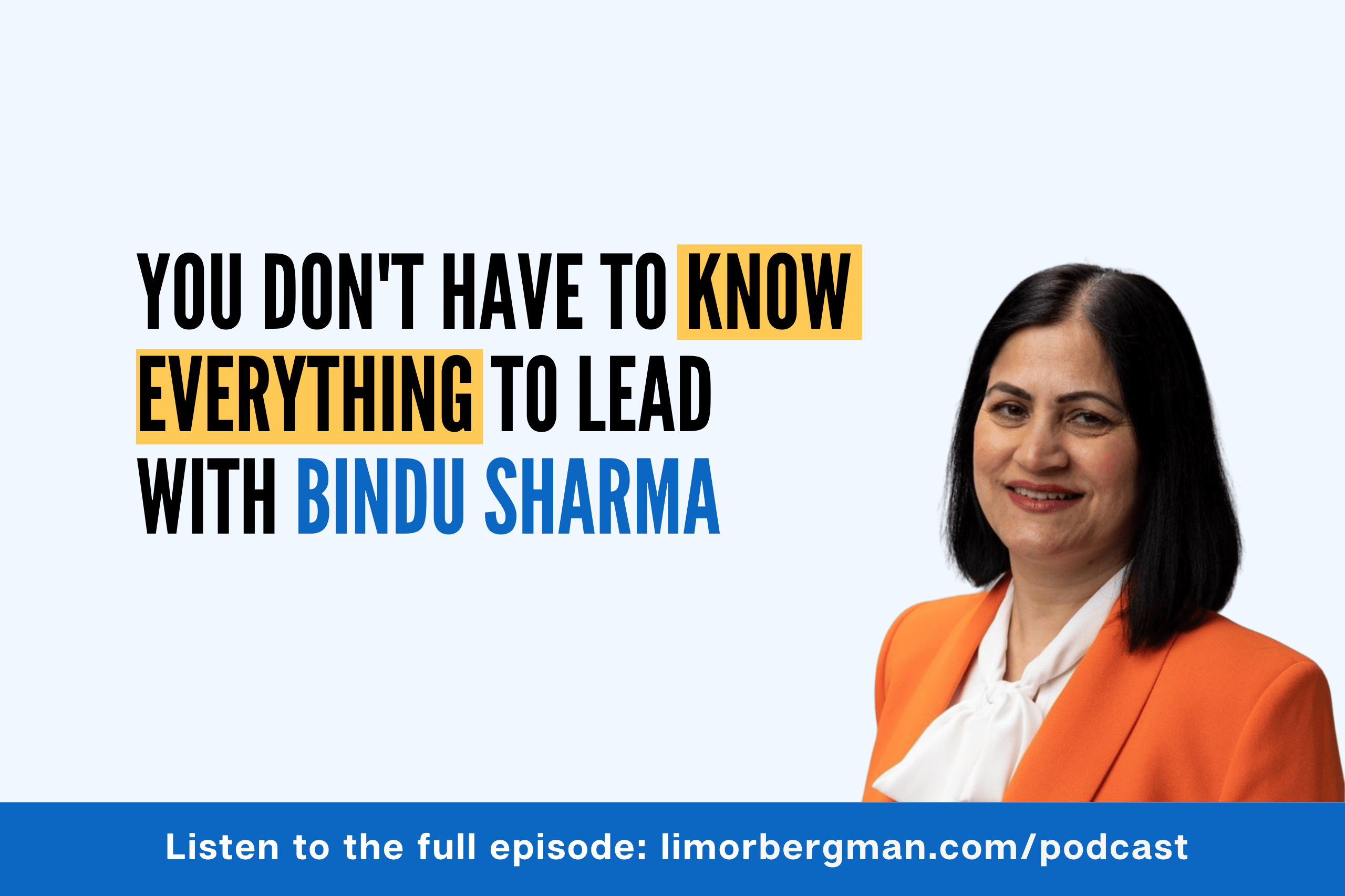
You’ve spent your whole career making sure you’re prepared. You read the book before the meeting. You learn the framework before you lead the project. And somewhere along the way, you started believing that the reason you belong in the room is that you know more than the next person.
So what happens the day you walk into a senior-level meeting and you don’t?
That was the question that opened my conversation with Bindu Sharma on this week’s episode of From a Woman to a Leader (https://limorbergman.com/podcast/). Bindu is a Senior Director of Cloud Financial Operations at Teradata. Her career has crossed quality assurance, program management, hardware compliance, and cloud, plus a three-year break in the middle when her second child was a baby. And the thing she credits for all of it isn’t how much she knows. It’s how openly she says what she doesn’t.
Here are the five things from that conversation that I think every woman in tech leadership needs to hear.
1. Why does admitting “I don’t know” build trust instead of breaking it?
Because when the most senior person in the room says it first, it gives everyone else permission to learn out loud.
Bindu is a senior director at a public tech company. She walks into meetings with finance people, engineering people, and operations people, and she openly says, “Please correct me if I’m wrong.”
Her words:
“I’m not afraid to learn and I’m not afraid to accept that I don’t know. When I’m talking to a finance person, when I’m talking to an engineer, I’m learning because I don’t know everything. I give this disclaimer: if I state something incorrectly, please correct me. There should be no ego. That role is on paper. It’s on your signature. But other than that, you’re always a peer with anybody in the team.” — Bindu Sharma
Here’s what I see again and again in my coaching work. Senior women are carrying the quiet belief that saying “I don’t know” at their level will cost them credibility. It’s the opposite. It opens the conversation. It gives the junior person on the team permission to ask the question they’ve been sitting on. It builds the kind of trust where your team actually tells you the truth.
How to apply this:
Try one of these phrases in your next meeting:
- “Help me understand this before we decide.”
- “I might have this wrong — correct me if I do.”
- “I don’t know the answer to that. Let me find out and come back to you.”
None of these diminishes you. They make it safer for your team to do their best work in front of you.
2. How do you pivot into a new technical domain without starting over?
You bring the skills you already have, and you’re honest about what you still need to learn.
Bindu’s career is a stack of pivots. She did a master’s in physics in India. Came to the US, took summer classes in a community college to understand computers, and went back for a software engineering master’s. She started in quality assurance at Netscape. She moved into program management. She moved into hardware compliance. Then a senior VP approached her and asked if she’d take on cloud financial operations because no one in the company knew who was buying what in the cloud.
She said yes each time.
“You already have the knowledge to grasp other areas. You know how to grasp them. It’s only to understand the new subjects.” — Bindu Sharma
Women I coach often treat a domain change as a demotion. They tell me, “If I move from engineering into product, I’m starting over.” You’re not. You’re taking what you already know and adding new context. That’s compounding, not restarting.
How to apply this:
Before your next pivot conversation, list five skills that will transfer with you. Relationship-building, project management, domain expertise, pattern recognition, the ability to translate between teams — those come with you. What you’re adding is the new technical layer, and that’s learnable.
3. Can you take a career break and still become a senior leader?
Yes — if you come back honestly, not by pretending nothing changed.
Bindu handed in her resignation on January 3rd when her second child was eight months old. She took three years off. She says it plainly: “I enjoyed my time with my kids, doing all the mommy things and doing nothing else.” When they started full-time school, she came back.
She came back through consulting, not through pretending her last role was current. She was honest with every new manager about what she did and didn’t know. She learned along the way.
“You already have the skills to learn. You know how to learn.” — Bindu Sharma
If you’re in a season where you’re weighing a break, Bindu’s story matters because it’s specific. She didn’t come back by pretending. She came back by choosing a re-entry path that matched her actual situation.
How to apply this:
If you’re considering a break, plan the re-entry alongside the exit. Consulting, fractional work, project-based roles, and internal returnship programs at major tech companies are all real paths. Know what your re-entry looks like before you decide. That’s not “hedging” — that’s designing the season.
4. What should you do if no one is offering you a promotion?
Ask for one — and show up with a plan, not a hope.
Bindu’s first promotion to senior manager happened because her manager left and recommended her for the role. She’s the first to point out — that’s not how it happens for most people. So she laid out a practical playbook for the women listening who aren’t getting tapped on the shoulder.
Her advice:
- Talk to your manager directly about the path you want.
- Ask for a mentor inside the company.
- Ask for a shadowing program with someone already in the role.
- Use your company’s tuition reimbursement to take a management course.
- Put your development steps into your yearly performance review.
“Go and talk to your manager and tell them you are inclined in this path… Show the willingness. And when the opportunity comes, they will remember that she came to me, she showed her willingness, she did the mentorship shadowing program. Let us give her a chance.” — Bindu Sharma
How to apply this:
Book a 30-minute conversation with your manager in the next two weeks. Go in with three things: the specific role or scope you want, the development steps you’re willing to take (mentor, shadow, course), and a commitment to put them in your next performance review. You are not being pushy. You are showing up like a leader.
5. Why is “I’m not ready” the phrase that keeps you small?
Because no one is ready, and waiting for the feeling costs you the opportunity.
The line that kept coming back in our conversation was Bindu’s: “No one is ready.” She wasn’t ready when she took the QA lead role at Netscape. She wasn’t ready when her senior VP asked her to own cloud governance. She wasn’t ready to come back after three years out. She ran with each one anyway.
“Don’t say no to the opportunity with ‘I’m not ready.’ No one is ready. Just run with it. Learn along the way. You won’t imagine people will help you that you didn’t even think would be so supportive.” — Bindu Sharma
This is the pattern I see again and again with the women I coach. They’re waiting for a feeling — the feeling of being ready — that does not come on its own. It comes after you say yes.
How to apply this:
The next time you hear yourself saying “I’m not ready for that yet,” translate it. You mean “I’m scared.” Those are different sentences, and they need different responses. “Not ready” sounds like a reason. “I’m scared” is information that tells you exactly what support you need — a mentor, a shadow period, a thinking partner, a coach. Ask for the support. Say yes to the thing.
The Bottom Line
Bindu Sharma’s career doesn’t look like a straight line. It looks like a series of honest moves — honest about what she knew, honest about what she didn’t, honest about when she needed to step back, and honest about when she was ready to come back. Every honest move built the next one.
If you’re carrying the belief that you need to know everything before you can lead, that a career break will end your career, or that you should wait for the right feeling before you go after the next role — I want you to hear what Bindu said out loud on the episode.
No one is ready. Run with it. Learn along the way.
About Bindu:
Bindu Sharma is a Senior Director leading enterprise cloud infrastructure strategy, technical programs, and financial operations across AWS, Azure, and GCP at Teradata. She has led initiatives delivering ~$15M in savings, and serves as an Advisor to the Board of California State University East Bay’s CX program.
Connect with Bindu:
Listen to the full episode
🎧 Listen on Spotify, Apple, or anywhere you get your podcasts: https://limorbergman.com/podcast/
📺 Or watch on YouTube:
FAQ
Can a senior leader admit they don’t know something without losing credibility?
Yes — and at senior levels, admitting you don’t know actually builds credibility rather than breaking it. In this episode, Senior Director Bindu Sharma explains that saying “please correct me if I’m wrong” in meetings with finance, engineering, or operations teams opens the conversation instead of undermining her authority. When the most senior person in the room says it first, it gives everyone else permission to contribute honestly.
How do you pivot your career into cloud or a new technical domain?
You pivot by bringing your existing skills (project management, cross-functional collaboration, domain expertise) and adding the new technical knowledge on top. Bindu Sharma’s career moved from physics to quality assurance to program management to hardware compliance to cloud financial operations — and she describes each pivot as compounding, not restarting. Start with a course or certification, pair it with stretch projects, and be honest with your manager about what you’re building.
How do you come back to work after a 3-year career break?
Come back through a path that matches where you actually are — consulting, fractional work, returnship programs, or contract roles are all real options. Bindu Sharma took three years off when her second child was a baby and returned through consulting work in program management. The key is to be honest with new managers about what’s current and what you’ll learn along the way, rather than pretending the gap didn’t happen.
Is it okay for women in tech to take a career break for kids?
Yes, if it’s the right decision for you. In this episode, Bindu Sharma’s advice to women considering a break is to do what you can look back on without regret — because content, happy decisions produce the energy and clarity to make your next move well. That may mean taking the break fully, staying in with a slower pace, or finding a middle path. There is no universally “right” answer, but there is a right answer for your life.
How do you ask for a promotion when no one is offering you one?
Talk to your manager directly about the path you want, and show up with a concrete plan — not just a hope. Ask for a mentor inside the company, request a shadowing program with someone in the role you want, use your employer’s tuition reimbursement for a relevant course, and put your development steps into your formal performance review. Bindu Sharma’s advice is that showing willingness consistently is what makes leaders remember you when opportunities open up.
Why do women in tech wait to feel “ready” before going after a bigger role?
Often because they’ve been conditioned to believe they need full mastery before they’re allowed to lead. The truth is that no one is ready — not the senior director, not the executive, not the person who got the role you wanted. The feeling of readiness does not come before the opportunity. It comes after you say yes and learn in the role. Waiting for readiness is one of the most common patterns that keeps capable women stuck.
How do you speak the language of both finance and engineering teams?
Know your audience, and use the vocabulary and priorities of the person you’re talking to. Bindu Sharma, who leads cloud financial operations, translates across finance, engineering, and operations every day. When she’s talking to a finance person, she frames decisions in terms of cost and margin. When she’s talking to an engineer, she frames them in terms of service capability and performance. The same decision, translated across audiences.
What’s the difference between a career pivot and starting over?
A pivot brings your existing skills with you and adds new ones. Starting over implies the old skills don’t count — which is almost never true in a knowledge-based career. Bindu Sharma pivoted from physics to software engineering to program management to cloud without starting over, because each role used skills from the previous one. The question to ask isn’t “what am I giving up?” but “what am I bringing with me?”
Connect with Limor
Website: https://limorbergman.com
Podcast hub: https://limorbergman.com/podcast/
Substack: https://limorbergman.substack.com
Book a promotion strategy call: https://limorbergman.com/coaching/