You have a good idea. Maybe you have had it for years. But you keep telling yourself you are not the right person to build it. You are not technical enough. You are not ready. You do not have the background, the credentials, or the single brave moment where everything suddenly feels clear.
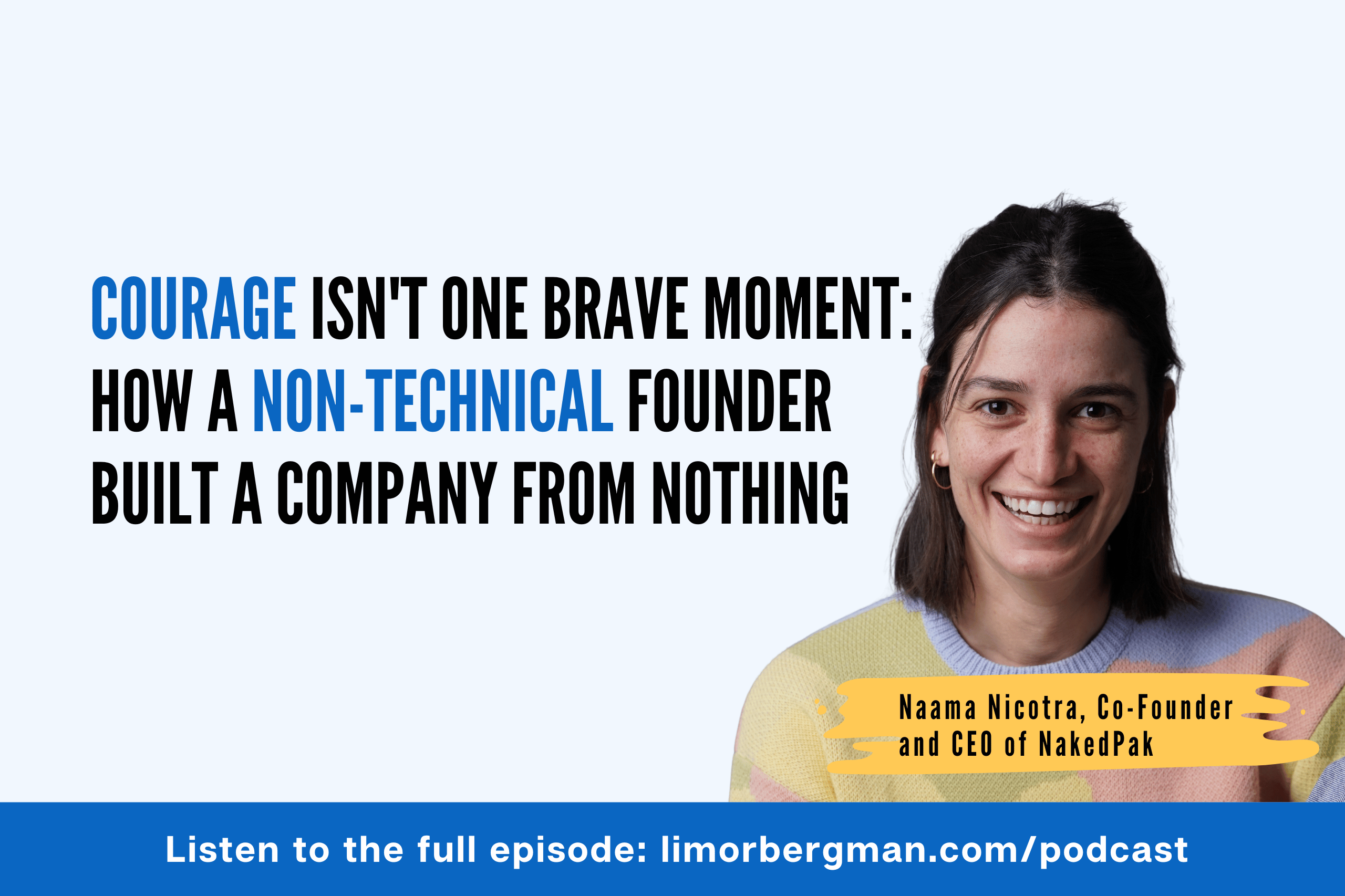
This week on the From a Woman to a Leader podcast I sat down with Naama Nicotra, the founder and CEO of NakedPak. Naama is building food packaging you can actually cook and eat, with no plastic, no waste, and no chemicals. She did it with no technical background and no line of code. And she will be the first to tell you she does not feel like a successful founder yet.
What struck me most was not the science. It was how she thinks about courage, rejection, and what it actually takes to start. Below are the insights from our conversation, along with my own experience and concrete steps you can take this week.
1. You Don’t Need to Be Technical to Build Something That Matters
When we think about founders, especially here in Israel, we picture the person who came out of an elite technological unit in the army, the one who has been coding since they were a teenager. Naama is not that person. She studied industrial design and served as the first training officer in a new commando brigade. She has never written a line of code.
“Although I didn’t learn how to code anything, I really knew how to approach a problem and to find a real solution.”
What she has instead is a designer’s way of seeing problems and years of building things from scratch in places where no one could hand her a playbook. As she put it, this combination is rare in the background of successful founders, but it gives her the chance to do something in entrepreneurship from a completely different angle.
I say this to the women I coach all the time. You do not need to be born with a keyboard in your hand. Some of the most valuable things you bring, the way you see a problem, the way you bring people together, the way you connect the dots others miss, have nothing to do with how technical you are.
How to apply this: Make a list of the strengths you bring that are not on your job description. The way you spot the real problem. The way you calm a room. The way you ask the right question. Those are not soft skills. They are your edge. Stop discounting them because they are not technical.
2. Success Is the Small Wins, Not the Big Exit
We are trained to measure success by the headline outcomes. The funding round. The launch. The acquisition. The IPO. Naama pushed back on that, gently but firmly. For her, success is something much smaller and much more personal.
“Success is the little things that you do, that you had an idea and you want to implement it.”
She also said something that I think every ambitious woman needs to hear:
“It is hard during this journey to celebrate little wins or to really be happy with what you accomplished with very, very little steps, but it is so important to do it because if you don’t, it’s impossible to survive this journey.”
This is where I see so many women get stuck. They are so focused on the big milestone that they never let themselves feel good about anything along the way. And then they burn out, or they quit right before the thing they were building started to work.
How to apply this: At the end of this week, write down three small wins. Not the giant outcomes, the small steps. The conversation you started. The email you finally sent. The thing you tried even though it scared you. Let yourself actually feel them.
3. Courage Isn’t One Brave Moment, It’s Built One Step at a Time
I asked Naama where she found the courage to leave everything behind and bet her time, money, and energy on this idea. I expected a story about a single decisive moment. She told me there wasn’t one.
“I cannot say that there was a moment of time of courage, but there were many, many moments where my courage just lifted and lifted and lifted.”
It started as an idea in design school that some people loved and some people hated. She showed it at design weeks around the world. She got feedback, some of it encouraging and some of it brutal. A French magazine once featured her invention, and when she ran the article through Google Translate, she found out they had called it the most stupid idea they had ever seen and said everything looked disgusting. She laughed, and she kept going, because at least people were reacting.
So much of the advice out there makes courage sound like a switch you flip. Naama’s story is the opposite. You collect it in pieces, every time you do the scary thing and the world does not end.
How to apply this: Stop waiting to feel brave before you act. Pick the smallest version of the scary thing and do that one. Send the message. Raise your hand for the one project. Courage is the result of action, not the requirement for it.
4. How to Handle Rejection Without Letting It Stop You
Naama is fundraising right now, which means she gets rejected often. I asked her how she keeps going. Her answer was so simple and so practical that I have not stopped thinking about it.
“When I get a rejection from an investor, I reply to the mail, thank you. Then I move it to the rejection folder, and then I continue working.”
And then she said the line that I think every woman should write on a sticky note:
“I don’t feel like this is how I’m judged. I judge myself by how hard I work.”
She was honest that the easy thing is to crawl under the blanket and scroll. She feels that pull too. But she does not let the no decide her worth. A rejection is one decision, in one room, on one day, often for reasons you never get to see.
This is something I learned the hard way in my own career. Early on, I watched colleagues get promoted to roles I was not even considered for, and I let it tell me a story about whether I was good enough. It took me years to understand that the no was about timing, fit, and visibility, not about my value.
How to apply this: Build your own version of the rejection folder. When a no comes, let yourself feel it for a moment, then move it somewhere and take one small action that moves you forward. Action is what shrinks the sting.
5. Ask for Help, Because Most People Want to Say Yes
One of my favorite parts of the conversation was how openly Naama talks about asking for help. She has between five and ten mentors she speaks with regularly, each on a different topic, from go-to-market to technology to financials. She did not have any of these relationships when she started. She built them by walking into rooms, being curious, and simply asking.
“If you ask for help, 99 percent that the person in front of you will say yes.”
She also pointed out that people are genuinely excited to help female founders, partly because they do not see enough of them, and partly because they have daughters, sisters, and wives, and they understand the world is not open enough yet.
I will be honest, asking for help is something I have had to work on myself. It can feel like you are admitting you do not have it all figured out. But the women who grow fastest are almost always the ones who ask.
How to apply this: Pick one person this week whose perspective would help you, and ask them one specific question. Be clear about what you need and respectful of their time. Most people say yes. You just have to ask.
6. Don’t Try to Be the Smartest Person in the Room
When we talked about how to handle criticism and who to listen to, Naama shared a mindset that flips the usual advice on its head.
“You never want to be the smartest person in the room. You want to be actually the least smart one, because you want to learn from everyone else.”
She intentionally surrounds herself with founders who are far ahead of her, the ones who are about to be acquired or are years into their journey, so she always has someone to learn from. And she is just as intentional about her inner circle, the people who support her without judging every turn she takes.
This connects to something I believe deeply. Your environment shapes how far you go. If you are always the most senior, most certain voice in the room, you stop growing. And if the people around you are not in your corner, the hard days get much harder.
How to apply this: Look at the rooms you spend time in. Are there people you can learn from, and people who genuinely have your back? If not, that is worth changing before anything else.
About Naama Nicotra
Naama Nicotra is the founder and CEO of NakedPak, the first brand to create edible, hot-water-soluble food packaging that leaves no plastic, no waste, and no chemicals behind. She studied industrial design and served as the first training officer in a new IDF commando brigade. She came to entrepreneurship not from a technical unit but from design and from years of building things from scratch.
Links:
- NakedPak: https://www.nakedpak.com/
- LinkedIn: https://www.linkedin.com/in/naama-nicotra-1b9232174/
What I Took From This Conversation
I host this podcast to help other women in tech, but the truth is, I walk out of almost every conversation having learned something for myself. This was one of those weeks.
Naama reminded me that you do not need to be the most technical, the most certain, or the most ready person in the room to build something that matters. You need a problem you care about, the willingness to take small steps, and the resilience to keep going when people doubt you.
I go deeper on my own take in this week’s solo episode, where I share what her story stirred up for me about courage and starting before you feel sure.
You Don’t Have to Figure This Out Alone
If you are reading this and recognizing yourself, if you have a good idea or a bigger role you want but you keep waiting to feel ready, technical enough, or qualified enough, I want you to know you do not have to navigate this by yourself.
I work with women in tech leadership every day on exactly these questions. How to stop waiting for permission. How to make yourself visible without feeling like you are bragging. How to keep going when the no’s pile up. If that sounds like where you are right now, let’s talk.
Book a promotion strategy call, and we will figure out your next step together.
Where to Start if You Want to Build Something
You do not need to leave your job tomorrow. Naama’s own advice was to build the infrastructure first, speak with people, find support, and take small steps. A few simple places to begin:
Find your mentors. You do not need a formal program. Identify a few people who are ahead of you on the specific things you need, and ask each of them one clear question.
Join a community of women who are building. Whether you are starting a company or pushing for a bigger role, being around other women on the same path makes the hard days easier and the asks less scary.
Start before it is polished. Naama showed her concept at exhibitions long before it was a real product, and that visibility is what brought the opportunities to her. Share the work in progress.
Frequently Asked Questions
Can you start a company without a technical background? Yes. Naama Nicotra built NakedPak, a food packaging company, with no technical background and no coding ability. Her strength is a designer’s approach to problem solving and years of building operations from scratch. A technical background helps in some ventures, but a clear problem, the right team, and persistence matter more than knowing how to code.
How do you find the courage to start a business? Courage is rarely a single brave moment. As Naama describes it, it builds in small steps, every time you take action and survive the outcome. You do not wait to feel brave and then act. You act in small ways, and the courage grows from there.
How do you handle rejection as a founder? Treat each no as one decision in one room on one day, not a verdict on your worth. Naama replies thank you, files the rejection away, and immediately goes back to work. The fastest way to shrink the sting of rejection is to take the next small action.
Why is it important to celebrate small wins? Celebrating small wins is how you survive a long journey. Big outcomes like a launch or a funding round are rare and far apart. If you only let yourself feel good about the big milestones, you risk burning out or quitting right before the work starts to pay off.
How do you ask people for help in your career? Be specific and respectful of their time. Naama’s experience is that 99 percent of people say yes when you ask, especially when supporting a younger or female founder. Identify the person whose perspective would help, ask one clear question, and follow up with genuine gratitude.
Should you be the smartest person in the room? No. Naama deliberately stays in rooms with people who are further along than she is, so she always has someone to learn from. If you are always the most senior or most certain voice in the room, you stop growing.
What is NakedPak? NakedPak is a company creating edible, hot water-soluble food packaging. You can cook the package along with the food, and it dissolves completely without affecting the flavor, leaving no plastic, no microplastic, and no waste.
Do women founders get enough support? Not yet, but Naama’s experience is that many people are genuinely eager to help female founders, partly because they are underrepresented and partly because mentors and investors want the next generation of women to succeed. Asking for help is often met with a yes.
🎧 Listen to my conversation with Naama Nicotra: You Don’t Need a Technical Background to Build Something
🎧 Listen to my solo episode this week (releases Friday): https://youtu.be/wMRELxTkj8M
📺 Watch on YouTube: https://youtu.be/wS6mAq_CaT8
📝 Read the deeper, more personal version on Substack