You walk into the meeting prepared. You know the material better than most people at the table. And still, somewhere in the back of your mind, you wonder whether quiet confidence is enough, or whether you need to be louder, tougher, and more forceful to be taken seriously.
Maybe you have tried it. You raised your voice a little, argued points you didn’t really care about, and walked out feeling like you had performed a version of yourself that wasn’t you.
And underneath it sits a belief many women carry for years: that to be bold, you have to become someone else.
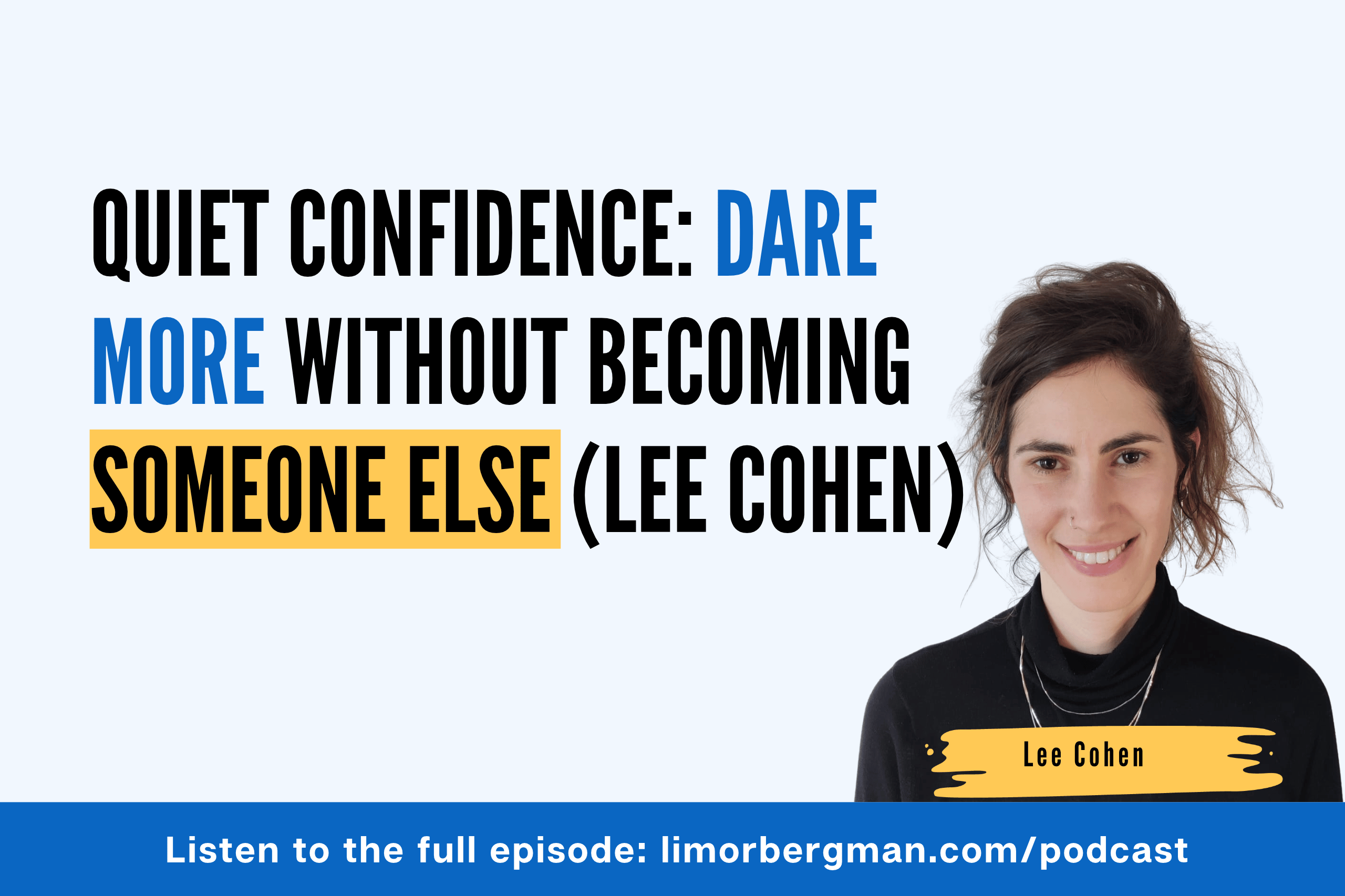
This week on the From a Woman to a Leader podcast, I sat down with Lee Cohen, co-founder and CEO of TextRe, who spent five years as a lawyer in real estate and infrastructure, often as the only woman in the room, while building her startup on the side. We recorded this conversation in person at the Google for Startups studio in Tel Aviv.
On paper, this is a story about leaving law to build a company. But that’s not really what we talked about. We talked about what it actually costs to chase a dream, why strength doesn’t have to be loud, and why daring starts with accepting who you already are.
Below are the insights from our conversation, with my own experience and concrete steps you can take this week.
1. Quiet Confidence Is Still Confidence: Strength Doesn’t Have to Be Loud
As a young lawyer, Lee walked into negotiations in a very masculine world. Nobody said it out loud, but she felt the question hanging in the room: you’re a woman, what do you understand about infrastructure and real estate? So she tried to adopt the persona she thought those rooms expected, speaking loudly and arguing about everything, even points she didn’t believe were worth arguing about.
Over time, she came to a very different conclusion:
“Strength shouldn’t be just speaking out loud. No, if we are showing vulnerability, if we are speaking not that loud, it’s still not saying anything about who we are and what we can do and what we can build or establish. We should stop thinking like that.”
Lee Cohen on why strength isn’t about volume
I know this one personally. Early in my career, I was passed over for a director role and told I wasn’t “charismatic” enough, by executives who didn’t really know me or my work. For a while, I thought the answer was to become someone louder. It wasn’t. What changed things for me was getting clear on my value and saying it with conviction, in my own voice.
Here’s what I see again and again with the women I coach, especially in engineering and other male-dominated fields. They assume confidence has one look, and if they don’t match it, they don’t count. Sound familiar?
How to apply this: Before your next important meeting, pick the one point that matters most to you. Say it once, clearly, at your normal volume, and then hold it when someone pushes back. You don’t need to win every argument. You need to not give up the one that matters.
2. Negotiation Doesn’t Have to Be a Fight
Lee shared a meeting she had with her father, who is also her partner in the company. The other side told her he didn’t want to see her presentation. She had prepared for it, and instead of pushing, she said, “Okay, let’s do it your way.” Five minutes later he told her exactly what he needed, and what she had planned to suggest wouldn’t have worked anyway.
So she said:
“I’m looking at your eyes and I feel that we are going to have a good deal. You know why? Because in the essence we see the same things.”
He looked at her and said, “I agree.”
Her definition of a good deal is simple:
“A good deal will be something that we are both feeling that we got what we want.”
Lee Cohen’s win-win negotiation story
This is exactly how many women naturally approach negotiation: as a collaboration, not a battle. The problem is that we’ve been told this approach is “soft,” so we either abandon it or apologize for it. My take is that it’s not soft at all. Listening first is how you find out what the other side actually needs, and that’s where the deal is.
How to apply this: Before your next negotiation, whether it’s a raise, a project scope, or a deadline, write down two lists: what you need, and what you think the other side needs. Open the conversation with a question about their list, not a pitch for yours.
3. You Can Know What You Want and Still Take Years to Get There
Lee knew within three months of law school that she didn’t want to be a lawyer. She still finished, passed the bar, and practiced for five years, building her company on the side through very long days. She doesn’t see that as wasted time:
“It’s totally okay that you have the realization of something, but it takes you a while to do it, as long as you are committed to yourself and you know that you will do it.”
And the years she spent in law turned out to be useful. She drafted all of the company’s agreements herself and knew how to walk into a business meeting and close a deal.
This is where women get stuck. We tell ourselves that if we haven’t made the move yet, maybe we don’t really want it, or maybe it’s too late. But the gap between knowing and doing isn’t a failure. The real risk is letting that gap become permanent because you never decide what your next step is.
How to apply this: Write down the change you keep thinking about, then write one concrete step you’ll take toward it this quarter. Not the whole plan. Just the next step, with a date.
4. “I Have No Backup” Is a Real Constraint, Not an Excuse
I asked Lee a challenging question: not everyone has a father who can back them up, so what would she do without that support? She didn’t brush it off. She agreed that most of us don’t have a safety net, and then she said:
“I think it’s not an excuse. Let’s start with that. I’m telling you it’s not an excuse.”
Her advice is to build it smartly and be pragmatic about it: work another year and save money, move to a cheaper apartment, ask for help. When she told a friend she might have to leave her apartment and move back in with her parents, her friend answered:
“But this is your dream, no? So you should pay what you want for your dream.”
Every decision has a cost and a benefit, whether you’re starting a company or going for a promotion. The question isn’t whether there’s a price. It’s whether you are honest with yourself about what the price is, and whether you’re willing to pay it.
How to apply this: Take the move you’re considering and write down what it would honestly cost you, in money, time, comfort, and status. Then mark which of those you’re willing to pay for one year. That list usually turns a vague fear into a decision you can actually make.
5. You Don’t Have to Be 100% at Everything
Lee is building TextRe with a baby at home. She told me about a moment in the garden with her daughter, answering a work email on her phone and feeling guilty right away. Then she caught herself, and realized she had nothing to feel guilty about. What she said next is something I wish I had heard years ago:
“It’s okay because I’m a different mum.”
And more broadly:
“We are not just one thing. We are not just a lawyer, I’m not just a CEO, I’m not just a woman, I’m not just a mother… I’m everything.”
Lee Cohen on mom guilt and being a different kind of mom
When my daughter started daycare, I wasn’t the one picking her up. I had a nanny, and help from my parents and in-laws, and for years I asked myself whether I was a good enough mom. The guilt never fully went away. What changed is that I stopped treating it as a verdict.
Many women hold themselves to 100% in every role, as a leader, a mother, a partner, and then feel ashamed when they can’t get there. That standard doesn’t exist. Lee’s daily practice helps here: every morning and every night, she reads a list she wrote about the kind of person, manager, and mother she wants to be. It doesn’t remove the guilt, but it reminds her what she actually chose.
How to apply this: The next time guilt shows up, ask yourself one question: is this telling me something I need to change, or is it telling me I’m not following someone else’s model? Act on the first. Let go of the second.
6. Daring Means Accepting Who You Are, Not Fitting Someone Else’s Model
In our pre-call, Lee told me it makes her angry that women still don’t dare more. But her definition of daring surprised me:
“Daring more and being something that we are not, it’s not daring. It’s becoming something else, or trying to adopt a figure that it’s not us. It’s just trying to fit in. Daring is first of all accepting who we are.”
She sees the same pattern when women look at job descriptions:
“No one has all the check boxes.”
If you fit 80% of the role, and you bring 150% on the things that matter most, why not apply? Lee also challenged the way we frame our ideas. When a friend shared an idea and then immediately started doubting whether she could succeed, Lee’s answer was: why is the first question not “why not?”
This is the heart of my work with women in tech. Most of the women I coach are not short on skill. They are waiting until they feel like the “right type” of person for the next role. But there is no right type. There is you, with your strengths, deciding to go for it.
How to apply this: Find one role, project, or opportunity you’ve been talking yourself out of because you don’t tick every box. Write down the three strongest things you’d bring to it. Then apply, or raise your hand, this week.
About Lee Cohen
Lee Cohen is the co-founder and CEO of TextRe, a materials company that converts mixed synthetic textile waste into engineered recycled polymers for the plastics industry. Before founding TextRe, she spent five years as a lawyer in real estate and infrastructure, building the company on the side until she could commit to it full time. She grew up in her father’s textile factories, watching mountains of fabric go to the trash, and that memory became the spark for her company. Today she is building TextRe while raising her first child.
- Website: text-re.com
- LinkedIn: Lee Cohen
What I Took From This Conversation
What stayed with me most is how often Lee came back to the same idea from different directions. In negotiations, in motherhood, in leaving law, in how she shows up in a room, the bold move was never becoming someone else. It was accepting who she is, being honest about the price, and going anyway.
Quiet confidence is not a smaller version of confidence. It’s confidence that doesn’t need to perform.
I go deeper on my own take in this week’s [solo episode]([SOLO EPISODE LINK]).
You Don’t Have to Figure This Out Alone
If you’re the quiet one in the room, wondering whether you need to become louder to get the promotion, or you know what your next move is but keep talking yourself out of it, you don’t have to work it out by yourself.
Book a promotion strategy call, and we’ll figure out your next move together.
Where to Start
Hold one point, at your own volume. In your next important meeting, decide in advance which point you won’t give up, and say it clearly without raising your voice.
Name the price. Write down what your next move would honestly cost you, and which of those costs you’re willing to pay for one year.
Apply at 80%. Pick one opportunity you’ve been avoiding because you don’t tick every box, and go for it this week.
Frequently Asked Questions
What is quiet confidence? Quiet confidence is knowing your value and acting on it without needing to be the loudest person in the room. It shows up as clear opinions, calm follow-through, and holding your position when it matters, rather than volume or dominance.
How can I be confident at work without being loud? You can be confident at work without being loud by preparing your key point in advance, stating it clearly at your normal volume, and holding it when challenged. Confidence is about conviction and consistency, not about speaking the most or the loudest.
How should women approach negotiation? Women can approach negotiation as a collaboration where both sides should leave feeling they got what they needed. Start by understanding what the other side wants, be clear about what you need, and look for the deal where both of you win, as Lee Cohen describes on the podcast.
How do you chase a dream if you can’t afford to quit your job? You can chase a dream without quitting your job by building it on the side and planning the transition pragmatically. Lee Cohen practiced law for five years while building her startup, and suggests saving for a year, lowering your costs, and asking for help rather than treating “no backup” as a reason not to start.
How do working mothers deal with mom guilt? Working mothers can deal with mom guilt by accepting that they don’t have to be 100% in every role at the same time. A useful question when guilt shows up is whether it points to something you really want to change, or only to someone else’s model of what a mother should be.
Should I apply for a job if I don’t meet all the requirements? Yes, you should apply for a job if you meet most of the requirements and bring strong value in the areas that matter most. As Lee Cohen puts it, “no one has all the check boxes,” and hiring managers look at the whole person, not just a checklist.
Who is Lee Cohen? Lee Cohen is the co-founder and CEO of TextRe, a materials company that turns mixed synthetic textile waste into recycled polymers for the plastics industry. She is a former real estate and infrastructure lawyer who built her startup on the side for five years before going full time.
What does TextRe do? TextRe converts mixed synthetic textile waste into engineered recycled polymers that the plastics industry can use instead of virgin, fossil-based materials. It bridges two industries: textiles, which produce large amounts of waste that is mostly landfilled or incinerated, and plastics, which needs recycled materials.
🎧 Listen to my conversation with Lee: Dare More, Without Becoming Someone Else
📺 Watch on YouTube: https://youtu.be/9k4mdVY5d5U
📝 Read the deeper, more personal version on Substack
Full Transcript
Full transcript of my conversation with Lee Cohen on the From a Woman to a Leader podcast. Lightly edited for readability: filler words and false starts removed, wording otherwise unchanged.
Daring starts with accepting who you are
Lee Cohen (00:00): I think daring more and being something that we are not, it’s not daring. It’s becoming something else, or trying to adopt a figure that it’s not us. It’s not daring. It’s just trying to fit in all the things that they’re trying to make us fit for. Daring is first of all accepting who we are.
Limor Bergman Gross (00:23): Hi everyone and welcome to another episode of From a Woman to a Leader. My guest today is Lee Cohen. Lee actually started her career as a lawyer. She was five years a lawyer in real estate and infrastructure. Often she was the only woman in the room. And while doing that, she was building a startup on the side. And today she is the founder and CEO of TextRe, which turns textile waste into recycled plastic. We talk about what it really costs to chase a dream, negotiation and why it doesn’t have to be a fight, how to build a company with a new baby at home, and why daring starts with accepting who you are. So for any of you who want to chase a dream and maybe are not sure how to do that, stay with us. Let’s dive right in.
Recorded at Google for Startups in Tel Aviv, and why Lee reached out
Limor Bergman Gross (01:27): Hi everyone and welcome to another episode of From a Woman to a Leader. And before we begin, I want to thank Google for Startups for hosting us in their wonderful studio in Tel Aviv. So thank you, Google. And excited to introduce my guest today, Lee Cohen. Hi Lee, how are you?
Lee Cohen (01:45): Great, Limor. It’s very exciting being here. So thank you for hosting me as well.
Limor Bergman Gross (01:53): My pleasure as well. Thank you for reaching out. I’m always excited to speak with women entrepreneurs like yourself.
Lee Cohen (02:00): Maybe I can just dive in and say we should dare. So this is the reason I approached you after I saw you on LinkedIn, just taking the power in my hands and saying, why not? What can happen? I just write to you and let’s see what happens.
Limor Bergman Gross (02:13): For sure, for sure. Yes. So Lee reached out to me on LinkedIn, and we’re going to talk among other things about audacity and why women need to dare more. But before we get there, Lee, your journey is non-traditional. So you started as an attorney, and now you are leading a startup.
Lee Cohen (02:38): Leading my dream.
Limor Bergman Gross (02:39): Yeah. So it’s not a very traditional path. So share with our audience, how did you transition from an attorney to an entrepreneur?
How do you move from lawyer to entrepreneur?
Lee Cohen (02:51): First of all, I want to say to you, whoever is listening over there, just do it. First of all, just do it. But maybe telling about my personal story. I studied law and business in Reichman University. Today it’s a university, before it wasn’t. And I think after maybe three months I knew that a lawyer I don’t want to be. I want to be something else. But I thought it would be very useful to be a lawyer, knowing the rules. And I also worked five years as a lawyer after not wanting to be a lawyer in my studies.
Lee Cohen (03:15): And when I started working as a lawyer, I also had an entrepreneurship course in Reichman University where my eyes were opened. This is how I’m saying it, because I think it was a deep understanding that this is where I want to be. Having my ideas, telling the world what I want to do, doing exactly what I believe in, and not just sitting in an office and doing something for someone else, maybe I can phrase it like that. But it took a while. It took me five years from the moment that I realized that I don’t want to be a lawyer and I want to establish something on my own.
Lee Cohen (04:10): And I think it’s okay. I’m talking to you because I’m saying that it’s totally okay that you have the realization of something, but it takes you a while to do it, as long as you are committed to yourself and you know that you will do it, but it may take long, and we want to build it. Why I’m saying it, because during my working as a lawyer, I established my company. I did both things. It was super hard, super, super hard, because working as a lawyer, everybody knows, it’s crazy hours. But I was so devoted, or I believed so much that this is what I want to do, and I believe in my idea. We can speak about exactly what we are doing later.
Lee Cohen (04:52): So I think it gave me a lot of power and a lot of strength to keep on and to say, okay, I have to do both things right now, but it’s not for the end. It will be different. And after five years I decided. I remember the moment that I told my father. My father is a partner in the company, this is the reason that I started all this. So I remember sitting and telling him, Dad, I’m quitting my job and I need your support, because the startup didn’t give me any money, still not, and I need to know that I have someone that will support me financially. I lived in Tel Aviv. So he told me, I’ll do whatever I can, just go and chase your dream. And I think as a child, I grew up in a family that all the time encouraged me to chase my dreams, and I truly believe that this is the foundation of what I am today.
Lee Cohen (05:47): So I think it’s important. Basically, I think that it gave me a lot to be a lawyer. I think a lot of the tools that I learned as a lawyer really, really helped me when I established my company. I did all the agreements by myself. I knew how to go to a business meeting or to close a deal. It gave me a lot of tools, so I can’t regret it. I think it really built the person that I am and the entrepreneur that I am.
Being the only woman in the room
Limor Bergman Gross (06:17): That’s incredible.
Lee Cohen (06:18): When we spoke on the phone, if it’s okay that I’m sharing, I told you that all the time I’m the only woman in the room. And it started when I was a lawyer. It happened a lot of times that I entered the room to discuss the agreement that we want to draft, and I found myself, maybe to mention that I was in a very masculine world of infrastructure and real estate, and I think that I felt, I don’t want to say disrespect, but maybe, yeah: you’re a woman, what do you understand about infrastructure and real estate? And I think this also gave me the inner willingness to do it and to say to everyone, of course I can. So what if I’m a woman? Women can understand infrastructure or real estate or agreements, or they cannot build their own company? Why not? What’s the difference?
Do you have to be loud to be strong?
Limor Bergman Gross (07:13): Yeah, and there are a lot of biases. There are a lot of biases and preconceptions about who can do what, and I felt that myself in my career. But obviously you’re a woman, and you have this presence of a very gentle figure, and that even adds to it. So there is a perception that there needs to be a persona that is strong, I don’t know, big, speaks loud, and that’s the type of persona who can do those things. And you’re not like that. But you still can do it.
Lee Cohen (07:44): I think I try to adopt those things that you are mentioning. I try to come in, to enter the room and to say I know exactly what I’m doing, and to speak out loud, and to argue about everything, that maybe I don’t really believe that we should argue about. I think that we can agree about it and it’s still okay, and the agreement, for example, will still be a good agreement. And if I’m passing on something that I thought was important for me, I’m not just giving up. I’m not weak. We should stop using such terminology. We can have things in very different ways, a lot of different ways. Agreement shouldn’t be just one thing. Showing strength shouldn’t be just speaking out loud. No, if we are showing vulnerability, if we are speaking not that loud, it’s still not saying anything about who we are and what we can do and what we can build or establish. We should stop thinking like that.
Negotiation is a win-win, not a fight
Limor Bergman Gross (08:41): A hundred percent. And I think what you’re saying really represents a lot of times how women enter negotiations, rather than men. So we bring the feminine energy, and we say, negotiation, it’s a win-win. It’s a collaboration. Let’s figure this out together. We don’t have to have winners or losers. We can all win together.
Lee Cohen (09:04): Yesterday I was in a meeting, I just wanted to share, with my father. And it was a very important meeting for us, and it was a very joyful meeting, also I want to say. And the other side said, I don’t want to see your presentation. And I prepared myself, and I told him, okay, let’s do it your way. And we spoke like five minutes, and then he told me exactly what he wants, and what I was about to suggest won’t work. And I told him, you know what? I’m looking at your eyes and I feel that we are going to have a good deal. You know why? Because in the essence we see the same things. Maybe we are not agreeing about the framing of things, but a good deal will be something that we are both feeling that we got what we want. I don’t need what you need. Everybody needs something else. But it will be a good deal when we are both winning. And he looked at me and he said, I agree.
Lee Cohen (09:58): And I think that with that energy we should go into negotiations. Negotiation is not fighting. It’s not who gets more. Stop thinking like that. I want to say it’s the Israeli way, but it shouldn’t be like that. And when you realize that it’s okay that you are both winning, even if it’s not the same, you’re bringing another energy into the room. And I think another thing, it’s all about people. And if you have chemistry with the other person, and you’re entering confident in yourself and what you’re doing, it works out.
How do you chase a dream if no one is backing you financially?
Limor Bergman Gross (10:33): And I wanted to ask you something unrelated. So those are great tips for negotiations. And I wanted to ask you something about the decision point. You decided to start your business and you asked your father to back you up. Now I have a challenging question for you. Not every entrepreneur has the backing of someone that backs them up. Sometimes you’re on your own. What would you do differently if you didn’t have your father’s backing? I mean financially, or any kind of support. I’m sure that he supports you not just financially. He’s an advisor, he helps you.
Lee Cohen (11:05): My father is my mentor.
Limor Bergman Gross (11:07): Yeah. What would you do if you didn’t have that?
Lee Cohen (11:15): Finally, he didn’t support me financially. This is the reason that I approached him. He didn’t back me, because I was working five years before and I knew that I have the background to do it. But I want to say that my partner, the father of my baby today, truly supported me when I started it. And it was only in the beginning, I was on our first date just telling about what I’m doing and my company and my dream, and there was nothing, only the dream in my head, but I was so excited. And I think that he saw the excitement in my eyes when I spoke about it. So he was truly supportive.
Lee Cohen (11:43): But to your question, I think that you should build it. And it returns to the reason that I worked as a lawyer five years, and I didn’t just drop everything and say, I have a dream, I’m going to it, what will be will be. So I worked really, really hard for that. And I think that I was also willing to pay what I should pay, maybe to return to live in my parents’ house, not to pay rent, or to work in another job in the meanwhile, to have some income. I think it’s not an excuse. Let’s start with that. I’m telling you it’s not an excuse. I think most of us don’t have the backup to really drop everything and go chase our dreams.
Lee Cohen (12:37): But I think we should smartly, and being pragmatic, build it. If it means to work one year in another job and save money to the moment that you can leave, or ask help from someone else, or move into a cheaper apartment. I don’t know. I think you have thousands, thousands of solutions to deal with that. And I think you should really be true with yourself and say, this is what I want, this is what it will take for me. I remember I told my friend, what? I leave my apartment, I go to live with my parents again? My god. And she told me, but this is your dream, no? So you should pay what you want for your dream.
Lee Cohen (13:20): So we cannot gain everything. It’s not the whole cake. I think the first lesson in economics is we should compromise about things. We cannot have it all. And each of us knows what is the price that she’s willing to pay for chasing her dreams, and not everyone will do it. And not for everyone it suits to be an entrepreneur and not have a salary every month. And I think this is the deep conversation we need to have with ourselves, and it’s not easy. Not just financially.
Every choice has a cost: building a startup with a new baby
Limor Bergman Gross (13:53): A hundred percent. And I think that regardless, actually I wrote about it last week. So regardless of whether you want to be an entrepreneur or not, every decision you make in life has its cost.
Lee Cohen (13:59): Exactly.
Limor Bergman Gross (14:01): And has its benefit. And the question is, are you willing to pay the price?
Lee Cohen (14:05): And I want to say that you have to be really, really honest with yourself, if you are willing to pay the price and what is the price, because the price may change. For example, I have a baby today. She’s small.
Limor Bergman Gross (14:16): How old?
Lee Cohen (14:17): Nine months this week. And it’s super challenging to have a baby and build a startup. Not just the hormones as a woman. It’s my first child.
Limor Bergman Gross (14:27): You cannot prepare for such a thing.
Lee Cohen (14:30): I know. You cannot be prepared. And it took a lot for me. After the birth I said, okay, I gave birth, now I’m going back to work, like everything.
Limor Bergman Gross (14:44): So you didn’t have any maternity leave?
Lee Cohen (14:47): It’s my maternity leave, because I didn’t work. I’m working at home. But yeah, I’m breastfeeding and I’m pumping and I’m having Zooms. And after two months I told myself, whoa, just a minute. Something happened. I have a baby. I need to take a moment to myself and to adjust everything. And it was really difficult, because I have two babies, so to say: my company, that really was my first baby and my true baby, and how you are managing, and you have also your partner.
Lee Cohen (15:24): So I’m saying it because this is also the cost. I took a decision that for at least two months I’m doing nothing. I’m only with my baby. I’m understanding what it is to be a mom. It’s a new title that I had, and it brought a lot for me. And I think I paid a cost for the company, doing nothing for two months. But I have good partners that back me. And I think now I’m backed with power and true understanding of who I am, what kind of manager I am, what kind of a woman I am and what kind of mother I am. And it can all live together. It can all live together.
Lee Cohen (15:52): We are not just one thing. I’m not just a lawyer, I’m not just a CEO, I’m not just a woman, I’m not just a mother, I’m not just my partner’s spouse. I’m everything. And I think as women, we all the time think that we should be one hundred percent in everything. If I’m a CEO, I have to be there, giving my life for being a CEO. If I’m a mother, I’m not a good mother if I didn’t make her the perfect breakfast. It’s not like that. It’s the compromise. It’s the cost that we spoke about. So today I couldn’t make her the biggest breakfast or the healthiest breakfast. I did whatever I could.
Lee Cohen (16:45): And I’m saying it because now I’m in a position to say that I trust myself, that I’m doing the best that I can for my partner, for my company, for my baby, for my family. And I understand that it won’t be the one hundred percent that I want. And it’s super, super difficult for me not to be the one hundred percent. I feel guilty, I feel ashamed. I think the women out there in the audience truly understand me. This is the feeling that we feel all the time, that we are not enough, that we feel ashamed that we didn’t do that, a guilt that we didn’t clean the house or didn’t do another task in the job. But no, it’s okay. Because we are a lot of things. We are not just one thing. And we are learning to live with that, and to live with all of that.
Mom guilt and being a different kind of mom
Limor Bergman Gross (17:41): I love what you’re saying, and I wish I felt that way when I was your age. Because, I don’t know how old you are, but you are a young mom. When I became a mom, I had this mom guilt all the time. And I wanted to invest in my career and I wanted to be a mom, and obviously, as you said, there are compromises. So I hired a nanny, and I wasn’t there at four PM like all the other moms. And when my daughter went to daycare, I wasn’t there to pick her up. I had my in-laws and my parents. And I kept beating myself up: am I not a good enough mom? And after many years I realized, yeah, this is who I am, and this is the kind of mom I am. I’m not a bad mom. I’m just a different kind of mom. And I choose how to blend everything together.
Lee Cohen (18:36): I think what you just said is the most important thing. A different mum. And maybe it’s a realization for everything in our life. It’s not one thing. It’s not one truth. As a lawyer, there is not one truth. There are different ways to look at something. And you’re saying that, I’m with my baby at home still, nine months, I’m working during, and my parents look after her, and my sister, and everybody helps.
Lee Cohen (19:07): But yesterday I was in the garden with her, and she was playing, and I was on my phone. I had to answer an email, and I felt guilty about that. But then I caught myself and said, why are you feeling guilty? You are nine months with her at home. It’s not who I am. If you were telling me that one year ago, I would tell you, are you crazy? After one month I’m going back to work fully. What are you talking about? But I’m completely, completely okay with what I did. I think I needed the time with her. I needed to understand that I couldn’t do everything one month after the birth. I needed to just take a moment for myself.
Lee Cohen (19:43): And I think that now I can do both. I can answer the email, and it’s okay that I’m not looking at her for a moment when she’s in the garden, because I had to answer the email. And it’s okay that I’m speaking on the phone with someone at work while I’m here with her at home. It’s okay, because I’m a different mum. Because I’m a different person. And not every mum is the same, and it took me a long time to understand it during those nine months.
Limor Bergman Gross (20:15): Not so long. I mean, those nine months.
Lee Cohen (20:18): Yeah, a lot. It was very painful, I have to say. I didn’t speak like that after the birth, and even three months ago. But I think I realized that this is who I am. And I think it sounds really poetic, we need to be very true with ourselves, and it sounds really good, but to live it, it’s very difficult. But I truly believe that this is the message that I want to pass to my daughter. It’s really important for me that she will learn that she needs to be whoever she is, not someone else.
Lee Cohen (20:55): And I think this is the problem for us as women, a lot of things come into my mind, but maybe it’s for a different podcast, that we are looking all the time around and seeing models of how we should be about everything. How we should look, how we should speak, how we should work, how we should manage, how we should manage companies, how we should be at work, whether we should ask for another salary, whether we shouldn’t. No. What we believe in, the person that I am, not what someone else told me, what the environment told me. Let’s be more us. It’s so beautiful, no?
You don’t need permission, and a daily practice for guilt and anxiety
Limor Bergman Gross (21:33): I completely agree with you. And I think this is a strong message. So there are multiple things here. First of all, you give a strong message to other women who are listening to us that they have the permission. You have the permission to be your own kind of mom, of an entrepreneur, of an employee, whatever that may be. You don’t need to settle, and you don’t need to compare yourself to whatever model you have in mind. And the mom guilt is part of us. I mean, it never goes away. I can tell you, my oldest is twenty-two years old. I still carry that mom guilt. But as you said, when this guilt pops up, you just give it space, and then you say, okay, but this is who I am.
Lee Cohen (22:17): Exactly. The guilt, the shame, the anxiety, the fear, everything, it’s still inside me. I’m not perfect. I’m super, super, super far from being that. I still feel all those kinds of feelings. But maybe a tip: I adopted two things to do in my life to have a better life. When I’m waking up in the morning, I’m reading a list of things that I wrote to myself, what is really important for me about myself, first of all. What kind of person I want to be in this world, how I want to manage, and to speak, and to behave with my partner, with my daughter, with my family and with my environment. And something to remember, that it’s all okay. Something happens and we think this is the whole world, but no. We need to understand that a lot of things happen in the meanwhile.
Lee Cohen (23:12): And I do it also when I’m going to sleep. It’s very difficult for me to fall asleep, even with all the tiredness that I feel. It’s really, really hard for me. And it helps me to reduce the levels of anxiety and tension. And I think when you’re walking with that realization, you have something to think about: it’s okay, and what kind of person I want to be, what kind of woman I want to be in this world. So for me it’s really helpful. And I want to say something about what you told the audience. You don’t need permission. You just need to be.
Why women need to dare more
Lee Cohen (23:46): And I think as a society we will earn so much when women will dare. Just dare more. Really. If you think of any person in your life, and what someone can really gain from you being brave, you understand what kind of power we have in our hands. And I think about women that hear us and have dreams or ideas. I have a friend that told me she has an idea to do something, and I got so excited that she told me about it, and I said, let’s have a plan, let’s do it. But she told me, there are a lot of things like this, why would I really succeed? And why not? Why would the first question not be, why not? Let’s turn the terminology.
Limor Bergman Gross (24:46): Love that, yeah. So why not? Yeah. And you mentioned in our pre-call that it makes you really angry that women don’t dare more.
Lee Cohen (24:57): Right.
Limor Bergman Gross (24:58): And they don’t dare more in their own way, being gentle, not aggressive or super power hungry.
Daring is accepting who you are, even without every checkbox
Lee Cohen (25:12): I think daring more and being something that we are not, it’s not daring. It’s becoming something else, or trying to adopt a figure that it’s not us. It’s not daring. It’s just trying to fit in all the things that they’re trying to make us fit for. Daring is first of all accepting who we are. Accepting who we are. And we are something, with all the force and all the benefits that we have. And once we are accepting that, we can be that, with all the power and all the braveness that it takes, and express ourselves, even if it’s how we are dressing or speaking or behaving, or taking something that we want. It’s okay to come and take something that you want. If it’s to ask for a higher salary, if it’s to apply for a job that maybe…
Lee Cohen (26:07): We all know that example. I’m using it all the time because for me it’s so clear: why not? Okay, so you’re not perfect with all the parameters, but you believe that you can fit that job. We are in a new world. We don’t need to have the checklist that, yes, I have, I have, I have. No one has all the check boxes. No, because you’re not perfect. So someone has it at eighty percent, and maybe this I don’t have at all, but this I have at one hundred and fifty percent. But I’m a person. We say that it’s all about people, right? Also jobs and roles and positions, it’s people. And when you’re bringing who you are, with everything, with your qualities as a person, not what you studied in university and how good you are at speaking English or another language, or how assertive. No. You’re bringing the whole of you.
Lee Cohen (27:01): When I was a lawyer, I felt that if I won’t know all the rules, if I won’t phrase the agreement in the best way that I can, or whatever it was. But then I realized that I have a lot of qualities. Other qualities. I’m sensitive. I’m very good with people. This is also what my partner told me on our first date, and it took me four years to understand it. I love people. I think great things and exciting things happen when we are meeting and we are discussing things and we are dreaming together. And I think this is my superpower, people. And this is the reason that I know that I can close deals that I believe in, because I know what I’m bringing to the deal. Back to our first thing in this podcast, what is a good deal for me and for the other side. And I’m not afraid to compromise on things that maybe weren’t so important for me, to gain the other thing that is truly important for me, and for the other side.
TextRe: turning textile waste into recycled plastic
Limor Bergman Gross (28:04): Wonderful. And before we end, I want to give you a chance to share with our audience about your company and what you do.
Lee Cohen (28:12): Sure. So as I’ve mentioned, my father kind of led me to do what I’m doing, so I will wrap everything up. When I studied the entrepreneurship course at the IDC, when I started to be a lawyer, there was a course about sustainability. And I’m always ashamed to say that this is the first time that I understood the cost of fashion in terms of sustainability, how unsustainable that kind of industry is. And my father is a textile manufacturer, as I told you in the beginning. He owns factories. And as a child I grew up in those factories, walking on the floors, with a lot of fabrics just on the floor. And I remember as a child asking my father, what happens with all those fabrics? And he told me, what do you mean? To the trash. And just imagine mountains of fabrics just going to the trash.
Lee Cohen (29:06): And after I heard the course at the IDC, I understood: what am I doing, being a lawyer? I have something that I grew up on. I truly believe in sustainability, and I want to do something that is good, something that drives me internally. And this is the moment that I understood that a lawyer I won’t be, even if it took me a while to sustain myself. But it was to establish the foundations of my ability to be an entrepreneur and build my company.
Lee Cohen (29:34): And today what we are doing is, we are a materials company. We convert mixed synthetic textile waste into engineered polymers, recycled polymers for the plastic industry. So I like to think that we are bridging the gap between the textile industry, which has a lot of waste and nothing to do with it. Most of it is being landfilled or incinerated, creating a lot of GHG emissions. And on the other hand, we have the plastic industry that is really starving for recycled materials, to stop using all the virgin material from fossil fuels. So we are really bridging the gap between two very, very conservative industries, and we are offering something that I think is a gain for both of them.
Lee Cohen (30:30): We are truly utilizing the inner properties of the textiles that we are wearing, the clothes that you and I are wearing right now. Instead of being landfilled or incinerated after we don’t want to use them anymore, they can be turned into, for example, headphones, or something for the car, or something else. And I think in that way we truly offer something that is looking at waste differently. It’s not waste. We don’t have waste. We are not one thing. Waste is not just waste. If we think differently, we can use it differently. And it doesn’t have to be for the same purpose. It doesn’t have to be a shirt again. It doesn’t have to be a dress again. It can be something for automotive. It can be something else. We look at the material as a material, not at what it came from.
Where to find Lee, and her closing advice
Limor Bergman Gross (31:24): This is an incredible mission, and I wish you and all of us that you succeed.
Lee Cohen (31:31): Thank you. And we can help our planet.
Limor Bergman Gross (31:35): Hopefully. And how can our listeners find you?
Lee Cohen (31:38): On LinkedIn, on our website. And I want to say that I truly encourage you to follow your dreams. You don’t know what kind of life you can gain if you truly do something that you love. And I’m not saying that if you do it you’ll succeed right away. I’m not saying that you will be rich the day after. No. But you will live a full life, which I really, really wish for all of us. And I encourage you to approach me about anything, maybe just to hear, you can do it, go for it. I will be more than willing to help. Anyone.
Limor Bergman Gross (32:18): Wow, thank you so much, Lee. It’s been a pleasure speaking with you today.
Lee Cohen (32:22): Thank you, Limor, for the opportunity, and thank you for listening.