Someone told you that you’re not strategic enough.
Maybe it was in a performance review, maybe it was said casually on the way out of a meeting, and maybe it has been sitting with you ever since. You went home and turned it over. You are not lazy, and you are not shallow. You think about where things are going all the time. You have opinions about the roadmap that you have never said out loud in the room where it would have counted.
And what made it so frustrating is that nobody ever told you what they actually meant, or what you were supposed to do differently on Monday morning.
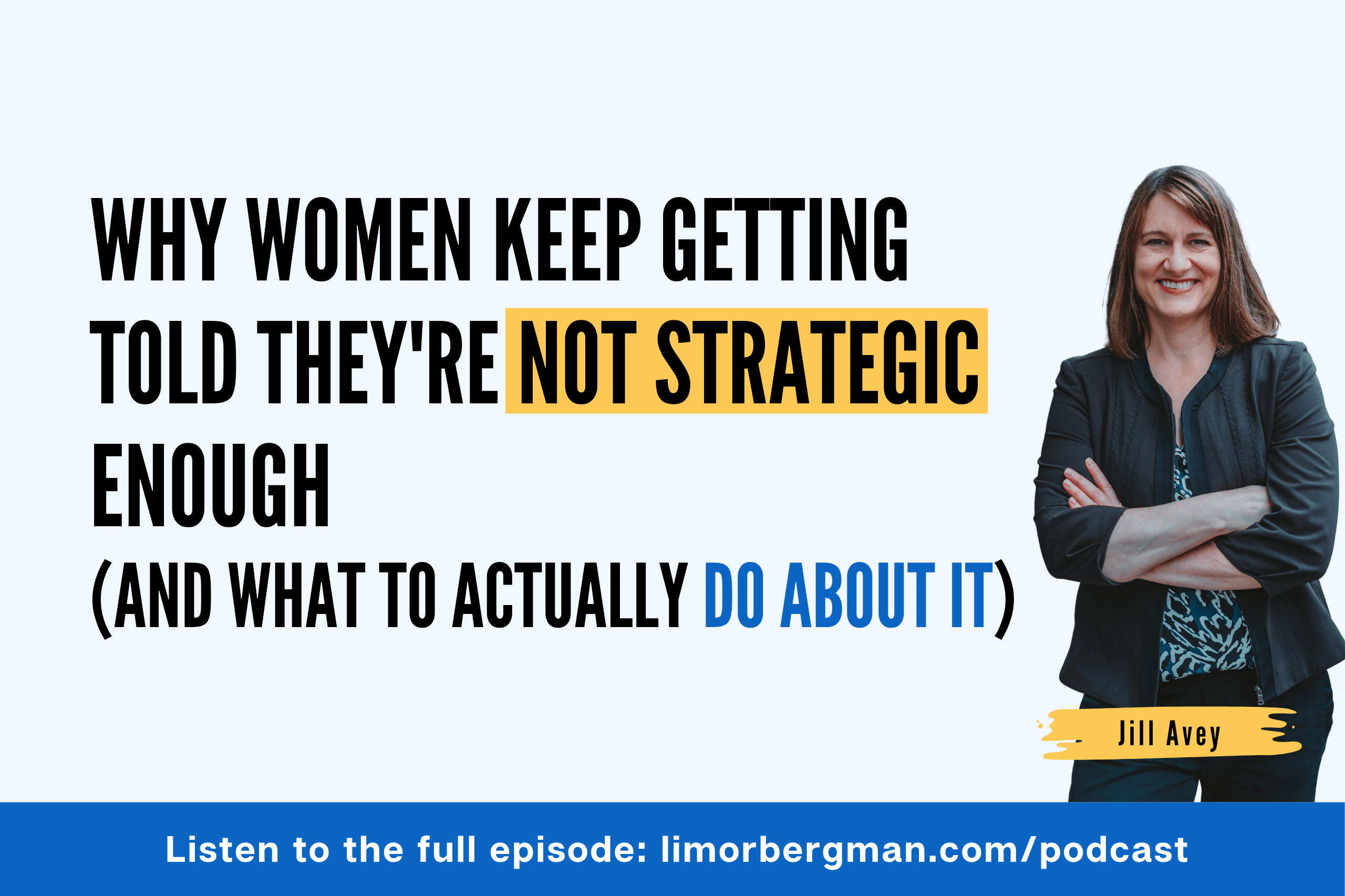
This week on the From a Woman to a Leader podcast, I sat down with Jill Avey, a women’s leadership coach, and the founder of SisterSmart. She has spent more than twenty years working with leaders inside Fortune 100 companies, and she is one of the first hundred coaches certified in the Big 5 of Strategy assessment.
Here is why I wanted her on the show. Jill spent fifteen years as a marketing strategist. Strategy was her actual specialty, the thing she studied and the thing she was paid for. And she still got told she wasn’t strategic enough.
But we didn’t spend the conversation complaining about the feedback. We spent it on the thing most advice skips: what strategic thinking looks like when you put it on a calendar, and what to say differently in the room so that the thinking you are already doing becomes visible to the people who decide about your career.
“Below are the insights from our conversation, with my own experience and concrete steps you can take this week.”
1. “Not Strategic Enough” Almost Never Means You Can’t Think Strategically
Jill’s own story is the clearest version of this. She had the credentials, the specialty, and fifteen years of doing exactly this work. The feedback still came. What she eventually understood was that the problem was never located where everyone assumed it was.
“I really think that it’s a difference of being seen as strategic. It’s not about strategic ability.”
“I was being strategic, I just wasn’t communicating that out to people in a way that they were looking for, that they could understand how my strategic thinking was happening. So it was kind of happening on the inside and nobody could see it on the outside.”
Jill on why the feedback is about visibility, not ability
When I asked her what people actually saw instead, her answer was uncomfortably familiar. They saw her doing and planning a lot of things, because that is what she reported. Here’s what I see again and again in the women I coach. You walk into the update with a list of everything you handled because it’s proof that you worked hard. Your manager hears a list. Nobody hears the thinking that produced it, because you never said it out loud.
How to apply this: Take your last written status update and count how many sentences describe what you did versus why it mattered to the company. Then rewrite one of them to lead with the why. Not a new project, just a different first sentence.
2. The Skill That Decides Who Becomes an Executive Is the One Women Score Lowest On
This is the part of the conversation that changed how I think about the topic as a whole. Jill pointed to the well-known research on leadership competencies, where women come out ahead of men almost across the board.
“Women rank higher than men in 17 out of the 19. But guess what’s at the bottom? Strategic perspective and technical skills.”
And then she said the part that stings.
“Strategic perspective is really important if you want to rise up the ladder because it’s the number one leadership skill that will determine your success as an executive. So it’s the one thing that they can point to of why executives succeed or fail or stay at mediocrity and get stuck.”
The one competency women get marked down on is the one that decides promotions
So the single competency women get rated lowest on is the same one that decides who makes it to the top. Jill does not read that as women being worse at strategy. She reads it as a portrayal problem. I read it the same way, and I lived it. As you move up you are expected to be less of an executor and more of a strategic thinker, and nobody hands you a manual for that transition.
How to apply this: Go back to whoever gave you that feedback and ask for one specific example. Not “how can I be more strategic,” which gets you a platitude. Ask: “Can you give me one moment in the last quarter where you wanted to see more strategic thinking from me?” A specific example is something you can work with.
3. Working Harder Is the Wrong Answer, and It’s the One We Were Trained to Give
When people hear they’re falling short, they do more of what already works. They put in longer hours. They try to be the smartest person in the room. Jill sees this constantly, and she is clear that it makes things worse, not better.
“What got you here won’t get you there. And this is exactly that shift that needs to happen from doing to leading.”
Then she explained why this shift is harder for women, and it was the most honest part of the episode.
“For women, I think this is especially sticky because we are raised to do, we’re raised to support, we’re raised to keep everything together. Socially, that’s really what our role has been, and it’s what’s expected of us. And so we have to break all of that social programming to let that go and be the strategist. And men don’t have to do that. They don’t get that same programming.”
Sound familiar? This is where women get stuck, and it is not a willpower problem. Doing feels good because doing is what you were praised for your whole life. Leading feels like you are getting away with something.
How to apply this: Write down one thing on your plate this week that you are still doing when you should be leading it. Then decide who you are handing it to, and what you will do with the time instead. If you cannot name what fills the space, you will take the task back by Thursday.
4. Thinking Doesn’t Feel Like Work, So It Never Makes It Onto the Calendar
Jill runs the Big 5 of Strategy assessment with her clients, and two areas consistently come up as the weakest. The first is thinking about the future.
“A strategic leader needs to be able to think ahead, understand what might happen. And that’s one that I find is often number 20 on people’s list.”
The second one is the one I want you to sit with.
“The second worst is reflective awareness, because taking time to reflect really doesn’t feel like work.”
She is direct about why it happens, and she does not blame anyone for it.
“You’ve got this huge checklist of things that you need to get done, and you’ve got to get home, you’ve got things at home, maybe kids to take care of, maybe parents to take care of. Women get squeezed from all sides. And we often put ourselves last.”
But the fix starts before any technique.
“The first thing is you have to decide that this is work.”
I want to underline that sentence, because everything else in this episode depends on it. As long as thinking sits in the category of “things I’ll do if there’s time left over,” there will never be time left over.
How to apply this: Put a fifteen-minute block at the end of your day, three days this week. Set a phone timer half an hour before it, and put a message in the timer explaining why it matters to you. Jill does this deliberately, because it is easy to blow off a reminder and much harder to blow off your own reason.
5. Hand Your Monthly Future Thinking to AI
This was the most practical minute of the conversation, and it addresses the objection every woman I coach raises: that there is no time to sit and think about the industry.
“Use AI for this, create an AI tool that’s going to run once a month for you that’s going to go out there and search for what is going on, what is the news, what are the scientific advances, whatever it is in software engineering, what are the new tools that are being used, what are the challenges.”
The part people skip is what happens next.
“Then have it report back to you, and now you have to take the time to reflect on it and see what does this mean to me, and what does this mean to my projects and my team and my company. And take that all the way up to the top, all the way up to the company’s objectives, the company’s overall strategy, and how am I fitting into that.”
The research is not the strategic act. The laddering is. Anyone can forward an industry newsletter. Almost nobody connects it to their own team’s work and their company’s stated goals, out loud, in a meeting.
How to apply this: Book one recurring hour a month, right now, while you are reading this. Half of it is reading what the tool brought you. The other half is writing three sentences on what it means for your team. Those three sentences are what you say in your next skip-level.
6. The Sentence to Stop Saying in Meetings
If you take one thing from this episode, take this one. It costs nothing and you can use it tomorrow.
“It might be tempting to say, well, leadership wants this to happen. Or it’s important to the CEO, so we need to get this project done. And you can use that. That’s like a borrowing power thing.”
Here is the replacement.
“If you instead said, this is an important strategic project for us because it ladders up to our company strategy in this way and that way, and then all of a sudden people realize, oh, our whole company’s waiting on us to do this. This is important for the whole company to achieve their goals. It’s not just some busy work that somebody gave me.”
“So that’s going to make you look more strategic versus I’m just the lackey for the CEO.”
The one language shift that changes how people see you
I said something to Jill in the moment that I want to repeat here, because I have done it myself. Sometimes we hide behind “the CEO asked for it” because it feels easier than making the case ourselves. It is borrowed authority, and borrowed authority makes you look like a messenger. The same work, described as something that ladders up to the company’s goals, makes you look like someone who understands the business.
How to apply this: Pick one thing you are asking your team to do this week. Write one sentence connecting it to a stated company objective. Say that sentence instead of “leadership wants this.”
7. Notice When You Drop Below the Line
Near the end, Jill offered a self-audit that I keep coming back to. In her leadership lab, she has people track how often they are above the line or below it.
“That’s something that you can think about in your day to day, is when am I dropping into being reactive? And we all know that feeling. Like, I just get through the day, if I could just get through the week, why is this happening to me?”
I told her that for me it shows up as autopilot, and her answer was immediate.
“Autopilot is definitely below the line.”
Then she closed with the thing I have quoted three times since we recorded.
“The plate will always get more full. As humans, we just do that. We add and add and add. And so you need a practice to be able to sometimes subtract.”
A practice, not a decluttering weekend. Something you do on a schedule, because the plate refills on a schedule too.
How to apply this: At the end of each day this week, ask yourself one question: was I above the line or below it today? Do not fix anything yet. Just count. After five days you will see which days and which meetings pull you under, and that is the thing worth changing.
About Jill Avey
Jill Avey is a women’s leadership coach with an Ivy League MBA and the founder of SisterSmart. For more than twenty years, she has worked with leaders at Fortune 100 companies and global organizations on executive presence, mindset, and the transition from the “stuck VP” phase to executive roles. She spent fifteen years as a marketing strategist before coaching, which is exactly why her take on this topic carries weight. She was told she wasn’t strategic, even though strategy was her job.
She is one of the first hundred coaches certified in the Big 5 of Strategy assessment, a twenty-competency tool that measures strategic thinking, doing, and adapting, and she built the Strategic Leadership Lab for Women around the pattern in this episode.
Since recording this episode, the next Strategic Leadership Lab for Women, a six-week online program, starts September 11. Details and registration are at sistersmart.com/sla.
Connect with Jill:
- LinkedIn: linkedin.com/in/jillavey
- Strategic Leadership Lab: sistersmart.com/sla
- Substack: jillavey.substack.com
- YouTube: SisterSmart Leadership
What I Took From This Conversation
The thing I cannot stop thinking about is how much of this is a calendar problem dressed up as a talent problem.
You were told you’re not strategic. You heard it as a verdict on your mind. But when Jill breaks it down, almost every piece of the fix is about where the thinking happens and whether anyone else can see it. Fifteen minutes at the end of the day. One hour a month. One sentence in a meeting that connects your work to the company’s goals instead of borrowing someone else’s authority.
None of that requires you to become a different person. It requires you to treat thinking as work, and to say the quiet part out loud in the room where decisions get made.
I go deeper on my own take in this week’s solo episode, where I share what I wish someone had told me when I got this feedback as a manager, and the calendar test I now run with every client. [SOLO EPISODE LINK]
You Don’t Have to Figure This Out Alone
If you are reading this and thinking “I know something needs to change, but I have no idea where to start,” I want you to know that you do not have to work this out by yourself.
I coach women in tech and other male-dominant fields who are competent, over-responsible, and quietly frustrated that the work is not speaking for itself. This exact question, how to be seen as strategic without turning into someone you are not, comes up almost every week.
Book a promotion strategy call, and we’ll figure out your next move together.
Where to Start This Week
Ask for one specific example. Go back to whoever said you’re not strategic enough and ask for a single moment from last quarter. Vague feedback stays vague until you make it concrete.
Put fifteen minutes of thinking on your calendar and defend it. End of day, three days this week, with a timer that reminds you why it matters. If it is not on the calendar, it is not work, and it will not happen.
Replace one sentence. Stop saying “leadership wants this.” Say what the work ladders up to instead. Same project, completely different impression.
Frequently Asked Questions
What does it mean when your boss says you’re not strategic enough?
In most cases, it means your strategic thinking is not visible, not that it is missing. Jill Avey, who spent fifteen years as a marketing strategist and still received this feedback, describes it as thinking that happens on the inside where nobody can see it on the outside. Managers see the activities you report, and if you report a list of tasks rather than the reasoning and priorities behind them, they conclude the reasoning is not there. The fix is usually in how you communicate your work, not in how you think about it.
Why are women rated lower on strategic perspective?
Research on leadership competencies published in the Harvard Business Review found that women were rated higher than men on 17 of 19 competencies, with strategic perspective and technical expertise as the two exceptions. Jill Avey’s view is that this reflects how women’s strategic work is portrayed and perceived rather than a real gap in ability. She also points to social conditioning: women are trained to do, to support, and to hold things together, so they default to reporting execution rather than thinking.
How do you become more strategic as a leader?
You start by treating thinking as actual work and scheduling it. Jill Avey recommends two habits: ten to fifteen minutes of reflection at the end of every day while it is still fresh, and one monthly session of future thinking where you research what is changing in your industry and connect it to your projects, your team, and your company’s objectives. The connecting step matters more than the research step, because that is what other people can see.
How do I show strategic thinking in meetings?
Change how you describe the work. Instead of saying “leadership wants this” or “the CEO asked for it,” which Jill Avey calls borrowing power, explain how the project ladders up to the company’s strategy and what it enables for the wider organisation. The task is identical. The impression is completely different, because one version sounds like a messenger and the other sounds like someone who understands the business.
What is the difference between being strategic and being seen as strategic?
Being strategic is the thinking you do about priorities, the future, and how the pieces of the system fit together. Being seen as strategic is whether the people who make decisions about your career can observe that thinking. Jill Avey argues most women who receive this feedback already have the first and are missing the second, which is good news, because the second is a communication skill you can practice.
How do you find time to think strategically when you have no time?
Schedule a smaller amount than you think you need and protect it. Fifteen minutes at the end of the day is enough to start, and one hour a month is enough for future thinking. Jill Avey suggests setting a phone timer half an hour before your reflection block with a message explaining why it matters to you, because the hardest part is not the time; it is giving yourself permission to spend it on something that does not feel like work.
Can AI help with strategic thinking?
Yes, for the research half of it. Jill Avey recommends setting up an AI tool that runs monthly and reports on changes in your field: news, advances, new tools, and emerging challenges. What AI cannot do for you is the second half: deciding what those changes mean for your projects, your team, and your company’s goals. That interpretation is the strategic act that makes you visible.
Who is Jill Avey?
Jill Avey is a women’s leadership coach, an Ivy League MBA, and the founder of SisterSmart. She has worked with leaders in Fortune 100 companies for more than twenty years, spent fifteen years as a marketing strategist before coaching, and is one of the first hundred coaches certified in the Big 5 of Strategy assessment. She created the Strategic Leadership Lab for Women, a six-week online program for women who keep hearing they are not strategic enough.
🎧 Listen to my conversation with Jill Avey: Why Women Keep Getting Told They’re Not Strategic Enough
📺 Watch on YouTube: https://youtu.be/KgJlCFmE_5I
📝 Read the deeper, more personal version on Substack
T
Full Transcript
Full transcript of my conversation with Jill Avey on the From a Woman to a Leader podcast. Lightly edited for readability — filler words and false starts removed, wording otherwise unchanged.
Why women keep getting told they’re not strategic enough
Limor Bergman Gross (00:00): Hi and welcome back to the From a Woman to a Leader podcast. I’m your host, Limor Bergman Gross, and my guest today is Jill Avey. Jill is a women’s leadership coach and the founder of SisterSmart. Jill spent fifteen years as a marketing strategist and she was still told she wasn’t strategic enough. She’s one of the first hundred coaches certified in the Big 5 of Strategy assessment, and she built the Strategic Leadership Lab for Women around exactly this problem. We talk about why strategic perspective is the one competency where women get rated below men, what strategic thinking actually looks like on a calendar, and the sentence to stop saying in meetings. So if any of you have ever been told that you’re not strategic, and I can share, I have been told that, and no one explained to you what they meant, this episode is for you. So are you ready? Let’s dive right in.
Limor Bergman Gross (01:13): Hi Jill, how are you?
Jill Avey (01:15): I’m great. Thanks for having me on today.
Limor Bergman Gross (01:17): I remember one of the things that I’ve been told as a manager, when I was managing, it was very annoying. I was told, you’re not strategic.
Jill Avey (01:27): Yes, so many women hear that, myself included.
Limor Bergman Gross (01:30): Right? You heard it too?
Jill Avey (01:34): Even though strategy was my specialty.
Limor Bergman Gross (01:37): Wow. But you know, the thing was that no one really told me what it meant and how to be strategic.
Being strategic versus being seen as strategic
Jill Avey (01:46): Exactly. I really think that it’s a difference of being seen as strategic. It’s not about strategic ability. I mean, we can use me as an example, that I actually was very strategic. That was one of my special things that I focused on in business school. I spent 15 years being a strategist in marketing, and yet I was criticized for not being strategic enough. And what I know now, from today’s seat, is that I was being strategic, I just wasn’t communicating that out to people in a way that they were looking for, that they could understand how my strategic thinking was happening. So it was kind of happening on the inside and nobody could see it on the outside.
Limor Bergman Gross (02:29): So what did they see?
Jill Avey (02:31): So they saw me doing a lot of things and planning a lot of things. And that’s what I talked about, was all the things. But yet I didn’t take the time to strategically communicate to them, and to prioritize and put things in buckets and make things easy to understand for my audience, which in this case was the senior leadership.
Limor Bergman Gross (02:53): Yeah. Wow. So this is actually two topics, right? How to be strategic and how to be seen as strategic.
Jill Avey (03:00): It is, yes.
What the Big 5 of Strategy assessment measures
Limor Bergman Gross (03:02): Wonderful. And you mentioned to me that this is like a specialty for you, and you’re also doing an assessment, right? A strategy assessment. Can you share a little bit about that?
Jill Avey (03:14): Sure. So what happened is, last year, I’ve been coaching for nine years and I’ve been hearing my clients get criticized for this. And I knew it was an issue that I really wanted to tackle, but last year I finally, you know, everything came together and I decided, okay, this is the time. And so I put together this curriculum that I have called the Strategic Leadership Lab for Women. It’s a six week online workshop program. And then as I was doing the research for that, somebody told me about this brand new assessment called the Big 5 of Strategy. And so then I got certified. I’m one of the first 100 coaches to be certified in that assessment. And now I use that for all my clients. And what we do is we do that assessment first so that they can see where they stand, and then they can really know what to lean into and what to really focus on throughout the program, so that they come out on the other side being the strategic leader that they want to be.
Jill Avey (04:12): Versus guessing, because for so long we had no language around this. And probably men get criticized for the same thing and don’t know what to do either. And so this assessment’s really exciting, because it’s finally giving people 20 different competencies that they can work on in five different buckets. And so it also helps you see the process of strategy. A lot of times people think that strategy is just thinking, but one of the things I love about this assessment is it combines the doing, because no strategy in the world is helpful if you don’t execute it. And so it really takes that into consideration. So there’s the thinking part, there’s a thinking axis, there’s a doing axis, and then there’s also a change management axis of adapting, which of course is super important right now.
Why strategic perspective decides who becomes an executive
Limor Bergman Gross (05:03): Yeah, before we dive into that, why is it even important for women, especially women in tech and women in male dominant fields? Why is being strategic and being seen as strategic important?
Jill Avey (05:16): So for two reasons. Strategic perspective is one of the 19 leadership competencies that was ranked by Zenger and Folkman. They studied 1,360 reviews. And they found, in that assessment, they found that women rank higher than men in 17 out of the 19. But guess what’s at the bottom? Strategic perspective and technical skills. Which both of those, I think, are about how they’re being portrayed, not that they’re actually lacking in them. Not that we don’t have some room for improvement, but why strategic perspective is so important, I mean, technical skills are important too, but strategic perspective is really important if you want to rise up the ladder, because it’s the number one leadership skill that will determine your success as an executive. So it’s the one thing that they can point to of why executives succeed or fail or stay at mediocrity and get stuck.
The shift from doing to leading, and why it’s harder for women
Limor Bergman Gross (06:19): Definitely, and that was a blocker for me as well in my career. Because as you grow you’re expected to be less of an executor and more of a strategic thinker.
Jill Avey (06:33): Exactly, and that shift is something that leaders often don’t understand needs to happen. And so what happens is they just keep working harder and trying to be smarter. And so you get people that are always trying to prove they’re the smartest person in the room, or working harder and harder and burning out. And those are two really good signs that you need to lean into strategy more.
Jill Avey (06:57): There’s a saying, what got you here won’t get you there. And this is exactly that shift that needs to happen, from doing to leading. And so that’s a big part of what we do in the leadership lab, because that’s a mindset shift. And people often don’t realize that they’re holding on to that doer mentality. And for women, I think this is especially sticky, because we are raised to do, we’re raised to support, we’re raised to keep everything together. Socially, that’s really what our role has been, and it’s what’s expected of us. And so we have to break all of that social programming to let that go and be the strategist. And men don’t have to do that. They don’t get that same programming. And so that’s why we spent two weeks on this in the leadership lab, of really shifting the mindset.
Why thinking doesn’t feel like work
Jill Avey (07:49): Until your mindset changes, you’ll keep pulling yourself back to that doing, because it’s going to feel good. And what happens is the strategy work, the thinking work, doesn’t feel like work to us. And so we’ll feel like we aren’t doing anything, and we want to contribute and be our best. And so we’ll keep pulling back.
The two areas where women score lowest
Limor Bergman Gross (08:07): Exactly, yeah. And when women reach out to you and you do this assessment, what are the most common areas where you see women falling short?
Jill Avey (08:19): It’s interesting, because there’s a couple that come to mind. One of them is about thinking about the future. And a lot of times we’re very much about the present and what is happening now, taking care of everybody, how is everybody feeling? How’s the team? We’re great at that stuff, but a strategic leader needs to be able to think ahead, understand what might happen, how is that going to affect things? And that’s one that I find is often number 20 on people’s list.
Limor Bergman Gross (08:57): And it’s hard, because one of the challenges I see also is that you have so much on your plate. You have so much to do and you have so many people to take care of. So how do you find that time to do things that are not urgent?
Jill Avey (09:14): Exactly, exactly. And that leads us to the next one. The second worst is reflective awareness, because taking time to reflect really doesn’t feel like work. And so that’s often one that gets left behind too. When you’ve got this huge checklist of things that you need to get done, and you’ve got to get home, you’ve got things at home, you’ve got maybe kids to take care of, maybe parents to take care of. Women get squeezed from all sides. And we often put ourselves last. And so therefore that reflective time, and really thinking about what do I need? How am I doing? How is the team doing? How are my stakeholders doing? How am I serving them? These kinds of things, what’s working and why and why not. That reflection time makes a big difference between leaders, and the ones that take that time to reflect are the ones that really make the gains.
Using AI for your monthly future thinking
Limor Bergman Gross (10:11): And let’s say you have a woman that reached out to you and she is coming short on those two things, future thinking and reflective awareness. Walk us through, I know that you have in the Strategic Leadership Lab, you have like toolkits for how to actually change that. So can you walk us through a little bit the process, so maybe women listening to us can start implementing that?
Jill Avey (10:37): Yeah, here’s some things you can do today. The first thing is you have to decide that this is work. You have to decide this is worth your time, and it needs to go to the top of your list at some point, at some point in the day for reflection, at some point in the month for the future thinking. So let’s take the future thinking. Just use AI for this, create an AI tool that’s going to run once a month for you that’s gonna go out there and search for what is going on, what is the news, what are the scientific advances, whatever it is in software engineering, what are the new tools that are being used, what are the challenges, these kinds of things. AI is perfectly suited for this. And then have it report back to you, and now you have to take the time to reflect on it and see, what does this mean to me, and what does this mean to my projects and my team and my company, and take that all the way up to the top, all the way up to the company’s objectives, the company’s overall strategy, and how am I fitting into that? Because that’s one of the things that we need to do as a strategic leader, is be thinking about the whole organization. And so once we’ve done that, that’s building in some reflection time once a month maybe. And at least do this once a quarter, but once a month would be better.
The daily reflection habit and the timer trick
Jill Avey (11:58): Because you want to get in the habit of it. You want it to be, you know, it’s not just something I do sometimes. It’s something where I have my finger on the pulse of what’s coming up. And then the reflective awareness piece is something that, honestly, I think every leader should be reflecting every single day. It only has to be 10, 15 minutes at the end of your day, and reflect on how it went while it’s still fresh in your mind. You can do it in the morning, but it’s harder to remember what happened yesterday. And this is not an easy habit to create, I realize, because you wanna just sign off and run.
Limor Bergman Gross (12:33): Yeah, usually you want to go and do something that is not work related, right?
Jill Avey (12:38): Right, right. And I also like to maximize what I got done in a day. So a lot of times I’m getting that one last thing done and then I put my computer to sleep and I’m gone. So what I do, and I recommend for everybody, is set a timer on your phone that reminds you like half an hour early, time to wind down, time to finish up this project. And then there’s another timer that says, okay, this is your reflection time. And what I do is, on the timer you can usually put a little message in there. And I put a message in of why this is important to me, because it’s so easy to blow it off. And so, using some behavioral science here, we want to remember what the purpose is, and remember why this is valuable for me and this is valuable for my career and my team. Because we’ll do things for others before we’ll do things for ourselves. And so bring the others in and show yourself why this matters across the board.
Getting outside input and stakeholder insight
Limor Bergman Gross (13:35): You know, it reminds me, I had a guest on this podcast and she talked about how she’s starting her own podcast, and it was very, very niched down, something in marketing, content marketing or whatever. And I remember after the conversation I reflected on it and I was thinking, hmm, that’s very interesting, maybe I should consider my podcast. Because right, it’s so easy to just execute and go with the flow and do things on autopilot. It kind of got me thinking about a podcast. So it was interesting that it happened after a recording.
Jill Avey (14:14): Nice, yeah.
Jill Avey (14:23): That’s another good strategic thing to do, is to get outside input. And really one of the other things that I find women are either great at or not so great at, they’re kind of usually on one end of the spectrum or the other, is stakeholder insight. Understanding their stakeholders and really understanding their viewpoints. It helps inform the whole rest of the strategic process. And so that’s another thing we can add in here.
The five buckets of strategy
Limor Bergman Gross (14:51): Definitely. And I would say, if you don’t know what to work on, or what the future holds, start, as you said, talking with stakeholders. Depending on your role, with clients, with teams, with other teams, and gather inputs from them.
Jill Avey (15:10): Absolutely, absolutely. So that’s kind of the first competency, is called grasp the present. And then you go from there to shape the future, which is all your ideating, and how you put your ideas together and tell the stories of it and shape that into frameworks. And then you go into the execution part, where it’s delivering the results, and moving the system is a piece of that too. So it’s not only like the project management piece, but it’s also the people, and understanding this whole organization and what does that need to move to be able to do this thing. So I think that grasp the present, the very beginning part of understanding the whole system, and then what needs to happen for the change management piece, is some of the most insightful pieces of this assessment. And then we also get the adapt to change, which is a really important piece for today’s world, because my gosh, so much adaption.
Limor Bergman Gross (16:07): Yeah, I think part of it is because there’s so much uncertainty. You can plan something and then it will change and it will no longer be relevant.
Jill Avey (16:19): And that’s part of that competency, is being able to be living in that uncertainty and being able to be flexible and move your goals and pull different resources together and things like that.
Inside the Strategic Leadership Lab framework
Limor Bergman Gross (16:33): Yeah, so what else can women listening to us do differently? So we talked about using AI to do some research, reflecting every single day. Anything else that you can recommend?
Jill Avey (16:46): Well, so I can go to the framework of the leadership lab. The first thing that we do is we develop an enactive mindset. And that’s a funny word, and it’s one that people don’t usually understand very well. It’s E-N-A-C-T-I-V-E. So enactive is about, you’re a person who happens to the world. Proactive is a little bit more of a pushing and making things happen. But enactive is more of a co-creation energy. And it’s acknowledging that the world is happening, but I’m also happening to the world, and how do we come together and create something better. And it’s a really beautiful energy to have, particularly as a strategic leader. And then we work on our strategic influence. So this is about how I build coalitions and how I position myself as a strategic leader. So starting to talk differently. So we make some language pattern shifts.
Jill Avey (17:42): This is what we were talking about in the beginning of, like, how do you speak about what you do? And then we work on innovation, because a strategic leader has to be innovating. They have to be bringing new things into the company. That’s really your value as an executive, is pushing things forward and creating new value. And so we spend a week on that. And then strategic insight. So this is about understanding where you get insight and what really matters. So we talk about the Pareto principle here. Everybody’s heard of the 80-20 rule, but very few people actually apply it to their daily life. And it’s really important to figure out what is in your 20 percent that really matters, and focusing on that, and continuing to even look at the 20 percent of that 20 percent.
Jill Avey (18:33): And then the strategic impact piece. So that’s where we look at constraint, because if you understand the constraints in your system and you work on those constraints, you will make a much bigger impact on your role in your company than by just checking off more things on your to-do list. And so really understanding which things you want to focus on first is important. And then the last thing is that mindset shift from doing to leading. And so we spend some time with that. That’s kind of the framework of how we are seen as a strategic leader, how we are more strategic. And if you’re focusing on those things, it’s gonna make a huge difference for how people perceive you. Our clients, I mean, they’ve had amazing results where things start shifting within the six weeks. And some people have been interviewing for jobs and have had their interviews go way better and gotten really good jobs as a result of shifting this thought pattern and how they’re being seen. So it was pretty neat stuff.
The client who wrote a white paper and changed jobs in six weeks
Limor Bergman Gross (19:32): Fantastic. Do you have an example of someone or something that created a huge shift?
Jill Avey (19:39): Yeah, one client, she was working for one company and she was deciding whether she was going to stay there or leave, because there had been a restructuring. So she was at an inflection point, and she really loved the company and had come in wanting to make it a go and find something different. But then through the program, she had some really big ideas. She’s a quality professional, and she came up with a whole white paper on how she saw the future of quality. And by doing that exercise, because we do a strategic project, so that was her project, and by doing that exercise she realized that the company she was with was not where she was going to be able to execute this. And so she moved on to another company within the six weeks. She got a job really fast, because she had these new ideas and she had something to offer. And so she went with a slightly smaller company that was growing and was one that would embrace new things more, and really bring her in to be able to do some of this work. And so it was pretty exciting to see that shift for her. That’s a client that I’ve been working with for quite some time, and so I know that this just unleashed a whole new direction for her, and I’m really excited about it.
Limor Bergman Gross (20:58): It’s incredible.
The sentence to stop saying in meetings
Limor Bergman Gross (21:01): Fantastic. And what is important for women to do to be seen, not just to be strategic, but to be seen as strategic? Can you point to several things? You mentioned language. What things can they do to make sure that they are seen as strategic?
Jill Avey (21:21): On LinkedIn, I do a lot of posts that give you language pattern shifts. So think about how we can talk about being strategic better. So maybe it might be tempting to say, well, leadership wants this to happen. Or it’s important to the CEO, so we need to get this project done. And you can use that. That’s like a borrowing power thing. But instead, if you instead said, this is an important strategic project for us because it ladders up to our company strategy in this way and that way, and then all of a sudden people realize, oh, our whole company’s waiting on us to do this. This is important for the whole company to achieve their goals. It’s not just some busy work that somebody gave me.
Jill Avey (22:15): So that’s going to make you look more strategic, versus I’m just the lackey for the CEO, you know? And so that starts to shift. When you start to speak differently, it starts to shift how people see you.
The chief of staff who reframed her whole role
Limor Bergman Gross (22:27): Wonderful. And I think sometimes you feel uncomfortable asking people, telling people what to do, and we use that, the CEO asked for that, just as an easier way, I guess. We think it’s easier just to convince people to do something.
Jill Avey (22:44): Yeah, yeah. And one client had a really big shift in her mindset. She was a chief of staff. And chief of staff is a funny role where you’re working on very high level things and very low level things, and sometimes you’re doing a lot of detail work. And she was tending to define herself as that lower level detail work. And she wasn’t communicating what she was doing, and especially not in this strategic way. And so this is one of those jobs where people can wonder, what does that person do? And so it’s important to be communicating out what you’re doing when you have one of these jobs that’s not obvious, and there’s not big deliverables. And so in this process, she was able to kind of reframe her role in her own mind, of how strategic it is and how important it is, and that she laddered it up to what this organization was doing out there in the world. And it’s impacting tens of thousands of people with the work that they’re doing, and in a very specific way that she’s really excited about. And so when you can start to see that greater purpose and that mission of your work, because you’re tying it to the strategy, it means that you can have so much more fulfillment in what you do and more purpose, and it gets you through those hard days. And so she was really excited about seeing it in a whole different light. And she was like, this is changing everything for me.
Limor Bergman Gross (24:15): Definitely. And I think also when you lead people and other people realize why you’re doing the things you’re doing, how it’s impacting the company, how it’s aligned with the company direction, it helps people be more motivated.
Jill Avey (24:32): Absolutely, yeah.
Above the line, below the line
Limor Bergman Gross (24:34): So what else haven’t I asked that you can share with us about strategy?
Jill Avey (24:42): One of the things, I wanna go back to the enactive mindset. One of the things that we do is an audit of how often you’re above the line or below the line. And so that’s something that you can think about in your day to day, is when am I dropping into being reactive? And we all know that feeling. Like, I just get through the day, if I could just get through the week, why is this happening to me? Everybody has that feeling of a victim once in a while. I’m just gonna put my head down and get things done. That’s a reactive state. So really watching, how is it that you’re dropping into reactive mode? How is it that you bring yourself back up? How does your energy shift when you do that? That’s another thing I’d like to leave people with.
Limor Bergman Gross (25:31): Sure, yeah. And I think for me it’s like trying to get out of autopilot.
Jill Avey (25:39): Yes, autopilot is definitely below the line.
Limor Bergman Gross (25:43): Yeah, so instead of doing things just because you’re used to doing them, try to kind of break that cycle.
The plate will always get more full
Limor Bergman Gross (25:51): Yeah, and for me I found that focusing on fewer things and fewer priorities really helps. Otherwise it’s overwhelming.
Jill Avey (26:00): Yes, I think most of us can use to focus on fewer things, and that’s where that 80-20 comes in, of really analyzing what is it that you’re doing that’s making a difference in all different areas of your life. And this is a big part of what we work on in my bigger leadership program, is what’s on your plate and what’s not on your plate, because that’s an important thing. To me, it’s a practice, because the plate will always get more full. As humans, we just do that. We add and add and add. And so you need a practice to be able to sometimes subtract.
The Strategic Leadership Lab, and where to find Jill Avey
Limor Bergman Gross (26:38): Yeah. And just before we end today, tell us about your Strategic Leadership Lab, when it is and how can women find more about it.
Jill Avey (26:49): Yeah, I’m really excited. We have a leadership lab starting September 11th. And so they can go to the sistersmart.com slash SLA website and see and learn more about that.
Limor Bergman Gross (27:02): I will definitely put that in the show notes. And how can women find you?
Jill Avey (27:08): They can find me on LinkedIn, that’s the easiest way. I post every day and I’m there chatting with people in the DMs and in the comments. And so I spend a lot of time on LinkedIn. So that’s the best place to find me. I also have a Substack profile as well, so if you like long form, you can find me there too.
Limor Bergman Gross (27:27): Wonderful. So I will find you as well, because I’m also there.
Jill Avey (27:31): And also on YouTube, I have a YouTube channel called SisterSmart Leadership, for my own podcast.
Limor Bergman Gross (27:38): Wonderful. Thank you so much. It’s been a pleasure speaking with you today.
Jill Avey (27:43): Thanks for having me.