
You know that role you keep circling? The promotion, the project, the idea you’d build if things were different. You’ve told yourself you’ll go for it when you’re more senior, more experienced, more ready.
And in the meantime, you keep scanning the room for proof: someone who has done it, someone who looks like you, someone more qualified who should probably go first.
Here’s the quiet lie underneath all of it: that the qualified person is someone else. If you have been waiting for someone more qualified to step up, take the role, or prove the path is real, this conversation is going to be uncomfortable in the best way.
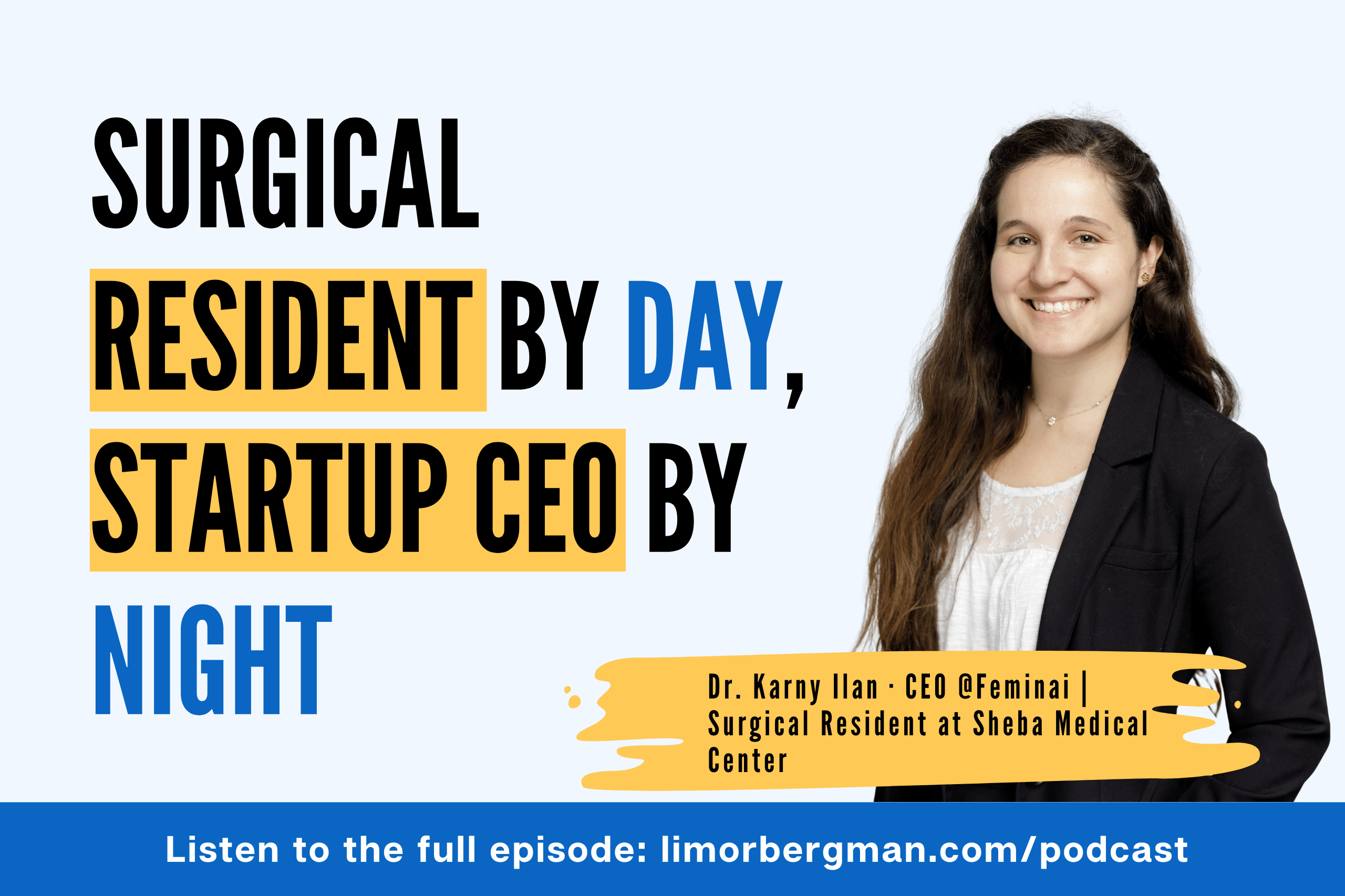
This week on the From a Woman to a Leader podcast, I sat down with Dr. Karny Ilan, a general surgery resident at Sheba Medical Center and the CEO and co-founder of Feminai, a startup building an AI-powered at-home breast cancer screening device. Karny and her two co-founders started as three students with no business experience and raised over $2 million in a seed round led by Vertex Ventures. Since we recorded, she became a mom. She was named to the Forbes Israel 30 Under 30 list, and she does all of this between 30-hour hospital shifts.
But that’s not what we talked about. We talked about the thing most career advice skips: what to do when the role model you’re looking for doesn’t exist, and how to stop assuming the person who should lead is anyone other than you.
Below are the insights from our conversation, with my own experience and concrete steps you can take this week.
1. When You Can’t Find a Role Model Who Looks Like You, You Might Be Her
Before starting her residency, Karny searched everywhere for one person who had done what she was attempting: practice medicine and run a company as the actual CEO, not as an advisor with a good idea.
“I wanted to find someone that was me. And I really couldn’t, I couldn’t find someone that was both the CEO, but also a doctor at the same time.”
She found no one. She did it anyway.
Here’s what I see again and again in the women I coach: we treat the absence of proof as proof of absence. No woman like you at the VP level? Then it must not be possible for someone like you. I ran this exact search myself, looking for quiet, introverted women in top leadership roles, and when I came up empty I concluded I wasn’t a fit. It took me years to understand that an empty search result is not a verdict. It is a vacancy.
How to apply this: Write down the sentence you’ve built from missing evidence (“there are no leaders like me here, so I don’t belong at that level”). Then ask: what would I attempt this month if being first was a reason to go, not a reason to wait?
2. If You’re Waiting for Someone More Qualified, You’ll Wait Forever
In Feminai’s early days, Karny assumed that at some point she would raise a seed round and hand the company to a “real CEO.” Then she understood the ecosystem.
“Today I’m looking back, I’m like, no way. It’s my company. No one will do this better than I do. And it’s not because I’m a different person than I was then. It’s just because I kind of understood the ecosystem. Ultimately, if you have a vision, you’re the best person to bring this forward.”
Karny on why she stopped planning to bring in a “real CEO”
Read her words again: she is not a different person. Her credentials didn’t change. Only the assumption changed. This is where women get stuck, in companies just as much as in startups. We defer to whoever sounds more confident in the meeting, assume the promotion belongs to the louder colleague, and save the big role for a future version of ourselves that never quite arrives. Sound familiar?
How to apply this: Name one responsibility you’ve been quietly saving for a “readier” you, and take one visible step toward it this week: raise your hand for it, tell your manager you want it, or put your name on the document.
3. Authenticity Beats the Costume, Even in Rooms Full of Men
When Karny started pitching VCs, she copied the women around her, who all seemed to transform themselves in male company.
“It kind of felt like they were all putting on a costume when they were like in male presence. And at my first few meetings, I kind of copied them until I was like, no way, this is not comfortable for me.”
So she walked into investor meetings as herself, wearing whatever she wanted. Her explanation is the best fundraising advice I’ve heard in a long time:
“Ultimately, pre-seed and seed funding is all about the team. So the VC has to like the team. If you’re dressing up and acting like someone else, no one will like you. So they want to see authenticity and they want to connect to you and trust you.”
The same is true in your performance review, your exec presentation, your interview. I see women rehearsing a lower voice, borrowing words that aren’t theirs, flattening how they naturally think so they’ll resemble the leaders around them. The costume doesn’t read as credibility. It reads as distance.
How to apply this: Before your next high-stakes meeting, notice one thing you do that is performance rather than preference (the borrowed jargon, the suppressed questions) and drop it. Watch what happens to the connection in the room.
4. “Especially Because You’re a Woman” Is Data About Them, Not About You
When Karny told senior surgeons she wanted general surgery, the field with almost no senior women, the reaction was scripted.
“They’d be like, no, no, don’t do it to yourself. Go to something simpler, especially because you’re a woman. They always add that especially.”
“Don’t do it to yourself, especially because you’re a woman”
She had clicked with surgery on day one of medical school, so she treated the warnings as noise: “To me it was like people scaring me and I was like, okay, it’s fine. I’ll handle it.” My take is that a warning like this tells you about the person giving it, their generation, their fears, the horror stories they’ve collected. It measures their imagination, not your capability. Karny is honest that the bias is real, she was scared to pitch while imagining what investors might think about three female founders having babies. Things are not there yet. And still, every woman who does it anyway makes it more normal for the next one.
How to apply this: Take one path you filed under “impossible” because someone warned you off it. Ask yourself whose fear that warning actually described, and what one small test (a conversation, an application, a pilot) would tell you the truth.
5. A Strong Why Beats Any Time Management System
I asked Karny the question everyone asks: how can you function as a CEO after a 30-hour hospital shift? Her answer had nothing to do with productivity hacks. She would finish a shift and take a cab straight to the office.
“It basically always comes down to what do you want to do? If that’s what you want to do, that’s what you’ll do.”
I have a sentence I always say, and this conversation proved it again: when you have a strong why, nothing can stop you except yourself. If your goals exhaust you, it may not be a scheduling problem. It may be a why problem. Karny doesn’t push through her weeks on discipline. She is pulled through them by a mission that started in a family with a history of breast cancer and a pain point she wrote in a notebook during hospital rounds.
How to apply this: Before you optimize your calendar this week, ask the harder question: do I actually want this goal, or do I think I should want it? If the why is weak, fix that first.
6. Borrow Belief Until You Build Your Own
When Karny couldn’t find a role model and didn’t know if the leap was survivable, her husband reframed it for her: people had warned her before, about combining work and research with medical school, and she had handled all of it easily.
“Who says it’s not gonna work like that with residency? We don’t know. We have to try.”
The leap: “We don’t know. We have to try.”
I know this pattern from my own life. When I was 8 months pregnant, and a manager opening came up, I applied because my husband pushed me, not because I believed I could. I got the role while on maternity leave, and it changed my career. Sometimes you borrow someone else’s belief in you until you can build your own. There is no shame in the loan. The mistake is refusing it.
How to apply this: Ask one person who knows your work- a manager, a mentor, a partner- what they think you’re ready for that you haven’t gone after. Let their answer be your push.
About Dr. Karny Ilan
Karny is a general surgery resident at Sheba Medical Center and the CEO and co-founder of Feminai, a women’s health startup developing the first AI-powered remote breast cancer screening platform for at-home use. She grew up in a family with a rich history of breast cancer, found her startup idea by walking hospital rounds with a notebook, and was named to the Forbes Israel 30 Under 30 list. Since recording this episode, Karny gave birth to her first child, and true to her own words about never really being on maternity leave from your own company, Feminai hasn’t slowed down.
Connect with Karny on LinkedIn and learn more about Feminai.
What I Took From This Conversation
The line I keep coming back to is “it’s not because I’m a different person than I was then.” Every version of waiting, for a role model, for a readier you, for permission, assumes that something about you has to change before you’re allowed to move. Karny’s story says the opposite: the capability was there the whole time, and what changed was only the assumption about who the qualified person is.
You Don’t Have to Figure This Out Alone
If you’re reading this and thinking, “I know I’m the one holding the vision, but I keep assuming someone else should lead it,” you don’t have to untangle that on your own. I work with women in tech leadership on exactly this: moving from waiting for permission to taking ownership, without becoming someone you’re not. Book a promotion strategy call, and we’ll figure out your next move together.
Where to Start If This Hit Home
Name the thing you’re saving for a readier you. One role, one project, one conversation. Take a single visible step toward it this week.
Run the evidence check. Take the warning or the missing role model you’ve treated as a verdict, and ask what it actually proves about you. Usually the answer is nothing.
Borrow one push. Ask someone who knows your work what they think you’re ready for. Then act on their answer instead of waiting to agree with it.
Frequently Asked Questions
Who is Dr. Karny Ilan? Dr. Karny Ilan is a general surgery resident at Sheba Medical Center and the CEO and co-founder of Feminai, a startup developing an AI-powered at-home breast cancer screening device. She was named to the Forbes Israel 30 Under 30 list and raised a seed round led by Vertex Ventures while completing her residency.
How do you become a leader when you don’t feel qualified? Start by acting on the evidence of what you can do rather than waiting to feel qualified, because the feeling usually follows the action. Karny Ilan planned to hand her company to a “real CEO” until she realized no one would do it better than her, and as she says, she is not a different person now. Take one visible step toward the role you want and let competence build confidence.
What should you do if there are no role models who look like you? Treat the absence of role models as a vacancy, not a verdict. Somebody is always first, and the missing example only proves that no one has done it yet, not that it cannot be done. Karny Ilan searched for a doctor who was also a CEO, found no one, and became that role model herself.
How do female founders raise money from VCs? Focus on trust and authenticity, because at pre-seed and seed stage investors are betting on the team. Karny Ilan found that dressing up and acting like someone else made investors trust her less, and that showing up as herself built the connection that closed her rounds. Statistically VCs meet fewer women, so some discomfort is about their unfamiliarity, not your ability.
Can you start a company while working a demanding full-time job? Yes, if your why is strong enough and you use the structure of your schedule deliberately. Karny Ilan runs Feminai around 30-hour hospital shifts by scheduling US meetings in the evening and going to the office after shifts, and she says it always comes down to what you actually want to do.
How do you deal with people telling you a career is not for women? Treat the warning as information about the person giving it, not a measurement of you. Karny Ilan was told “don’t do it to yourself, especially because you’re a woman” by senior surgeons and chose general surgery anyway, because she had already clicked with the work. Test the path yourself with small steps instead of adopting someone else’s fear.
What is Feminai and how does its at-home breast cancer screening work? Feminai is a women’s health startup building the first AI-powered remote breast cancer screening platform for home use. A woman places a disposable wearable patch on her chest, connects it to an app via Bluetooth, performs a five-minute exam per breast, and the results go directly to her physician, who decides if further examination is needed. It will initially serve as a triage tool alongside mammography.
How do you balance a demanding career with becoming a mom? Decide what kind of mother and professional you want to be, and organize your life around that decision instead of other people’s judgment. Karny Ilan delegates more at Feminai, accepts she will not fully step away from her own company, and points out that any decision you make is fine as long as it is yours.
🎧 Listen to my conversation with Dr. Karny Ilan: Stop Waiting for Someone More Qualified
📺 Watch on YouTube: https://youtu.be/Ot_sHeu8aFU
📝 Read the deeper, more personal version on Substack