
You were the best on your team. The one everyone came to when something broke. The star of the show.
So they promoted you. They handed you a team and told you to lead. And somewhere in the first few weeks, quietly, you realized you had no idea what you were actually supposed to be doing.
Nobody handed you a new map. Nobody told you that the skills that made you great are not the skills that make you a good leader. You just got the title and a whole new job that looks nothing like the one you were good at.
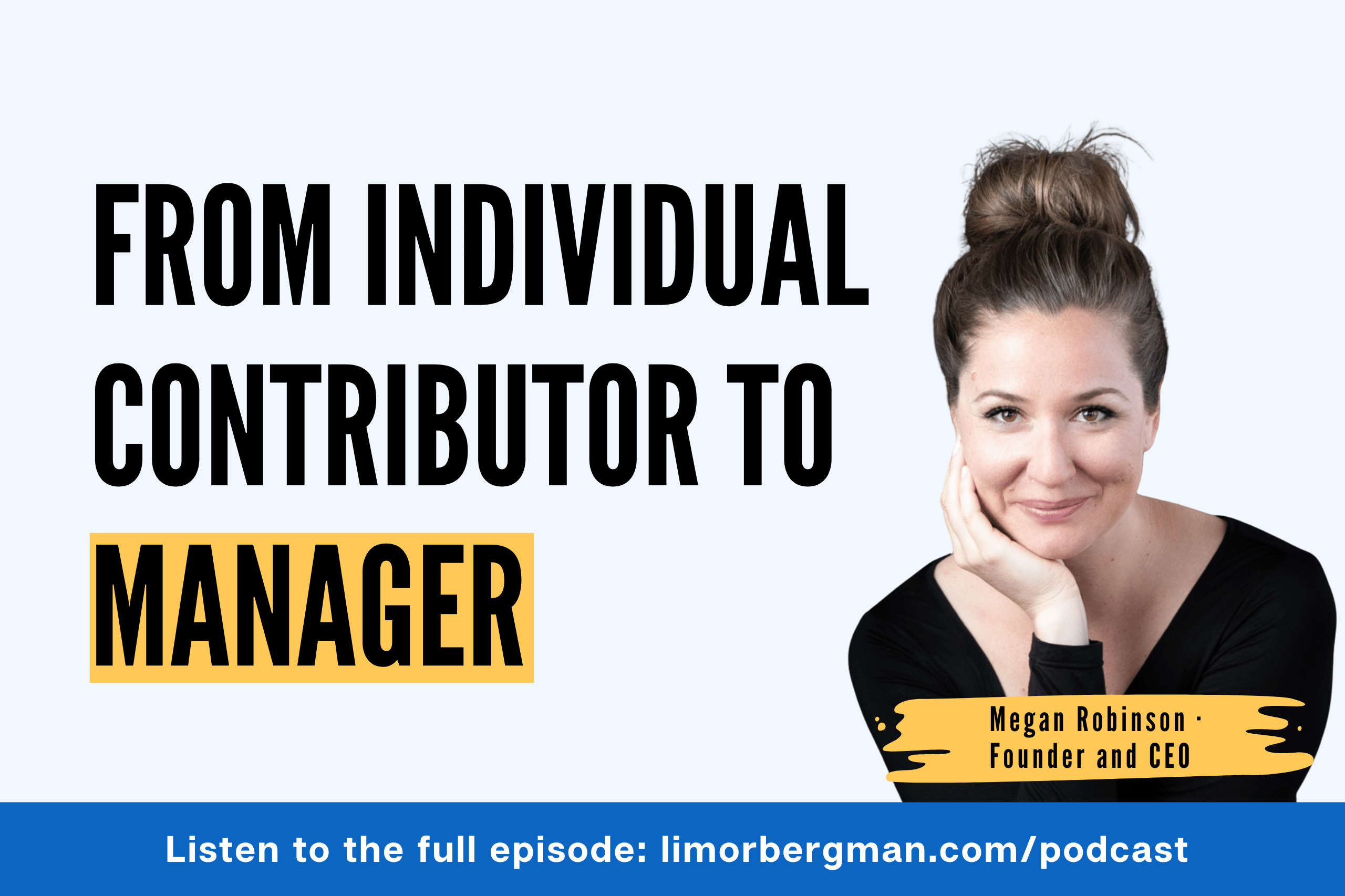
This week on the From a Woman to a Leader podcast, I sat down with Megan Robinson, founder and CEO of eLeader Experience, who has spent her career building leadership capability for exactly these people: engineers, product leaders, and operations professionals who get promoted for their expertise and are then expected to lead. She works right at the moment where technical skill outpaces leadership readiness.
But we didn’t talk about org charts or management frameworks. We talked about the thing most advice skips: what actually changes the day you stop being the individual contributor and start being the person responsible for other people, and why so many capable women stay stuck waiting for permission that never comes.
“Below are the insights from our conversation, with my own experience and concrete steps you can take this week.”
1. Nobody Trains You to Be a Manager, and That Is Not Your Fault
The move from individual contributor to manager is one of the biggest jumps in your career, and almost no one is prepared for it. Megan was refreshingly honest about her own start. Early in her career she saw a gap in a team member’s critical thinking, went to her director for help, and got a one-line answer and nothing else.
“I’m a new manager. I don’t know how to coach someone for any of this. And my supervisor at the time, she said, yes, critical thinking can be learned. And then did not tell me how to teach it, did not tell me how to develop it. And I struggled in that role. I failed in that role.”
Megan on struggling and failing as a new manager
When I started managing, I had absolutely no clue what I was doing either. And here is what I see again and again with the women I coach: they think everyone else got a manual they somehow missed. They didn’t. Most people are thrown into the job with little or no training and left to figure it out in public.
How to apply this: This week, name one thing about managing you have been pretending you already know how to do. Then find one person who is further along and ask them how they actually do it. You are not behind. You were just never taught.
2. The Day You Get Promoted, Your Value Changes, and No One Tells You
Here is the shift almost no one explains: when you become a manager, what makes you valuable completely changes, and if you don’t adapt, you quietly slide backward. Megan described what happens when your toolbox isn’t built yet.
“You’ll revert back to the technical expertise that you have and you overuse that tool because it’s what you’ve developed. It’s what school told you you had to develop. And no one told you how the rules have changed.”
Your whole life, school and work rewarded you for being the best at the thing. Then in one day, being the best at the thing stops being your job.
“Your value has changed. It’s no longer how much output you can create. It’s how you can work with other departments and teams. It’s how you can be more strategic. It’s how you get more out of your team, how you develop them.”
Megan on how your value changes from output to developing people
This is where so many new managers get stuck. When leading people feels hard and unfamiliar, they run back to the technical work, because that is where they feel competent. And they end up an individual contributor with a manager’s title.
How to apply this: At the end of this week, don’t measure your days by what you personally shipped. Ask a different question: what did I make possible for someone else this week? That one change in scorekeeping is the whole job.
3. Leadership Is Influence, Not a Title
You do not need anyone to hand you a title to start leading. Megan’s definition, borrowed from John Maxwell, is the one I keep coming back to: leadership is influence, nothing more, nothing less.
“Everyone can do it, not everyone steps into it. And I always look at it as leadership moments. We’re faced with these opportunities, with these challenges. Again, not the title, but there are ways that we can influence situations. We may not be in control, but we have influence.”
I feel the same way, which is why I love Robin Sharma’s book The Leader Who Had No Title. So many women I talk to are waiting: for a title, for permission, for someone to formally tell them they are allowed to lead. And while they wait, the leadership moments pass by.
How to apply this: Look for one leadership moment this week that has nothing to do with your title. A decision you can shape, a problem you can name, a conversation you can start. Step into it before anyone asks you to.
4. Waiting to Be Noticed Is a Strategy That Quietly Fails Women
Doing good work and waiting to be noticed is not a career strategy, and it holds women back more than almost anything else. Megan named the pattern directly.
“If you wait passively for it to happen, that’s not going to get you great results either. And I think particularly for women, it’s a challenge of, well, if I do good work, someone will notice me. And that’s a little bit too leaving to chance.”
There is a balance here that matters. You cannot force a promotion. But you also cannot sit quietly and hope excellent work speaks for itself, because most of the time it doesn’t speak loudly enough. Sound familiar? This is where I watch talented women lose years, doing brilliant work that no one in the room fully sees.
Megan on why “do good work and you’ll be noticed” fails women
How to apply this: Pick one piece of work you are proud of and make it visible on purpose this week. Share it with someone senior, explain the impact, not just the effort. Being seen is not bragging. It is part of the job.
5. Build Relationships Around “What’s in It for Them”
The most valuable relationships at work are not the friendly ones, they are the ones where you understand the other person’s business well enough to be useful. When I admitted that I have always found internal relationship building awkward, Megan reframed it completely.
“It’s understanding their business, it’s understanding their situation, it’s understanding the context of the organization. That’s what makes you valuable. When you build those cross-department relationships, you learn what their challenges are, you learn how you collaborate better, you learn when you should reach out to them.”
She told a story about coaching a newly promoted safety leader who went on a “road show” to meet other teams. He asked engineering when they would reach out to safety. Their answer:
“The engineer said, never. And it was just this moment of, that’s a problem.”
At least he found the problem, and started fixing it. Today those teams actually support each other. That is what real internal networking does, it turns “nice to know you” into business relationships that help you collaborate, navigate conflict, and build trust.
How to apply this: Choose one person in another department this week and get curious about their world, not yours. Ask what their biggest challenge is and when they would want to hear from you. Lead with what’s in it for them.
6. Think Like the CEO: Business Acumen Is the Skill Most Technical People Miss
If you want to grow into leadership, start wearing the hat of the business. The narrower you stay inside your own technical lane, the less valuable you actually become. Megan put it plainly.
“The more focused you are in your team, your department, your product, your skill set, the more narrow you get, the less value you add. The more you’re thinking broader and more about the business, about the stakeholders, about the clients, the more value you’re bringing.”
She sees the gap constantly, and named it: business acumen is sorely missing. I saw the same thing for years working with engineers who could solve any technical problem but rarely asked why we were building the thing in the first place. When product asked for a feature, my favorite question was always: who is actually going to buy this?
Megan and Limor on thinking like the business, not just the technology
Thinking about the business is not extra work on top of your job. It is what makes you better at your job, because you finally understand why you are doing it and how to prioritize.
How to apply this: For your current project, write down one sentence on how it makes the company money or serves the customer. If you can’t, that is your next conversation to go have.
7. Say the Assumption Out Loud
Some of the biggest limits on your career are assumptions you have never actually checked. Megan closed our conversation on this, and it might be the most useful thing she said.
“The assumptions you make of what you can or cannot ask or do or say is probably limiting your value. And it can even sound like, hey, the assumption I’m making is I’m not supposed to bring up this challenge. If you put it out there of what those assumptions are, people are able to confirm or deny them. Some of those assumptions I guarantee aren’t correct.”
This is where women get stuck more than anywhere else. We decide, silently, that it is not our place to speak up, that now is not the right time, that we would be overstepping. And we never test whether any of it is true.
How to apply this: The next time you catch yourself thinking “I can’t do that here,” say the assumption out loud to someone who would know. “I’m assuming this isn’t my call. Is that right?” Most of the time, you will find the wall you were respecting was never really there.
About Megan Robinson
Megan Robinson is the founder and CEO of eLeader Experience, where she builds leadership capability for technical and high-performing professionals, engineers, product leaders, and finance and operations people, who were promoted for their expertise and are now expected to lead people, influence stakeholders, and drive change. Her earlier career in advertising agencies during rapid technology adoption taught her firsthand that successful change depends as much on leadership, communication, and alignment as on the tools themselves. She helps leaders move from doing great work to being trusted voices who shape decisions, without overexplaining, people-pleasing, or burning out.
Connect with Megan: LinkedIn | eLeaderExperience.com
What I Took From This Conversation
The through line of everything Megan and I talked about is this: you are probably more ready to lead than you give yourself credit for, and you are probably waiting for permission that will never arrive in the form you expect.
The leap from individual contributor to manager isn’t really about learning a set of management tricks. It is about accepting that your value moved, that influence matters more than title, and that the assumptions keeping you small are usually not even true. You do not have to be handed any of this. You can start stepping into it this week.
I go deeper on my own take in this week’s solo episode, where I share what the day I stopped being “the star” actually taught me about leadership. [SOLO EPISODE LINK]
You Don’t Have to Figure This Out Alone
If you are reading this and thinking, “I know I am ready for more, but I don’t know how to make the move,” I want you to know you do not have to work it out by yourself. I coach women in tech leadership through exactly these questions, the promotion that isn’t coming, the new-manager overwhelm, the influence you know you should be building but aren’t sure how. Book a promotion strategy call, and we’ll figure out your next move together.
Where to Start This Week
Change how you keep score. Stop measuring your week by what you personally produced and start measuring what you made possible for your team.
Make one piece of work visible on purpose. Share something you are proud of with someone senior, and explain the impact, not just the effort.
Say one assumption out loud. Find the thing you have decided you “can’t” do at work and check whether that is actually true with someone who would know.
Frequently Asked Questions
How do you transition from individual contributor to manager? Start by accepting that your job has fundamentally changed: your value is no longer your personal output, it is what you enable through other people. Most new managers get little training, so seek out mentors, measure your success by your team’s growth rather than your own tasks, and resist the urge to retreat into the technical work you already know how to do.
Why do great engineers struggle as new managers? Great engineers struggle as new managers because the skills that made them successful individual contributors are not the skills leadership requires. When leading people feels hard, they revert to their technical expertise because it is comfortable, and no one tells them that the rules and expectations of the role have completely changed.
What does “leadership is influence, not a title” mean? It means you can lead without any formal authority by shaping decisions, naming problems, and influencing situations you do not fully control. As Megan Robinson says, everyone can do it, but not everyone steps into it, and leadership moments show up long before a title does.
Why doesn’t doing good work get women promoted? Doing good work alone rarely gets women promoted because excellent work does not automatically get noticed, and waiting passively to be recognized leaves your career to chance. You have to make your impact visible and be clear about what you want, rather than assuming someone will connect the dots for you.
How do you build professional relationships at work if it feels awkward? Shift your focus from “what’s in it for me” to “what’s in it for them” by getting genuinely curious about other people’s business challenges. Understanding another team’s context and knowing when to reach out is what makes you valuable, and it turns awkward small talk into real business relationships.
What is business acumen and why does it matter for technical leaders? Business acumen is understanding how your company makes money, serves customers, and makes decisions, beyond your own technical domain. It matters because the more narrowly you focus on just your product or skill, the less value you add, while thinking like the business makes you a stronger, more strategic leader.
How do you overcome the assumptions holding your career back? Say the assumption out loud to someone who would actually know whether it is true. Many of the limits people place on themselves, like “it’s not my place to speak up,” are unspoken assumptions that were never accurate, and naming them lets others confirm or correct them.
Who is Megan Robinson? Megan Robinson is the founder and CEO of eLeader Experience, a leadership development company. She builds leadership capability for technical and high-performing professionals, including engineers, product leaders, and operations professionals, who were promoted for their expertise and are now expected to lead people and influence stakeholders.
🎧 Listen to my conversation with Megan Robinson: From Individual Contributor to Manager
📺 Watch on YouTube:
📝 Read the deeper, more personal version on Substack