
You have spent your career being the agreeable one. The one who softens the message, who over-explains so no one feels bad, who says yes before you’ve even checked whether you want to.
And somewhere along the way, you started to wonder why being so easy to work with hasn’t gotten you further. Why the promotion went to someone louder. Why your clear, careful feedback never seems to land.
Here is the quiet fear underneath it: that if you stop being nice, you’ll become someone people don’t like. That the only alternative to soft is cold.
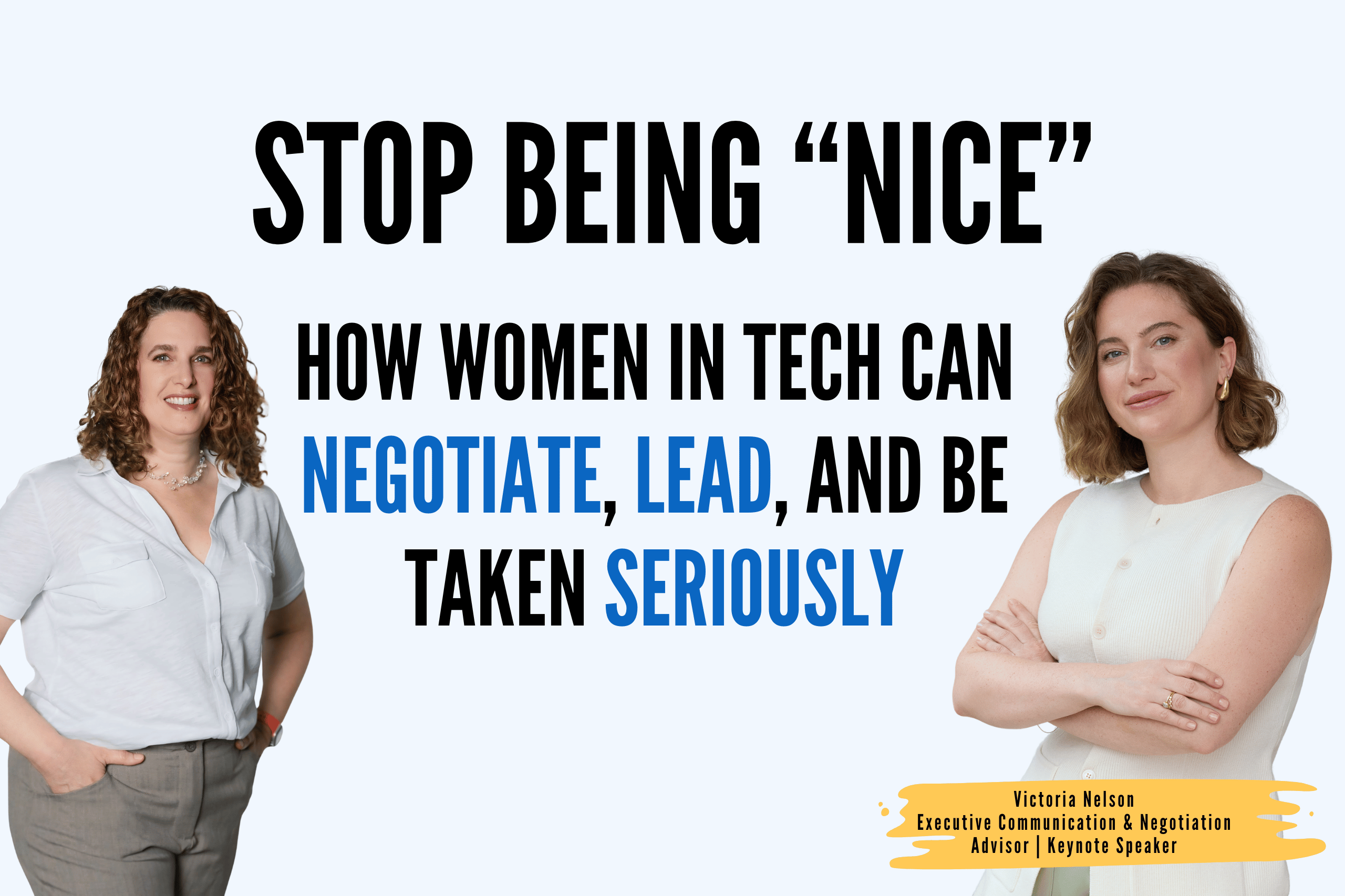
This week on the From a Woman to a Leader livestream, I went live with Victoria Nelson, a negotiation and conflict expert who runs a practice called Power of the Ask and coaches leaders, founders, and politicians through their hardest conversations. She left Russia at 18, arrived in London with five hundred dollars and a bag of clothes, and learned to negotiate by advocating for very young fashion models on photography sets before she was fluent in English. Years later, she discovered she was being paid up to 10 times less than her male competitors for the same job, and went to Harvard and then Columbia to study why.
But that’s not really what we talked about. We talked about the trap so many high-performing women fall into, the one where “nice” feels like a virtue and is actually quietly costing you authority, money, and growth.
“Below are the insights from our conversation, with my own experience and concrete steps you can take this week.”
1. Why does “negotiation” feel like such a scary word?
Negotiation is not a once-a-decade battle. It is something you are already doing multiple times a day, whether you call it that or not. Victoria says the moment she mentions the words negotiation or conflict, people pull back as if she’s said something dangerous.
“But after a while, somehow negotiation and conflict, those two words, became nearly like dirty words, something that people are afraid of.”
Here’s what I see again and again in the women I coach. We treat negotiation as the single high-stakes salary talk we have when we change jobs, so we never build the everyday muscle. But you negotiate scope, deadlines, priorities, and airtime in meetings constantly. Victoria reframes it as executive communication, and once it stops being scary, you start doing it on purpose instead of by accident.
Victoria on why “negotiation” and “conflict” became words people are afraid of
How to apply this: This week, pick one small everyday ask you’d normally avoid, asking for a clearer deadline, a different task, an extra resource, and treat it as a calm, normal conversation rather than a confrontation. You’re building the muscle.
2. What is the difference between being nice and being kind at work?
Nice is over-accommodating; kind is honest in a way that helps the other person grow. That distinction is the whole reason I titled this conversation “Stop Being Nice.” Victoria describes niceness as softening your language, over-explaining, and being as sweet as possible while you deliver hard news.
“Kindness is sometimes cutting through … and delivering really good, really solid feedback. But in a way that is not supposed to hurt, that in a way that’s helping you grow.”
And then the part that hit me hardest, because I lived it: being too soft does not make you look warm, it makes you look weak. Victoria put it plainly, that people actually don’t like somebody who is too soft to them in the long term. When I was a young leader who wanted to be liked, I avoided directness and watered my feedback down to almost nothing. I thought I was being kind. I was being nice, and I was failing the people I led, because vague feedback gives no one anything to work with.
Victoria on the difference between being nice and being kind
How to apply this: Think of one piece of feedback you’ve been softening into mush. Write down the one clear, true sentence you’ve been avoiding, and say it kindly and directly this week. Clarity is the kindness.
3. What does executive presence actually look like for women, and why does it matter for promotion?
Executive presence often matters more for promotion than your resume, and women are judged on it on a completely different scale than men. Victoria explained that when we describe a man who’s become an executive, we lead with his accomplishments. With a woman in the same role, the order flips.
“We usually talk about her likability first. We sometimes talk about what she looks like second, and then maybe, maybe we’re gonna get to the list of her accomplishments.”
She traces it to the fact that almost all of us were first cared for by warm, nurturing women, so we carry an unconscious expectation that women in charge should be soft, and we feel cheated when they’re direct. Women feel this double bind even before they can name it, and they tend to cope in one of two ways: shrinking into over-accommodation, or swinging to the opposite extreme and becoming what Victoria calls the ice queen, harder than any man in the room.
“I’m gonna be harder than any man out there, I’m gonna double down every single time I can.”
The ice queen isn’t the answer either, because no one brings their best ideas to a leader they experience as a punisher. I had an ice queen as my very first manager, and it’s an experience I’d happily forget. The work, as Victoria puts it, is finding the place in between: firm and compassionate at the same time.
How to apply this: Before your next high-stakes meeting, decide on one sentence that states your position clearly and without apology, no hedging, no over-explaining, and say it early. Presence is built one clear sentence at a time.
4. How can you handle workplace conflict without becoming too emotional or too aggressive?
The first step is to stop deciding the other person is simply broken, and get curious about the reason underneath their behavior. I told Victoria about a colleague years ago I clashed with constantly, someone I’d labeled self-centered, and admitted that I was young and so angry and frustrated that it showed and didn’t serve me at all. She named the thing I’d been doing without realizing it.
“When we really want to have a fight with somebody, we try to dehumanize the other person. We’re like, well, they don’t have a good reason to act the way they are. They’re doing this because something about them is broken.”
Her reframe is to separate a person’s position, the thing they say out loud, from their interest, the need sitting underneath it. Her example is her daughter screaming for ice cream: the position is the ice cream, but the interest is the sugar and wanting it while her sister doesn’t have it. Once you see the interest, the behavior makes sense.
“Majority of the time there is a reason. Just learning about that reason and learning about it in a way that you can relate to it could solve a problem.”
This is where so many women get stuck, the younger me included. We get so offended by someone’s position that we never ask what’s underneath it, and the conflict hardens. Victoria also reminded me that conflict, handled well, can be transformative: you can come out the other side closer to the person than you were before.
Victoria on dehumanizing the people we’re in conflict with, and the reason underneath
How to apply this: Pick the person at work you find hardest right now. Before your next interaction, write down one honest guess at the interest underneath their behavior, then ask them one real question to test it instead of bracing for a fight.
5. What’s the difference between a position and an interest in salary negotiation?
A position is the number you state; an interest is the real need behind it, and the whole negotiation opens up once you work with interests instead of numbers. Victoria says most people walk into a salary conversation and state exactly one thing, the salary, which is a weak place to negotiate from.
“The longer your list of requirements is, the better it is.”
A long list gives you things to trade. Some items you’ll concede, some are non-negotiable, and suddenly you have a real conversation instead of two people shouting numbers. The same is true on the employer’s side, where there’s almost always a range and reasons to move up or down within it. I pushed back honestly here, sharing that as an employer I sometimes passed on candidates who asked far above our range because I worried they’d be unhappy. Victoria agreed that sometimes it’s simply not a match, and also reminded me that asking does not mean you’ll always get it, but not asking guarantees you won’t.
How to apply this: Before your next salary or scope conversation, write a list of at least five things you want beyond the number, flexibility, title, travel, learning budget, scope, so you walk in with trading chips instead of a single demand.
6. What should you do when you get a “no”?
Treat every no as the beginning of a conversation, not the end of one. This was the most freeing thing Victoria said. Most of us hear no and walk away. She hears no and asks why.
“Every no is a start of a conversation. Most of the times people start with a no and you’re like, okay, so why no? What would make your no a yes?”
She told a story about trying to get a fencing teacher to come to her kids’ school. The answer was an immediate, sharp no, and another mom shrugged and moved on. Victoria called and respectfully asked why, and learned the teacher simply had no transportation for those hours. They solved the transportation, and the kids had fencing for a full year. She also shared a real estate negotiation where an older couple cared less about the highest dollar and more about their legacy, who would love the home they’d built, and her young-couple buyers got the house twenty percent down. Negotiation, she reminded me, is rarely only about money.
“People always think that negotiation is always about money, but there is a lot of other factors.”
Victoria’s fencing-class story, why “let’s find out why not” beats walking away
How to apply this: The next time you get a no, on a raise, a project, a request, ask one calm, respectful question: “I understand, and I’d just love to know what’s behind that.” Then listen. The reason is usually solvable.
About Victoria Nelson
Victoria Nelson is a negotiation and conflict expert and the founder of Power of the Ask. She learned negotiation the hard way, immigrating alone at 18, advocating for young fashion models on photography sets, and building a photography career in New York before discovering she was being paid a fraction of what her male peers earned. She then studied negotiation at Harvard and Columbia and now works with leaders, founders, and politicians on executive presence, conflict resolution, and high-stakes negotiation.
You can find Victoria at poweroftheask.com and on Instagram at @poweroftheask. She offers a free first conversation to see if she’s a good fit for your situation.
What I Took From This Conversation
The thing I keep coming back to is that I spent years believing nice and good were the same thing, and that belief cost me and the people I led. Nice protects someone’s comfort in the moment. Kind protects their growth. You can be warm and still be clear, still ask, still hold your ground. You were never too much. You were taught to ask for too little.
I go deeper on my own take in this week’s solo episode, where I share the conflict I made worse early in my career, the part of it I refused to see for years, and what I’d do differently now: [SOLO EPISODE LINK]
You Don’t Have to Figure This Out Alone
If you know you’ve been hiding behind nice, or you keep finding yourself the most emotional person in a conflict and you hate it, you don’t have to untangle this by yourself. I work with women in tech leadership every day on exactly these moments, the hard feedback, the negotiation, the question of how to be firm without becoming someone you don’t recognize. Book a promotion strategy call, and we’ll figure out your next move together.
Where to Start This Week
Say the one true sentence. Find a piece of feedback you’ve been softening and deliver it clearly and kindly. Clarity is the kindness.
Write the long list. Before any negotiation, list at least five things you want beyond the headline number so you have something to trade.
Ask why instead of walking away. The next time you hear no, ask one respectful question about what’s behind it. Most nos have a reason you can work with.
Frequently Asked Questions
What is the difference between being nice and being kind at work? Being nice is over-accommodating, while being kind is honest in a way that helps someone grow. Niceness softens the message and protects the other person’s comfort in the moment, often through over-explaining and excessive sweetness. Kindness delivers clear, solid feedback in a way that isn’t meant to hurt but to help. As Victoria Nelson puts it, niceness is frequently over-accommodating, and being too soft long-term actually makes you look weak rather than warm.
Why do women struggle to negotiate for themselves? Women struggle to negotiate partly because they’re evaluated differently than men and partly because they’re taught to avoid conflict. Research and experience show women are often judged on likability first and accomplishments last, which creates a double bind: be assertive and risk being disliked, or stay agreeable and get overlooked. Many women also default to over-accommodating, stating a single request instead of negotiating with a full list of priorities they can trade.
What is executive presence and why does it matter for promotion? Executive presence is how you show up, communicate, and are read by others, and at senior levels it often matters more than your resume. Victoria Nelson explains that once people have the qualifications on paper, the person considered for a major promotion is usually the one with the strongest executive presence. For women, building it means finding the space between over-accommodating and the “ice queen” extreme: being firm and compassionate at the same time.
How can women handle workplace conflict without becoming too emotional or too aggressive? Start by separating your emotions from the conversation and getting curious about the reason behind the other person’s behavior. It’s normal to feel anger or frustration, but giving those emotions too much room in the moment keeps you from listening. Instead of deciding the other person is simply broken, look for the interest underneath their stated position. Conflict handled this way can become transformative, sometimes leaving both people closer than before.
What is the difference between a position and an interest in negotiation? A position is what someone says they want, and an interest is the real need sitting underneath it. Victoria Nelson uses the example of a child demanding ice cream: the position is the ice cream, but the interest is the sugar and wanting it before a sibling does. In salary talks, a position might be a specific number, while the interest could be childcare, flexibility, or lifestyle. Negotiating around interests, not positions, is what opens up real solutions.
How do you respond when you get a “no” in a negotiation? Treat a no as the start of a conversation, not the end of one. Most people stop when they hear no, but the more effective move is to respectfully ask what’s behind it and what would turn it into a yes. Victoria Nelson got a fencing teacher for her kids’ school for a full year simply by asking why the teacher initially said no, and discovering it was a transportation issue she could solve.
How do you negotiate salary as a woman without asking for too much? Come in with a long list of requirements rather than a single number, so you have things to trade and a reason to move within the employer’s range. Most employers have a salary range and need reasons to move up or down inside it, which only emerges through conversation. Asking does not guarantee you’ll get everything, but it almost always creates options, and not asking guarantees you won’t.
Who is Victoria Nelson? Victoria Nelson is a negotiation and conflict expert and the founder of Power of the Ask. She immigrated alone at 18, learned to negotiate advocating for fashion models, built a photography career in New York, and after discovering she was paid far less than her male peers, studied negotiation at Harvard and Columbia. She now coaches leaders, founders, and politicians on executive presence and high-stakes conflict.
📺 Watch the livestream replay on YouTube:
📝 Read the deeper, more personal version on Substack