
You’ve built a career. You’re good at what you do. You’ve put in the years, earned the title, learned the room.
And then something in you starts to want a different chapter. A new role, a new field, maybe something of your own. But every time you picture leaving, the same voice shows up: if I walk away from this, I’m starting from zero. I’ll be no one.
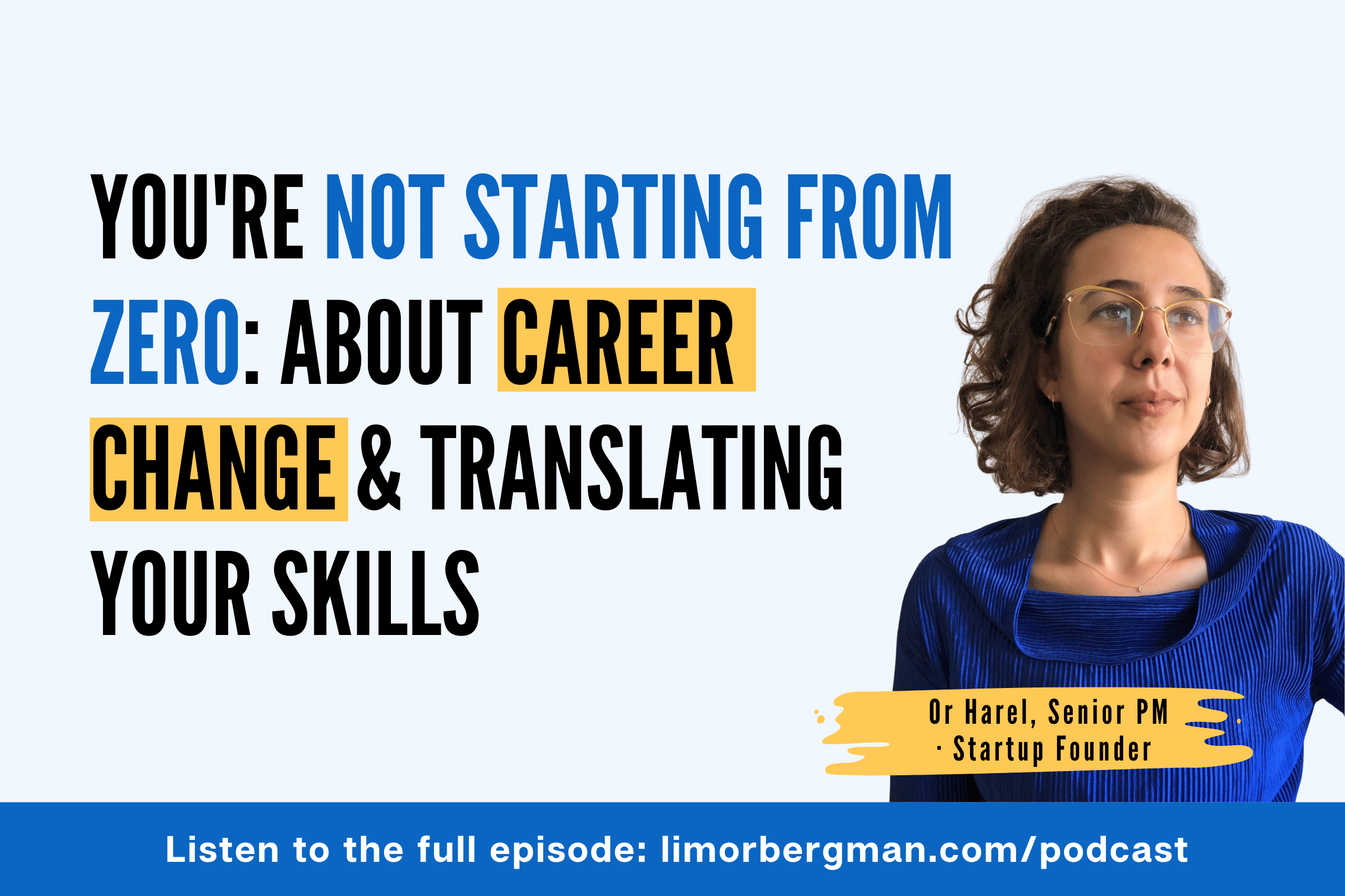
This week on the From a Woman to a Leader podcast, I sat down with Or Harel, who spent 13 years in military intelligence, including a role no woman had held before her, and then walked away at 31 to start over. Since then, she has co-founded two startups and built a career in research, product, and marketing, all from skills she almost didn’t recognize as skills.
But the resume isn’t what we talked about. We talked about the part most career-change advice skips entirely: the quiet story you tell yourself about whether anything you’ve done so far actually counts.
Below are the insights from our conversation, with my own experience and concrete steps you can take this week.
1. “Starting From Zero” Is a Story You Tell Yourself, Not a Fact
When Or decided to leave the military, she did something many women do at the edge of a big change. She braced herself to lose everything she’d built.
“I told to myself, okay, I’m okay if I will start from zero. It was something that I felt like I need to tell to myself to be able to go out.”
That line stayed with me because it’s so honest. Sometimes telling yourself “I’m willing to start from zero” is the only way to give yourself permission to leave at all. But here’s the part she caught herself on, almost in the same breath:
“On the same time, I told to myself, it couldn’t be that I cannot use all the stuff that I learned. So I’m going to figure it out.”
The truth she landed on is one I wish every woman in transition could hear. You’re not starting from the ground up. You’re starting from a higher level, and everything you built comes with you.
Here’s what I see again and again in my coaching work. The fear of “starting over” rarely matches reality. The woman moving from engineering into product, from a big company into a startup, from an individual contributor into management, from a career break back into the room, she isn’t at zero. She’s carrying judgment, pattern recognition, and hard-won instincts that take other people years to build. She just can’t see them, because they’ve become invisible to her.
How to apply this: Write down the sentence your fear is whispering, literally, “If I leave, I’ll be ___.” Then write the truer version next to it: “When I leave, I bring ___.”
Fill that second blank with five specific things. Not “leadership.” Specifics. “I’ve managed a team through a reorg.” “I’ve shipped under a deadline nobody believed in.” You can’t carry forward what you refuse to see.
2. The Skill You Discount the Most Might Be Your Most Valuable One
When I asked Or which of her military skills actually transferred, I expected something technical. Her answer was something quieter and far more useful.
“The art of asking questions is one of the most important things in life. And no one is teaching us it in high school. Also not in university.”
In intelligence, she explained, you’re trained to define a question, recognize that there are different kinds of questions, and build a process to answer them. She didn’t walk out with a credential anyone outside her unit would recognize. She walked out with a way of thinking that became the foundation for how she builds products.
“I know how to ask the question that helps me to understand what they might not know about themselves.”
This is the thing about transferable skills. The most valuable ones are usually not on your resume, because they don’t have a clean title. They’re the way you think, the way you break down a problem, the way you read what people actually need underneath what they say.
I watch women do this all the time. They’ll list their tools and titles and completely skip the thing that makes them rare because it feels too obvious to mention. The way you think is not too obvious to mention. It might be the whole point.
How to apply this: Think about the last hard problem you solved at work. Now describe how you solved it, the actual sequence of moves you made, as if you were teaching it to someone. That description is a transferable skill. Name it. Put it in language you’d use in an interview or a pitch. The “how you think” is usually the asset you’ve been giving away for free.
3. Before You Can Translate Your Skills, You Have to Own Them
There’s a step most people skip when they’re trying to reinvent themselves, and Or named it precisely.
“To be able to take an objective look on yourself, not too optimistic, but not to criticize yourself, and to own what you did and to realize what are the skills that you got during these years.”
I love that she put a guardrail on both sides. Not too optimistic, so you’re not overselling a story that won’t hold up. But not self-critical either, because that’s the trap most women fall into. We discount, we minimize, we wait for someone else to confirm that what we did was real before we’ll claim it.
Owning what you did is not arrogance. It’s accuracy. And accuracy is what lets you translate, because you can’t move a skill into a new context if you won’t first admit you have it.
This is where so many women get stuck. Not because they lack the experience, but because they won’t look straight at it. They keep waiting to feel qualified enough to call themselves what they already are.
How to apply this: Do an honest inventory this week. Make three columns: what I did, the skill underneath it, and where else that skill applies. Force yourself to fill the third column. “Ran a cross-functional project” becomes “coordinated competing priorities under pressure” becomes “exactly what product and program roles are built on.” Own it on paper before you have to own it in a room.
4. The Fear Isn’t Really the New Job. It’s the Unknown and Losing Who You Were.
I asked Or what actually holds women back from making a change like hers. Her answer reframed the whole thing for me.
“I think that a lot of people are afraid because it’s the unknown. When you’re in the army, you were a high school student, and then your first and only job was in the army.”
It’s not the new role that scares people. It’s the not-knowing, and underneath that, something even harder: the loss of an identity you’ve worn for years. When your whole adult self was built inside one world, leaving it can feel less like a career move and more like losing who you are.
“They have so much experience, they have skills, they have tools, and they feel like, okay, I’m no one now.”
“I’m no one now.” Say that line slowly, because it’s exactly what so many accomplished women feel and never admit. The competence is real. The skills are real. And the feeling of being nobody on the other side is also real, which is why so many capable people stay somewhere too long.
Naming it helps. The discomfort you feel isn’t proof that you’re making a mistake. It’s proof you’re leaving something that mattered. Those are different things, and confusing them keeps women stuck for years.
How to apply this: When the “I’m no one now” feeling shows up, don’t argue with it and don’t obey it. Name it instead. “This is the fear of the unknown, not evidence that I’m unqualified.” Then look at column three from the last exercise. The version of you on the other side of this change isn’t no one. She’s someone carrying everything the current version was built on.
5. You Don’t Have to Cross the Bridge Alone
For all her independence, Or’s most practical advice was about other people.
“To find a circle of support. To realize they are not at ground zero, to realize how to use their skills to find the new dream and vision.”
She volunteers with an organization that helps women leaving the military start their next chapter, specifically to show them they aren’t starting from nothing. But her broader point applies to anyone, in any field: you need people a step ahead of you who have crossed the same bridge, and people walking next to you who can think it through with you.
“Friends from the army that left a year before, or are going to leave, to talk with them and together to build this circle of trust and thinking together.”
This is the piece women skip the most. We treat the transition as something to figure out privately, quietly, so no one sees us in the messy middle. And then we wonder why it feels so heavy. It feels heavy because you’re carrying it alone, not because you’re incapable.
How to apply this: Name two people this week. One who’s a step ahead of where you want to go, and one who’s in the thick of a transition like yours. Reach out to both. Not for a favor, just to start the conversation. The room won’t build your circle of support for you. You have to start it.
6. The Mindset You Inherit, or Decide to Build
The most moving part of our conversation was our discussion of where Or’s confidence came from. She grew up one of four girls, with parents who never once framed anything as off-limits because of her gender.
“I never thought that there is something that I cannot do because I’m a woman. I never thought about it.”
Years later, while volunteering with young women, she realized how rare that was, so she went to thank her father for it. His response says everything:
“I told him, you never even told me ‘you can do it even though you are a girl.’ And he told me, what are you talking about? Of course you can do everything. What is the connection to your gender?”
He was genuinely confused she’d even raise it. To him, there was no connection to question. And here’s the part that turns this from a lucky story into a usable one. Or didn’t just keep that gift. She decided to pass it on.
“I felt like it’s my mission to help other girls get this mindset, even if they didn’t receive it at home.”
That’s the reframe I want you to sit with. Not everyone was handed that belief growing up. But a mindset you weren’t given is still one you can build and then give to someone else. You don’t have to have inherited it to start living from it.
How to apply this: Notice the next time you attach “because I’m a woman” or “because I’m not technical enough” or “because I didn’t come up the usual way” to a ceiling you’ve set for yourself. Ask Or’s father’s question back to yourself: what is the actual connection here? Often, there isn’t one. It’s an inherited story, and you’re allowed to put it down.
About Or Harel
Or Harel is a gerontologist, researcher, and product and marketing specialist who spent 13 years in military intelligence, including a role no woman had held before her, before moving into tech and entrepreneurship. She studied entrepreneurship and business, co-founded two startups, and has built her career around understanding how individuals and communities actually think, decide, and act.
Since recording this episode, Or has begun a new chapter herself. The company she co-founded, The Oak, has wound down, and she is now focused on her next challenge in aging innovation and products for older adults, an area she believes is one of the most important opportunities of our time. In other words, she’s living the exact thing this episode is about: starting a new chapter without starting from zero.
Links:
- LinkedIn: https://www.linkedin.com/in/or-harel-281182196/
- The NGO Or volunteers with, supporting women leaving the military: https://asur.co.il/en/home/
What I Took From This Conversation
For most of my career, I believed that changing direction meant accepting a loss. That you trade your accumulated standing for a fresh start, and the fresh start costs you everything you’d built.
Or doesn’t see it that way, and after this conversation, neither do I. She doesn’t have more raw talent than the people who stayed put. She has a clearer read on what she’s carrying. She knows her experience is portable, she knows how to translate it, and she refuses to walk into the next room pretending she’s empty-handed.
That’s a skill, and it’s one I think every woman in tech leadership needs, because the rooms we walk into only get higher-stakes from here. The ones who thrive through a transition aren’t the ones with the cleanest resume. They’re the ones who can look at everything they’ve built and say, this counts, and it comes with me.
You Don’t Have to Figure This Out Alone
If you’re reading this and recognizing yourself, you’ve been eyeing a change, discounting your own experience, quietly wondering whether any of it transfers, you don’t have to navigate this by yourself.
I work with women in tech leadership every day on exactly these questions. How to see the skills you’ve stopped noticing. How to translate years of experience into the language of the role you actually want. How to walk into the next chapter as someone who’s starting from a higher level, not a blank page.
Book a promotion strategy call, and we’ll figure out your next move together.
Where to Start if You Want to Stop Feeling Like You’re Starting Over
You don’t need to overhaul anything. A few simple places to begin:
Run the inventory. Three columns: what you did, the skill underneath it, and where else it applies. Force yourself to fill the third column. That’s your transferable-skills map.
Name what you think, not just what you know. Your way of solving problems is an asset. Describe it in plain words you’d use in an interview, and stop giving it away for free.
Start your circle. Reach out to one person a step ahead of you and one person in the thick of a similar change. The transition gets lighter the moment you stop carrying it alone.
Frequently Asked Questions
How do you change careers without feeling like you’re starting from zero? You start by separating the story from the fact. “Starting from zero” is usually a fear, not a reality. As Or Harel puts it, you’re not starting at ground zero, you’re starting from a higher level, because the experience, skills, and judgment you built come with you. The work is to name those specifically, on paper, before you walk into a new room.
How do you translate military experience into a civilian career? Take an honest, objective look at what you actually did, not too optimistic and not self-critical, and identify the underlying skills: planning, project management, leading people, research, and defining and answering hard questions. Then map each skill to where it applies outside the military. Most military skills, especially the way you think and solve problems, transfer directly into product, program management, operations, and leadership roles.
What are transferable skills, and how do I identify mine? Transferable skills are the abilities that carry across roles and industries, like problem-solving, leading people, research, and judgment under pressure. The fastest way to find yours is to describe how you solved a recent hard problem, step by step. The “how” you describe is a transferable skill, even if it never had a title on your resume.
Why do women undervalue their own skills? Because the most valuable skills, like how you think and how you read what people need, become invisible once they’re second nature, so women skip them as “too obvious to mention.” Many also wait to feel fully qualified before claiming what they already are. Owning your skills is about accuracy, not arrogance, and accuracy is what lets you translate your experience into a new context.
What actually holds women back from making a career change? It’s usually fear of the unknown and the loss of a hard-won identity, not a lack of ability. When your whole professional self was built in one world, leaving can feel like becoming “no one.” Naming that fear as fear, rather than treating it as proof you’re unqualified, is what lets capable women finally move.
How do you start over in a new field after a long career? Begin with an honest skills inventory, translate those skills into the language of your target field, and build a circle of support, people a step ahead of you and people going through a similar transition. Starting over is rarely starting from zero; it’s repositioning everything you already have.
How do you build confidence if you didn’t grow up being told you could do anything? A mindset you weren’t given is still a mindset you can build. Or Harel was raised to believe her gender placed no limits on her, and she made it her mission to pass that belief to women who didn’t grow up with it. You can practice it by questioning the ceilings you’ve inherited, asking, as her father did, “what is the actual connection here?”
Who is Or Harel? Or Harel is a gerontologist, researcher, and product and marketing specialist who spent 13 years in military intelligence, including a role no woman had held before her, then left at 31 to start over. She has co-founded two startups and is now focused on innovation and products for older adults.
🎧 Listen to my conversation with Or Harel: You’re Not Starting From Zero
📺 Watch on YouTube: https://youtu.be/KZLqCR3TKAM