
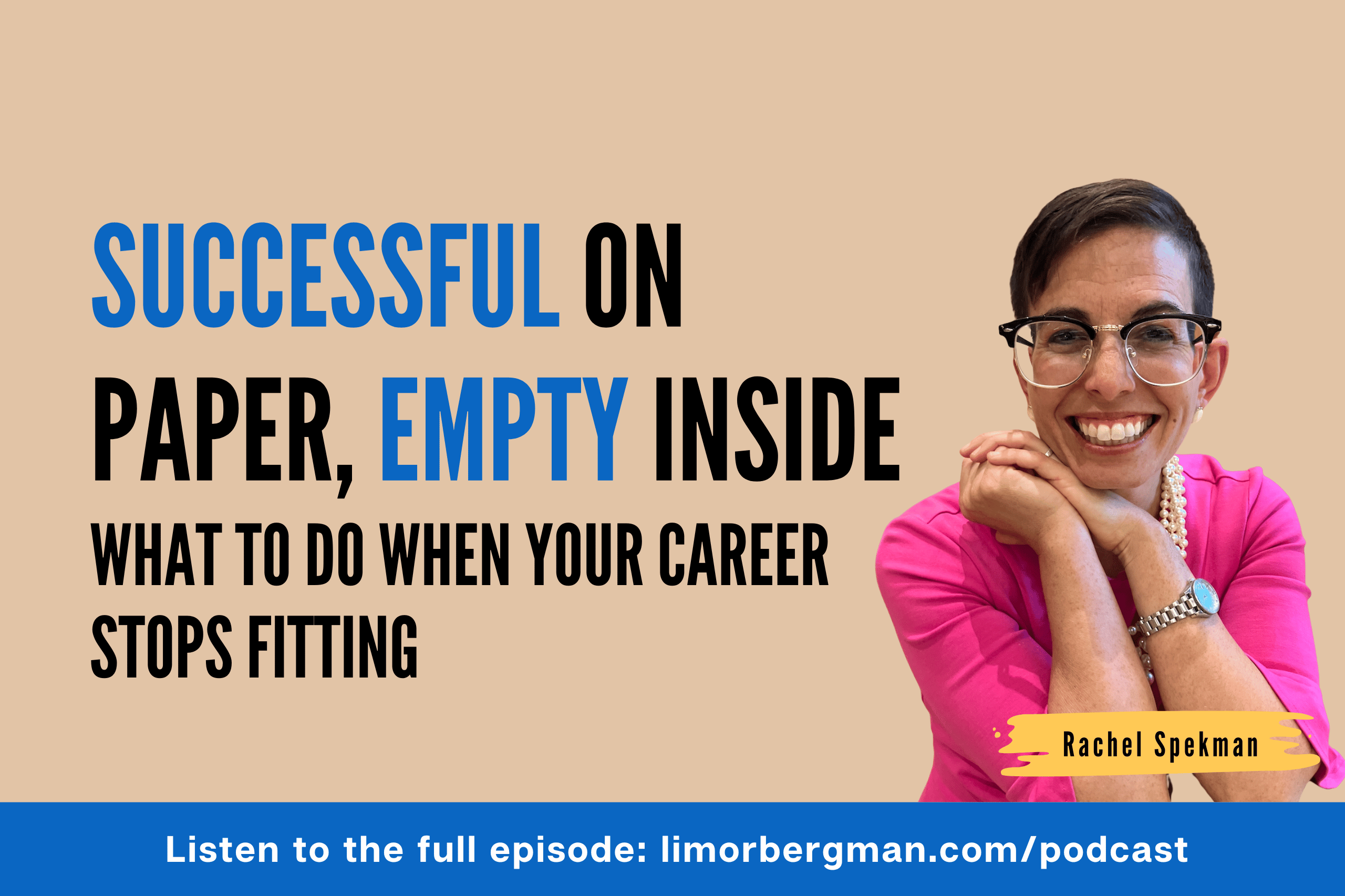
You can build the right career, hit every milestone, earn the title and the income, and still find yourself sitting somewhere — a plane, your car, the office bathroom — wondering why you feel so empty. That is not weakness, and it is not ingratitude. It is a signal. And it is one of the most common things I hear from the women I coach.
This week on my podcast, From a Woman to a Leader, I sat down with Rachel Spekman, founder of Made for More Coaching. Rachel spent a decade in startup tech and entrepreneurship before walking away from a senior director role to go back to school full time and become a licensed therapist. Today she blends mental health expertise with career strategy to help high performers redesign careers that actually fit. She has lived the exact thing she now helps other people navigate.
What follows is the heart of our conversation, plus what I have learned about the same pattern from twenty years in engineering leadership and from coaching women through it every week.
Why do successful women feel empty in careers that look great from the outside?
Because looking successful and feeling aligned are two different things, and we are taught to chase the first one. You can hit every external marker — the title, the salary, the recognition — and still feel a quiet, persistent sense that something stopped fitting. The success is real. So is the emptiness. Both can be true at once.
Rachel’s story started at what should have been a high point. She had just had her first child after three years of fertility challenges, and she was flying home from an international speaking engagement — a dream she had worked toward for years.
“Here I was at what would look like the pinnacle moment of my career. International speaker. I finally had a child. I was like, I’m doing it. And I said, what is feeling so empty inside?”
On the flight home, she watched Moana for the first time, and she started crying. Not because of the movie exactly, but because of what it surfaced. She did not know what she was called toward anymore. She just knew she felt stuck.
I had my own version of this. A great job, a team I led, a paycheck I worked very hard for, and every Sunday night I dreaded Monday without understanding why. From the outside, everything was great. Inside, it was not aligned anymore.
How to apply this: Stop arguing with the feeling. The most common response to “I feel empty in a great career” is “but I should be grateful.” You can be grateful and still know something needs to change. Let both be true. That is the start.
What is an “asymmetrical” career?
An asymmetrical career is one that looks one way on the outside and feels completely different on the inside. You present as successful and put-together while privately feeling lost, drained, or out of place. Rachel coined this word for the exact gap so many high performers live inside.
“I call it asymmetrical. People present one way, but are actually feeling quite differently about their career internally.”
The danger of an asymmetrical career is that nothing on the outside tells you to change. Your reviews are good. The money is good. So you keep going, and the gap quietly widens.
Rachel made a point that stayed with me: when you ignore the misalignment long enough, it stops being just a feeling and starts showing up in your body — insomnia, anxiety, that heavy Sunday dread. The signal does not go away. It just gets louder and harder to ignore.
How to apply this: Ask yourself one honest question this week. If a close friend could see how you actually feel about your work, not how you describe it, what would they notice that no one else does? That gap is your asymmetry.
How happy should you actually be in your career?
You will not hit 100 percent, and that is not the goal — but you should not accept living at 30 percent either. Rachel asks every client to rate their career happiness on a zero-to-100 scale when they first find her, and most people land somewhere between 20 and 40 percent. Some arrive at zero or 5.
Then she asks them a question that reframes the whole thing:
“Would you drive a car that was 80 percent broken? Would you live in a house that was 60 percent falling apart? Of course not. But people stay in their careers because we need the income and we have a lifestyle and we’re used to it.”
The goal she sets with clients is 80 percent. Not perfect. Not tomorrow. The work is to understand what would even get you there, and then to move from 30 to 40 to 50 over time.
This is one of the clearest reframes in the whole episode. We tolerate things in our careers we would never tolerate in any other part of our lives.
How to apply this: Put a number on it. On a scale of zero to 100, how happy are you in your career right now? Then ask the more useful question: what would move you up just ten points? Not to perfect. Just ten points.
Why does leaving a career feel like an identity crisis?
Because for high performers, the career is not just what you do — it is who you think you are. When you have spent fifteen or twenty years becoming “the engineer,” “the director,” “the person from that company,” the question of leaving is really the question of who you are without the title.
Rachel named this directly:
“This is really identity work. If I’m not a journalist, if I’m not in high tech, if I’m not a startup, who am I?”
She also named something most people skip past: there is often a grief period in a real career change. You are not just choosing a new path. You are letting go of a version of yourself that worked hard to exist. That is worth grieving, and rushing past it is part of why so many pivots feel chaotic.
I felt this too. I used to lead software development teams, and that was my identity. The hardest part of changing was not the logistics. It was figuring out who I was if I was not that anymore.
How to apply this: Separate the skill from the identity. You are not throwing away what you built. The values and strengths underneath your old title — the things you are actually good at — come with you. The work is to make your identity bigger, not to erase it.
How do you change careers without doing something reckless?
You change deliberately, with a plan, while you still have stability — not by quitting in a dramatic moment. Rachel is emphatic that real career change is not about impulsive leaps.
“I’m not about impulsivity moves at all, because those are what I call out of the fryer and into the pan. All of a sudden you have a whole new set of problems.”
Her advice is counterintuitive: the best place to figure out what you want next is often while you still have your current job. You get to study your own week in real time. What did I enjoy today? What did I dread? Which meetings lit me up and which ones drained me? That data is gold, and you only have access to it while you are still in the work.
This matters especially for women with families, mortgages, and people depending on them. Wanting alignment and being financially responsible are not in conflict. The whole point is to honor both.
How to apply this: For one week, keep a simple two-column note: what energized me today, what drained me. Do not analyze it yet. Just collect the data. The patterns will tell you more than any career quiz.
How do you figure out what you actually want to do?
You go backward before you go forward — to your childhood curiosity and to the conversations you are naturally drawn to now. Rachel offers two of the most practical exercises in the episode for people who feel completely stuck.
The first is the childhood-self exercise. Before your brand, before LinkedIn, before you had to prove anything — what were you naturally drawn to?
“I joke that I loved picking up trash as a kid. I would organize all these trash pickups in my neighborhood. No one’s paying me to do that now, but there are elements of it: I like organizing, I like leadership, I like making an impact.”
The point is not the literal activity. It is the values hiding inside it.
The second is the dinner party exercise:
“What dinner party conversations are you drawn towards right now? When someone’s talking about something and you can’t wait to jump in. That’s tapping into something you’re naturally curious about. And when we’re naturally curious, the work doesn’t feel like such hard work.”
How to apply this: Finish two sentences. As a kid, I could spend hours doing ____. Lately, the conversation I always want to jump into is about ____. The overlap between those two answers is a clue worth following.
What’s the first step if you’re miserable at work right now?
The first step is a decision, not a plan: deciding that you will not stay stuck. Rachel frames it simply.
“My feedback to that person is basically the first thing is just to say, I’m not going to stand for this. I’m going to figure out a way out of this.”
From there, she uses a framework she calls the three C’s: community, contribution, and challenge. When you are stuck, naming which of the three is missing tells you where to start. Are you lacking colleagues you feel connected to? A sense that your work contributes something meaningful? A challenge that actually engages you? Most misery traces back to at least one of these being dark.
She also recommends real, structured support — she uses a peer accountability model — because we make these changes badly when we are isolated. And one more piece of advice that surprised me, in the best way: find something that makes you laugh. When you are in the thick of misery, humor is not frivolous. It lifts you enough to think clearly.
How to apply this: Of the three C’s — community, contribution, challenge — which one is most missing for you right now? Start there. You do not have to fix all three. You have to find the one that is darkest and add a little light.
The bottom line
You do not have to stay stuck, and you do not have to blow up your life to get unstuck. The career that fit you at 25 is allowed to stop fitting you at 40. That is not failure. That is growth outpacing the container you built.
Rachel closed our conversation with a line worth keeping:
“If you are stuck, you do not have to stay stuck. Give yourself permission to change. And find good people around you to help you make that change.”
The work is rarely a single dramatic leap. It is a number on a scale moving from 30 to 40 to 50, one honest week at a time.
Frequently asked questions
Why do I feel empty in my career when everything looks successful? You feel empty because external success and internal alignment are different things. You can hit every milestone — title, salary, recognition — and still feel that your work no longer fits who you are. This gap is common among high performers and is a signal worth listening to, not a flaw to push past.
What does it mean when your career “stops fitting”? It means the work that once aligned with your values, interests, and identity no longer does, often because you have grown or changed while the role stayed the same. The career can still look successful from the outside while feeling hollow on the inside.
How happy should I be in my career? You will not reach 100 percent, and chasing perfection is not the goal. Career strategist Rachel Spekman sets a target of around 80 percent with her clients. The more useful question than “am I happy” is “what would move me up ten points from where I am now.”
How do I change careers without going broke or being reckless? Change deliberately while you still have stability, rather than quitting impulsively. Use your current job as a live laboratory: track what energizes and drains you each week, build a financial plan, and move in steps. Wanting alignment and being financially responsible are not in conflict.
Why does changing careers feel like losing my identity? Because for high performers the career is tied to identity — you become “the engineer” or “the director.” Leaving raises the question of who you are without that title, which can trigger a real grief period. The work is to carry your underlying strengths forward, not to erase who you were.
What are the three C’s for getting unstuck at work? The three C’s are community, contribution, and challenge. When you feel stuck, identify which one is most missing — connection with colleagues, meaningful impact, or engaging difficulty — and start there. Most career misery traces back to at least one of these being absent.
How do I figure out what I actually want to do next? Look backward and inward. Ask what you were naturally drawn to as a child before you had to prove anything, and notice which conversations you can’t wait to jump into now. The values and curiosity underneath those answers point toward work that won’t feel like such hard work.
Listen, watch, and go deeper
This post is based on my conversation with Rachel Spekman, founder of Made for More Coaching, on the From a Woman to a Leader podcast.
Listen to the full episode with Rachel: podcast hub or watch on YouTube
Connect with Rachel Spekman on LinkedIn or at Made for More Coaching.
If you are reading this and recognizing yourself — successful on paper, stuck on the inside — you do not have to figure it out alone. I work with women in tech leadership every week on exactly this. Book a call and let’s figure out your next move together.